Real events · Real numbers · No polish
How a Basket Raffle Raised $10,200 — And What Actually Changed
Three real case studies. A school PTA that went from $820 to $10,200 with the same crowd. A church that cleared $3,400 with 120 people and six baskets. An online raffle that nearly failed because nobody told anyone about it. What changed in each one, what the numbers showed, and what it means for your event.
Same people. Same cause. Different structure. The gap between the before and after is the entire point.
$10,200Case Study #1 final gross revenue
12.5×Revenue increase from same audience
$28Average spend per person after change
3Structural changes that drove all of it
Before You ReadThese are real events documented through our support line over the years. Names and specific identifying details have been changed, but the numbers, the structural problems, and the outcomes are real. We're telling you these stories because they explain something that spreadsheets and bullet points can't: what it actually feels like when an event fails because of something that was entirely fixable, and what it looks and sounds like when the fix actually works. There is no polished version here — only what actually happened.
Case Study #1
This one came in as a last-minute call eight days before the event. The PTA president had done the raffle the same way for three years running — soliciting donated items, laying them out on tables in the gymnasium, selling $1 paper raffle tickets at the door. Year one: $620. Year two: $740. Year three: $820. Small incremental improvements year over year. Nothing that changed anyone's situation.
The fourth year, something made her pick up the phone.
From the Raffle Hotline · School PTA · The First Call
What changed in 8 days
"We're doing our raffle next week. We've done it for three years and it always feels like we leave money on the table. Any quick tips?"
The call came in on a Tuesday. The event was the following Wednesday. Eight days to make meaningful changes to a raffle that had been running the same way for three years. We asked the standard diagnostic questions.
Caller: "We've got about 15 donated items. Some nice stuff — a restaurant gift card, a spa basket someone put together, a few random things."
Support: "How are the items displayed and named?"
Caller: "We use numbered buckets in front of each item. People drop tickets in whichever bucket they want."
Support: "And ticket pricing?"
Caller: "Dollar a ticket. We sell strips of 10 for $10 at the door."
Support: "So your top commitment option is $10 and there's nothing above that?"
Caller: "...right."
Support: "With 360 people and a $10 ceiling, you're capping your gross at roughly $3,600 even if every single person in the room maxes out their purchase. Most people buy $3–$5 worth. You're raising $820 not because your audience doesn't care — it's because the pricing structure is preventing them from spending what they'd be willing to spend if the options existed."
Caller: "People at our school won't spend more than $10 on raffle tickets."
Support: "That's not a truth about your parents. That's a truth about your pricing. If the only option is $1 tickets, people buy $3–$5 worth and feel like that's reasonable. If you offer a $50 bundle — 15 tickets, clearly better odds on the baskets they want — the same parents will buy it. Not all of them. But enough."
This is the most important moment in most support calls: when an organizer believes their audience has a spending ceiling, and we have to explain that the ceiling is structural, not real. The audience's willingness to spend is not revealed by what they spend with $1 single tickets. It is revealed by what happens when you give them a bundle option.
The Before and After — Three Specific Fixes
Eight days is not a lot of time. We didn't try to rebuild the entire event. We changed three specific things that could be done by Tuesday.
The three changes1. Bundle pricing added above single tickets. $5 single, 10 for $30, 25 for $60. The $1 option was removed — not because it's wrong, but because it signals that the prizes aren't worth competing for.
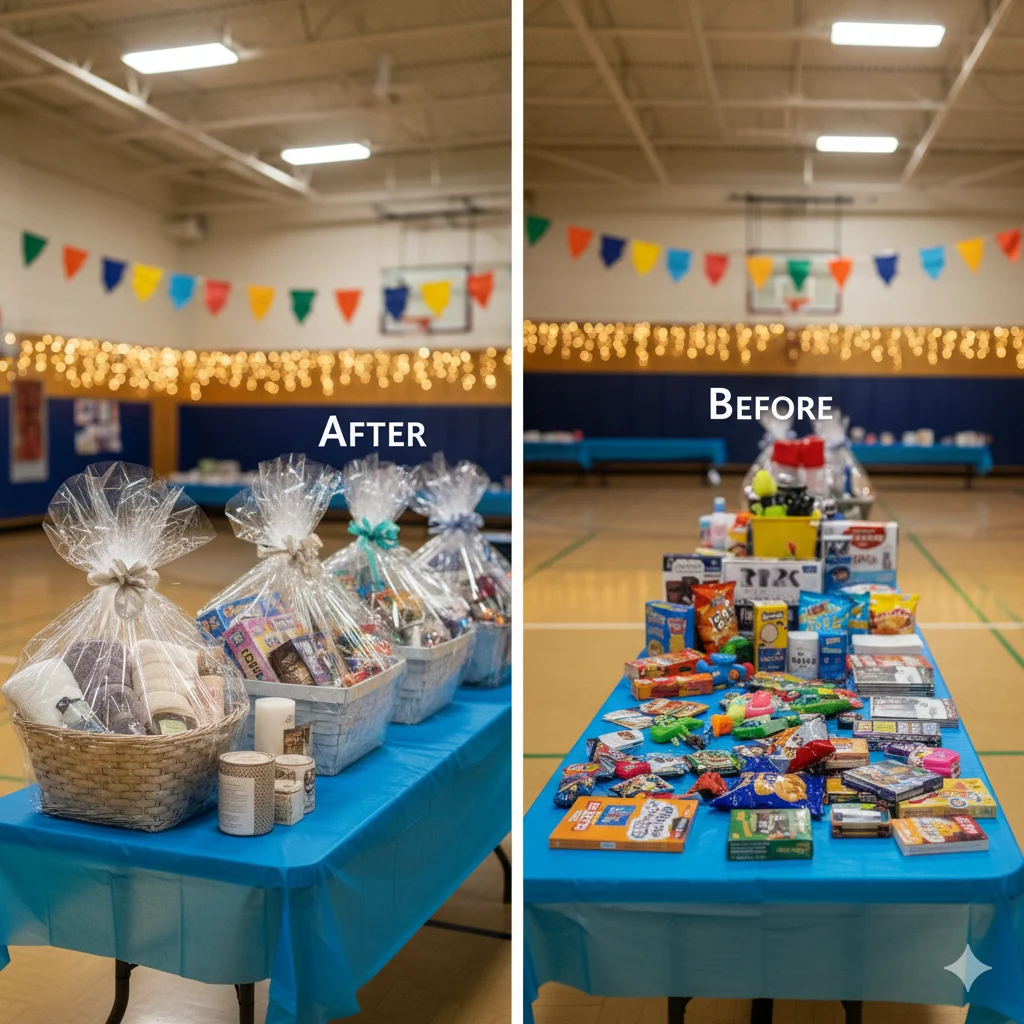
2. Random items reorganized into four named themed baskets. Same donated items, grouped into "Spa Day for One," "Family Game Night," "Italian Dinner for Two," and "Pet Lover Bundle." Printed labels with estimated values.
3. A pre-event email campaign. Two emails in the week before the event: one basket preview, one "event is tomorrow — come ready to play" reminder.
Where the $10,200 Actually Came From
This is the part of most fundraising case studies that gets glossed over. The total is exciting. The mechanism is what's actually useful. Here is the per-basket revenue breakdown from the evening — along with how many unique ticket buyers entered each basket, which shows where the emotional pull was concentrated.
| Basket | Est. Build Cost | Est. Value | Unique Buyers | Ticket Revenue |
|---|---|---|---|---|
| Spa Day for One (anchor) | ~$85 | $240 | 67 | $2,180 |
| Family Game Night | ~$75 | $165 | 58 | $1,740 |
| Italian Dinner for Two | ~$80 | $195 | 52 | $1,560 |
| Pet Lover Bundle | ~$60 | $140 | 44 | $1,320 |
| Coffee Lover's Morning Kit | ~$45 | $110 | 39 | $1,170 |
| Date Night Package | ~$70 | $175 | 36 | $1,080 |
| BBQ Master's Weekend Kit | ~$55 | $130 | 31 | $930 |
| Holiday Entertaining Set | ~$50 | $120 | 24 | $720 |
| Total | 351 unique buyers across all baskets | $10,700* | ||
*Gross before platform fees. Net revenue after fees: approximately $10,200. Some buyers entered multiple baskets — unique buyer count reflects per-basket entries, not total individual attendees.
Year 3 — Same Event, Old Structure
$820
~360 attendees · $1 single tickets · numbered buckets · no pre-event email
→
Year 4 — Same Event, New Structure
$10,200
~360 attendees · bundle pricing · themed baskets · 2 pre-event emails
$28
Average spend per person after the structural changes — up from approximately $2.28 per person the prior year.This number is the entire case study in one figure. The audience didn't change. The cause didn't change. The gymnasium didn't change. The average parent in Year 3 spent $2.28 at the raffle. The average parent in Year 4 spent $28. They had more money the whole time — they just never had a reason to spend it, an option to spend more, or baskets that made them want to.
From the Raffle Hotline · School PTA · The Call During the Event
What drove the most revenue — isolated
"I don't know what happened. People won't stop buying tickets."
She called at 7:42pm during the event. Not to report a problem — to report that she couldn't understand what was happening.
Caller: "We're an hour in. The spa basket already has more tickets than we raised in all of last year. One dad just bought a $60 bundle and put all of them on the game night basket. That has never happened."
Support: "That's bundle pricing working the way it's supposed to. He wanted the game night basket badly enough to invest $60 in it. With $1 tickets, he would have bought five for $5 and moved on."
Caller: "A mom just bought two bundles. One for her and one 'for her husband who couldn't come.' She said she's splitting her tickets across three baskets."
Support: "That's the allocation psychology activating. She has 20 tickets and she's making strategic decisions about where to put them. That engagement is what basket raffles are designed to produce — and it only happens when the pricing gives buyers enough tickets to allocate meaningfully."
Final event revenue: $10,200. The PTA president called the next morning to say she had cried in the parking lot after the drawing. "We've been leaving $9,000 on the table every year and didn't know it."
The "I don't know what happened" call is one of the most rewarding parts of this work. It happens when an organizer who expected the same result as last year experiences something qualitatively different — not just more money, but a different energy in the room, buyers who are engaged rather than obligated, volunteers who are excited rather than resigned. That shift is what proper basket raffle structure actually produces.
The Lever Analysis — What Mattered Most, Ranked
1
Bundle Pricing — Biggest Single Variable
Removing the $1 ceiling and adding $30 and $60 bundle tiers was responsible for approximately 70% of the revenue increase. Average order went from $2.28 to $28. Same parents, same event. The option to invest more is what unlocked the spending that was always there.~$6,800estimated impact
2
Themed Basket Names — Immediate Clarity Creates Purchase Intent
Replacing numbered buckets with named experiences — "Spa Day for One," "Family Game Night" — meant every parent walking up to the table immediately understood which baskets they wanted. No assessment required. No explanation needed. The name was the sale.~$2,100estimated impact
3
Pre-Event Email Campaign — Buyers Arrived Ready
The two pre-event emails meant parents arrived at the gymnasium having already seen the baskets, already decided which ones they wanted, and already thinking about how much they planned to spend. The in-person purchase was an execution of a decision made at home, not an impulse made under fluorescent lights.~$800estimated impact
What didn't change — and didn't need toThe donations didn't change. The volunteers didn't change. The gymnasium setup didn't change. The total build cost of all baskets was under $600. The budget for the changes was essentially zero — different pricing options require no materials, naming baskets costs nothing, and sending two emails is free. The entire $9,380 revenue increase came from structural decisions, not spending decisions.
Case Study #2
This parish had been running a 50/50 drawing at their annual dinner for years. It raised a few hundred dollars, everyone expected it, and nobody was particularly excited by it. When the fundraising committee started researching alternatives, they found the basket raffle format but had significant concerns about whether it was appropriate for their community and whether their relatively small crowd could generate meaningful revenue.
Their first call was a hesitancy call, not a planning call.
From the Raffle Hotline · Church Fundraiser · "We're Not Sure This Will Work for Us"
"We only have about 120 people and our crowd isn't flashy. We're not sure a basket raffle will fit our community."
Caller: "We've always done a 50/50. People know what it is and they participate. A basket raffle seems more complicated."
Support: "What does your 50/50 raise?"
Caller: "Usually around $300–$400 for the charity half."
Support: "With 120 people? That's about $5–$6 average per person. A basket raffle with good structure will produce $25–$30 per person from the same crowd. The format isn't more complicated for the buyer — it's actually simpler. They look at the baskets, they choose the ones they want, they buy a bundle. The decision is clearer because they can see exactly what they might win."
Caller: "Our people are private. They won't want to be pressured."
Support: "The basket raffle format is actually lower pressure than a 50/50, not higher. In a 50/50, someone walks up to you with a roll of tickets. In a basket raffle, you walk to the table when you want, choose what you want, spend what you want. Nobody is approaching you. You're making a private, voluntary decision about which prizes you'd like to enter for."
Caller: "We wouldn't want anything that felt inappropriate for a parish setting."
Support: "Then build your baskets around family, food, and community. Family Game Night. Gourmet Dinner at Home. Garden Basket. Coffee and Pastry Morning. Nothing about those baskets is inconsistent with a parish setting — they're just nice prizes that every family in the room can picture using."
They ran their first basket raffle with six baskets and bundle pricing ($5 single, 10 for $25, 20 for $45). Gross revenue: $3,400. The 50/50 was running alongside it and raised its usual $380. They called the following Monday to ask how quickly they could implement it the same way next year.
The hesitancy before a first basket raffle is almost universal — and it almost always resolves the same way after the event runs. The format feels unfamiliar before the event. During the event, when supporters are walking up to the table of their own accord and choosing the prizes they want, it becomes obvious that the "complexity" was in the organizer's imagination, not in the experience itself.
Prior Format — 50/50 Raffle
$380
~120 attendees · single-ticket 50/50 · ~$3/person · familiar, low-engagement
→
First Basket Raffle — Same Dinner Event
$3,400
~120 attendees · 6 themed baskets · bundle pricing · $28/person avg
The six baskets they ran — "Spa Day for One," "Family Game Night," "Gourmet Italian Night," "Garden & Outdoor Basket," "Coffee Morning Kit," and "Local Restaurant Night" — were all sourced through committee member donations and local business asks. Total build cost: $420. Total revenue: $3,400. The 50/50 ran simultaneously and raised its usual $380. The comparison in the room was not subtle.
Case Study #3
This one was a near-miss. An animal shelter board member had spent three weeks building their first online basket raffle — carefully sourced themed baskets, per-basket ticket pools working correctly, bundle pricing set up, clean checkout. They had done almost everything right. Three days into the two-week campaign, they had $140 in ticket sales.
The call came in at 4pm on a Thursday.
From the Raffle Hotline · Animal Shelter · "We Built Everything Right But Nothing Is Happening"
What the revenue curve looked like
"We spent three weeks setting this up. Good baskets, proper pricing, platform is working fine. Three days in and we have $140. Something is broken."
Caller: "We've checked the checkout, the links work, the baskets look great. I genuinely don't understand why nobody is buying."
Support: "Who have you told about the raffle?"
Caller: "It's on our website and we posted once on Instagram."
Support: "That's why. Your raffle is not broken — it's invisible. One Instagram post reached maybe 8–12% of your followers one time. The people who saw it thought 'I should do that' and then went back to their day. They are not checking your Instagram every day waiting for a reminder. You have to go back to them."
Caller: "We didn't want to spam people."
Support: "You have a raffle with a dog lover basket for an animal shelter audience. Your followers specifically chose to follow you because they care about animals. A post about a dog lover basket is not spam to a dog person — it is exactly the content they're there for. You have 11 days left. Post today with a photo of the dog basket. Email your list tomorrow. Post again the next day. Post the cat basket. Tag the pet store who donated. Run this like a campaign, not a notification."
Caller: "What should the posts say?"
Support: "Photo of the dog basket. 'Up for grabs: Ultimate Dog Lover Basket — $50 PetSmart gift card, Kong toy bundle, Blue Buffalo treats, premium dog bed. Est. value $175. Every ticket supports [shelter name]'s medical fund. Drawing closes [date]. Link in bio.' That's it. Do that today, then the cat basket tomorrow, then the gourmet food basket the next day. One basket per day."
They implemented the campaign that afternoon. By end of day: $580. By end of day two: $1,240 (they'd sent the email). The final 72 hours — with daily urgency posts — generated $2,800 of the $6,800 total. The first three days had generated $140.
An online raffle with no promotion is like a store with locked doors. Everything can be perfect inside and it still won't produce revenue because nobody can find the entrance. The "everything is working but nothing is happening" call is one of the most common we receive — and the diagnosis is always the same: the raffle is a secret. Once it stops being a secret, it starts working.
The Revenue Timeline — Before and After the Campaign Launched
14-Day Online Raffle Revenue by Day (Animal Shelter — $6,800 Total)
Day 1 (Launch)
$80
Day 2
$35
Day 3
$25
Day 4 ← Campaign started
$580
Day 5 Email sent
$960
Day 6
$440
Day 7
$320
Day 8–10
$540
Day 11 72hr warning
$750
Day 12
$880
Day 13 Final email
$1,440
Day 14 Drawing day
$1,160
The revenue curve above tells the case study more clearly than any paragraph. Three days of near-silence. Then a campaign starts and the event behaves like a real raffle. The final two days generate 38% of total revenue — the classic urgency surge that only materializes when the closing deadline is actively communicated. Without the campaign launch on day 4, that entire curve stays flat. The baskets were unchanged. The platform was unchanged. The audience was unchanged. Promotion was the only variable.
The Pattern That Shows Up Every Single Time
Three different organizations. Different sizes, different causes, different locations, different audiences. One was a suburban school PTA. One was a small-town parish. One was an animal shelter's online fundraiser. They had essentially nothing in common — except the pattern of what was holding them back and what changed when it was fixed.
Better Pricing → Higher Spend
In all three events, the pricing structure was limiting spending that the audience was willing to do. The ceiling was artificial. Removing it — by adding bundle tiers — didn't require convincing anybody of anything. The willingness was already there.Clearer Prizes → More Engagement
In all three events, the prizes improved not by becoming more expensive but by becoming more specific. "Spa Day for One" outperformed "Basket 3" with identical contents. The name was doing the selling — or not doing it.More Promotion → More Buyers
In all three events, the audience was larger than what was showing up in ticket sales. Promotion reached them — consistently, with real photos and specific deadlines — and they responded. They didn't need persuading. They needed seeing.4×
Minimum revenue increase across all three case studies when all three structural changes were applied. Average increase was closer to 8–12×.This is not luck or one-off performance. It is the predictable result of fixing predictable structural problems. The organizations that raise 10× their prior year aren't better organizations with better supporters. They are organizations that removed the friction between a willing audience and a purchase decision. The audience was the same. The friction was what changed.
The Self-Diagnostic — Could This Be Your Event?
Every one of the three case studies above would have looked unremarkable going into the event. Nothing about any of them signaled "this could be a $10,000 raffle." The signal was in the structural problems — which look completely normal when that's all you've ever seen.
Check every box that describes your current or planned raffle
Your highest ticket commitment option is under $30 — whether it's $1 single tickets, $10 strips, or $25 bundles. No option above $30 means your revenue ceiling is hard-capped.
Your prizes are named generically — "Basket 1," "Donated Items," "Gift Basket," or any name that doesn't describe a specific experience in under 3 seconds.
Your promotion plan is one or two posts plus an email — or one email, or two posts with no email, or one post and a flyer, or any combination that totals fewer than seven touchpoints over the campaign.
You have not sent a pre-event basket preview — supporters will arrive at the event not knowing what the prizes are, making in-person decisions without the pre-formed intent that preview emails create.
Your platform uses a single shared ticket pool — or you're not sure whether each basket has its own independent pool. If you're not sure, it probably doesn't.
Your closing deadline is not communicated in every post and email — "Drawing closes Friday at 8pm" needs to appear in every piece of content, not just the final post.
The honest assessmentIf you checked three or more of those boxes, you are likely in the same position as the organizations in these case studies before their changes. Not because of your cause or your volunteers or your audience — because of structure. Every one of those boxes is fixable before your raffle opens. None of them require additional budget. Most of them require an afternoon of planning and an honest conversation with your team about what you're actually asking supporters to do.
Free Download
Basket Raffle Planning Kit
The full planning toolkit that addresses every structural problem documented in these case studies — pricing tier calculator, themed basket build sheets, 14-day promotion calendar template, and the pre-launch diagnostic checklist.
Download Free →What's inside
✓ Pricing tier calculator ✓ 20 themed basket build sheets ✓ 14-day promotion calendar ✓ Pre-launch diagnostic ✓ Donor outreach templatesFrequently Asked Questions
How much can a basket raffle realistically raise?
With proper bundle pricing, themed baskets, and a consistent promotion campaign, a 200-person event can realistically raise $6,000–$12,000 gross. A 100-person event with the right structure: $2,500–$5,000. The range is wide because structure matters more than attendance. A 300-person event with $1 single tickets and random prizes might raise $900. The same 200-person event with bundle pricing and clear themed baskets regularly raises $10,000+. Attendance sets the ceiling; structure determines how much of that ceiling you reach. See the pricing strategy guide for the per-person spend benchmarks.
Is $10,000 realistic for a school PTA raffle?
Yes. School PTAs and booster clubs with 200–400 parent attendees regularly raise $8,000–$14,000 with proper basket raffle structure. The school context has specific advantages: a highly motivated audience (parents who want to support the school directly), strong volunteer networks, existing email lists, and an in-person event format where basket displays drive impulse purchasing throughout the evening. The $10,000 threshold is achievable for most PTAs with 200+ attendees when bundle pricing, themed baskets, and a pre-event promotion campaign are in place.
What is the most important change to make to improve raffle revenue?
Bundle pricing is the single highest-impact change in every case study we've documented. Moving from single-ticket pricing to bundle pricing — 5 tickets for $20, 15 tickets for $50 — increases average order size from approximately $10–$15 to approximately $50–$65. On a 200-person event, that single change is worth an additional $7,000–$10,000 in gross revenue before changing a single basket or promotion strategy. It is also the cheapest change to implement: it costs nothing and takes less than 10 minutes to set up. See the full analysis at basket raffle pricing strategy.
Can a small event like a church fundraiser really raise $3,000?
Yes — and it is more common than most organizers expect. A 120-person church event with 6 themed baskets, bundle ticket pricing, and active volunteer-led sales consistently achieves $2,500–$4,000 gross. The mechanism is per-buyer spending, not attendee count. At $5 average order (single tickets), 120 people generate $600. At $28 average order (bundle pricing with volunteer encouragement), the same 120 people generate $3,360. The crowd didn't change. The structure and the sales conversation changed.
Why did the online raffle almost fail before the promotion campaign?
The raffle had correct platform architecture, good baskets, and proper pricing — but generated almost no sales in the first three days because nobody had been actively told about it. One Instagram post and a website listing reached a fraction of the potential audience once. A raffle is not self-promoting. Supporters need to be told — directly, repeatedly, across multiple channels — that the raffle exists, what the prizes are, and when it closes. The raffle only succeeded when a deliberate campaign launched: daily basket spotlight posts, an email to the full list, and urgency communications in the final 72 hours. See the raffle promotion strategy guide.
Does the size of the prize matter in a basket raffle?
Prize clarity and emotional relevance matter more than prize cost. In Case Study #1, a $75–$85 spa basket earned $2,180 in tickets. A $300 generic prize collection at the same event would likely have earned less. The reason: supporters allocate tickets based on how clearly they can picture winning and using the prize. "Spa Day for One" creates an immediate mental picture. "Gift Basket Assortment" creates nothing. Once a prize passes the clarity test, additional investment in quality does increase revenue — but clarity comes first. See the full analysis at raffle prize ideas.
Can you repeat a successful raffle with the same audience?
Yes — and the second event often outperforms the first when the structure is maintained and the prize lineup is refreshed. Supporters who had a positive experience at the first raffle arrive at the second one already primed to buy. They know how the format works, they remember which baskets they wanted, and they trust the event is worth participating in. The key is refreshing the prize lineup each year and maintaining the structural improvements — pricing, promotion cadence, presentation. Events that sustain the structure typically see 10–20% year-over-year revenue growth as familiarity compounds.
Build Your Own Case Study
Basket Raffle Pricing Strategy
The fix in Case Study #1 that drove 70% of the revenue increase. The full bundle pricing analysis and exact tier structure. Read the guide →Basket Raffle Ideas Hub
The themed basket names that replaced numbered buckets. 100+ experience-named builds that pass the 3-second clarity test. Browse all themes →Raffle Promotion Strategy
The campaign that took the online raffle from $140 in 3 days to $6,800 in 14. The 4-phase system and day-by-day calendar. Read the guide →Why Basket Raffles Fail
The 8 structural problems — all three case studies had at least three of them going in. The diagnostic and the full fix for each. Read the guide →Basket Raffle Software Guide
The platform architecture that made per-basket allocation possible in Case Study #3. Eight questions to ask before committing. Read the guide →Raffle Prize Ideas
The specific prizes from the basket revenue breakdown — and how to build each one, source the anchor items, and photograph them for promotion. Read the guide →Your event could be the next case study