Restaurant gift card anchor · Couple decision dynamic · Most competitive basket at school events
Date Night Basket Raffle Ideas
Date night baskets consistently generate the most tickets per event — not because of the fill items, but because of the experience they're selling. A local restaurant gift card plus four complementary items creates a specific, vivid picture: an actual night out. That picture produces the "why not?" moment faster than almost any other basket theme. Here are six builds that work, why they work, and how to name them so they sell themselves.
60–120tickets at a 150–200 person event — most competitive in the lineup
$75sweet spot restaurant gift card amount
2×buyer decisions — couples decide together, producing more tickets per household
3 ticketsper entry at variable entry cost pricing for $120+ builds
The short versionDate night baskets anchor on a local restaurant gift card — not on bath products, not on wine, not on chocolates. The gift card is what creates the specific, vivid experience picture that drives ticket purchases. Without it, you have a nice collection of items. With it, you have an actual night out. Everything else in the basket supports that anchor. Name the basket after the experience it promises, clip the gift card front-center at eye level, and put it at a 3-ticket variable entry cost if the value is over $120.
Why the Restaurant Gift Card Is the Whole Basket
Here is why date night baskets outperform their stated value at almost every community event: the experience is immediately vivid and personally relevant to the largest demographic in the room. At a school PTA event, most buyers are parents who rarely get a night out without the kids. At a church dinner, most attendees came as couples. At a nonprofit gala, virtually everyone arrived as a pair. The "dinner for two at a real restaurant" pitch lands on a genuine desire that already exists — you are not creating the want, you are offering to fulfill it.
The restaurant gift card does three specific things that no collection of items can do: it anchors the basket on a verifiable dollar value, it names a specific local business the buyer already knows and has an opinion about, and it makes the prize concrete enough to picture before the buyer stops walking. A basket labeled "Dinner for Two at Marco's — $75 Gift Card" sells itself to anyone who has ever wanted to go to Marco's. The other items — the wine, the chocolates, the candle — support and enhance that picture. They don't create it.
From the Raffle Hotline · PTA Spring Fundraiser · "The Date Night Basket Bombed"
"I don't understand it. We put together a really nice date night basket — wine, chocolate, candles, a nice card game. Easily $80 worth of stuff. It barely got any tickets. The spa basket beat it by a mile."
Us: "Was there a restaurant gift card in it?"
Caller: "No. We thought the wine and chocolates were enough for a romantic night in."
Us: "That's the issue. 'Romantic night in' is a different basket than 'date night out.' And more importantly — wine and chocolate require buyers to picture themselves doing something with those items at home. A restaurant gift card requires buyers to picture going somewhere specific and having an experience. The second picture is more vivid, more exciting, and easier to get to in the 10 seconds someone spends looking at your table. The spa basket won because it had a spa gift card. Your date night basket lost because it had product without destination."
Caller: "So next year, restaurant gift card, even if we have to buy it?"
Us: "Yes. A $75 gift card costs you $75. A well-named date night basket at a 200-person event typically generates $200–$400 in tickets. That's not a raffle prize — that's a return on investment."
Following year: restaurant gift card anchored, basket renamed "Dinner for Two at [Restaurant]," gift card clipped front-center. Tickets: 94 at $2.50 each = $235. Prior year: 18 tickets. The basket contents were nearly identical. The gift card and the name changed everything.
A date night basket without a restaurant gift card is a cozy-evening-in basket. That is a different thing with different appeal. If you want to run the most competitive basket in your lineup, the restaurant gift card is not optional.
The 6 Date Night Basket Builds That Consistently Perform
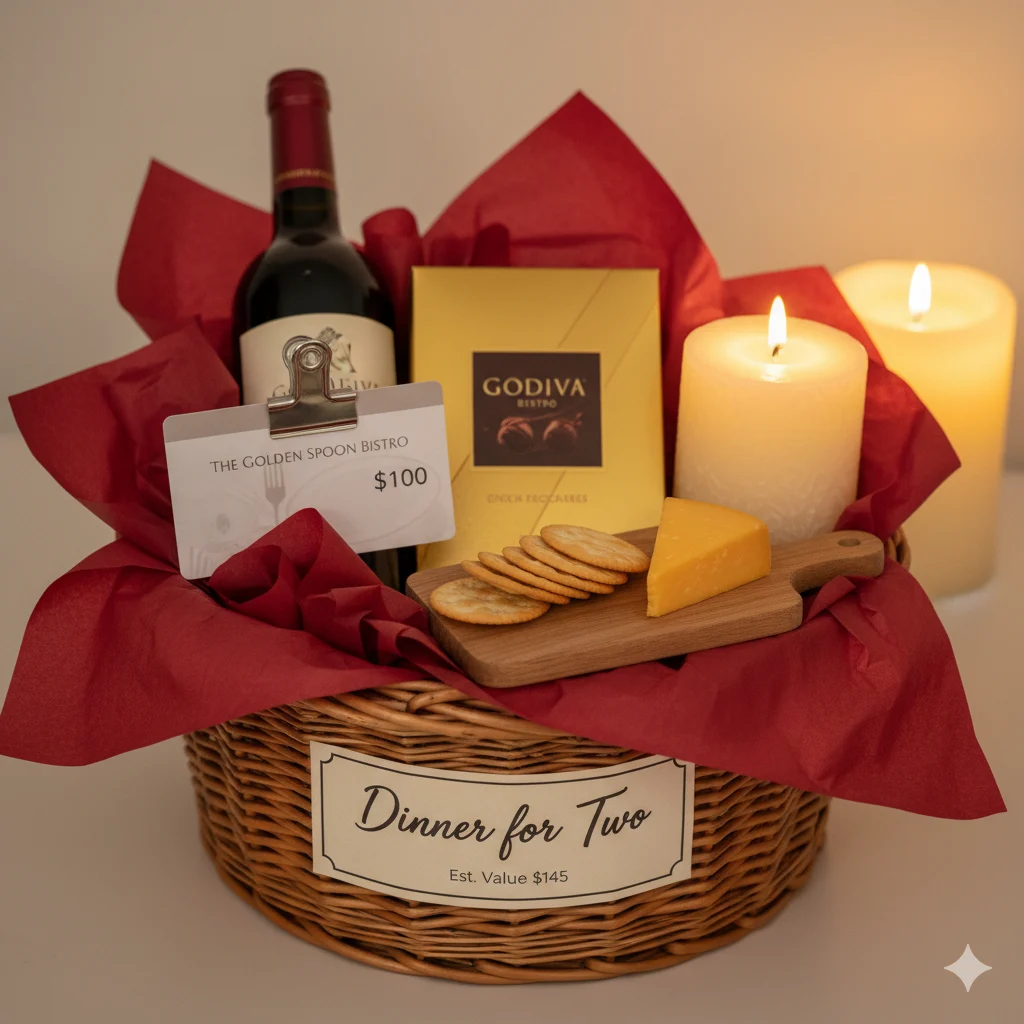
Dinner for Two
What's Inside
- $75–$100 local restaurant gift card
- Bottle of wine or sparkling cider ($18–$25)
- Box of quality chocolates (Godiva, local chocolatier)
- Small pillar candle or taper candle set
- Card game for two (Exploding Kittens: 2-player, Taco Cat Goat Cheese Pizza)
- Hand-lettered "Tonight We Feast" note card
The anchor restaurant should be recognizable to most of the room — a beloved local spot, not a chain. When buyers see a name they know, the "I've been wanting to go there" response is immediate.
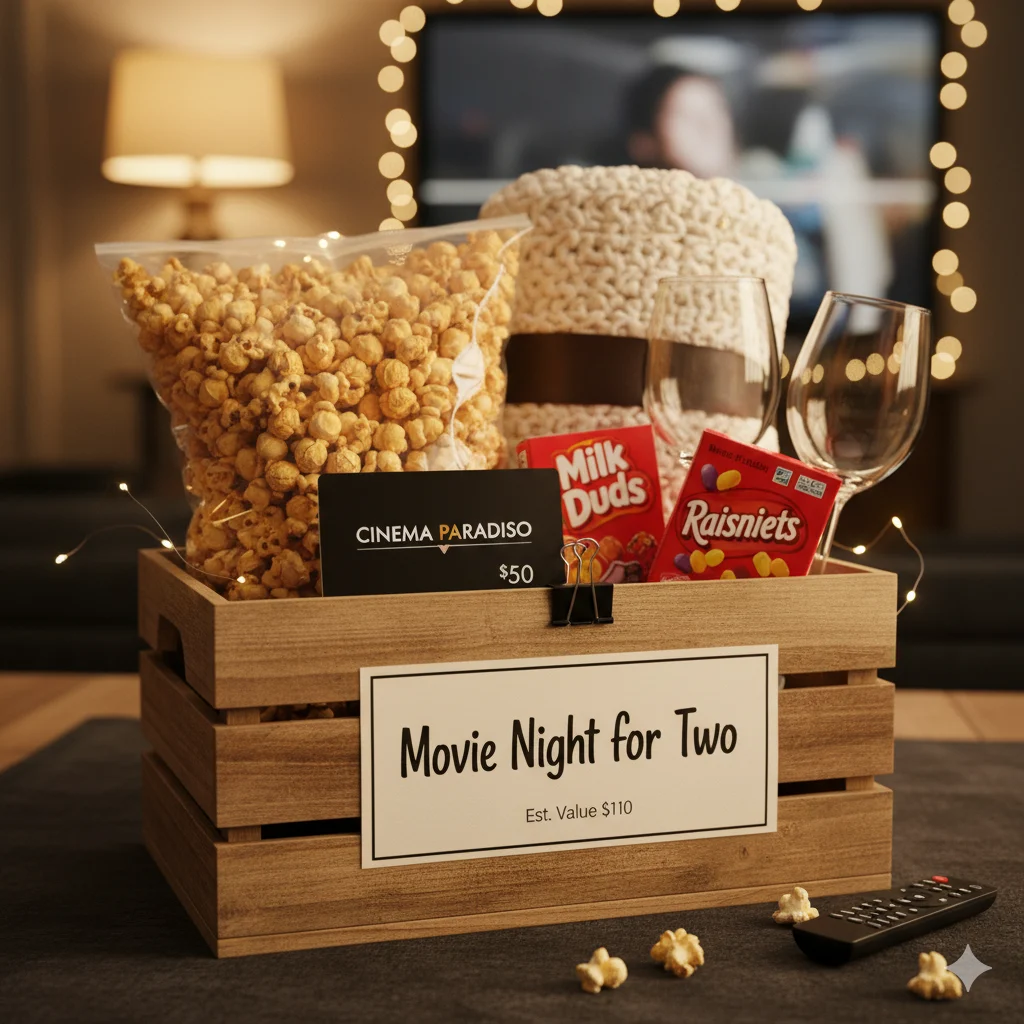
Movie Night for Two
What's Inside
- $50 cinema gift card OR $50 streaming gift card
- Gourmet popcorn set (flavored varieties)
- Movie-theatre candy selection (Milk Duds, M&Ms, Twizzlers)
- Soft throw blanket
- Two wine glasses or insulated tumblers
- Bottle of wine or sparkling cider
Cinema gift card is better than streaming when your audience has young families — they already have Netflix. A night at the actual theatre is a rarer treat. Streaming works for quieter demographics.
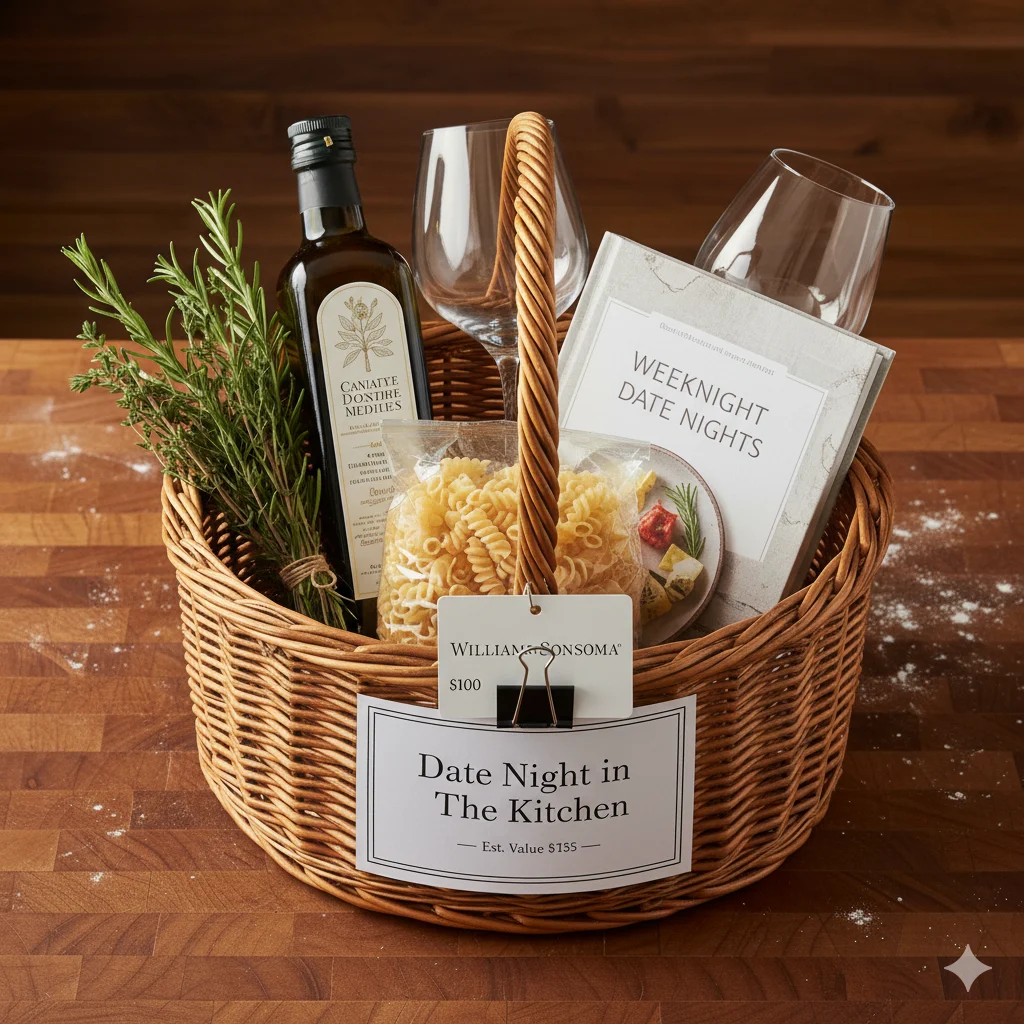
Date Night in the Kitchen
What's Inside
- $50–$75 kitchen store gift card (Williams-Sonoma, Sur La Table, or local)
- Artisan pasta (fresh or high-quality dry)
- Premium olive oil and sea salt
- Small "cooking together" cookbook
- Dried herb bundle or spice set
- Nice dish towels (linen, not cotton)
Performs especially well at events where couples include home cooks or foodies. The kitchen store gift card is unusual enough to stand out from dinner baskets. Label it as a cooking-together experience, not a kitchen supplies basket.
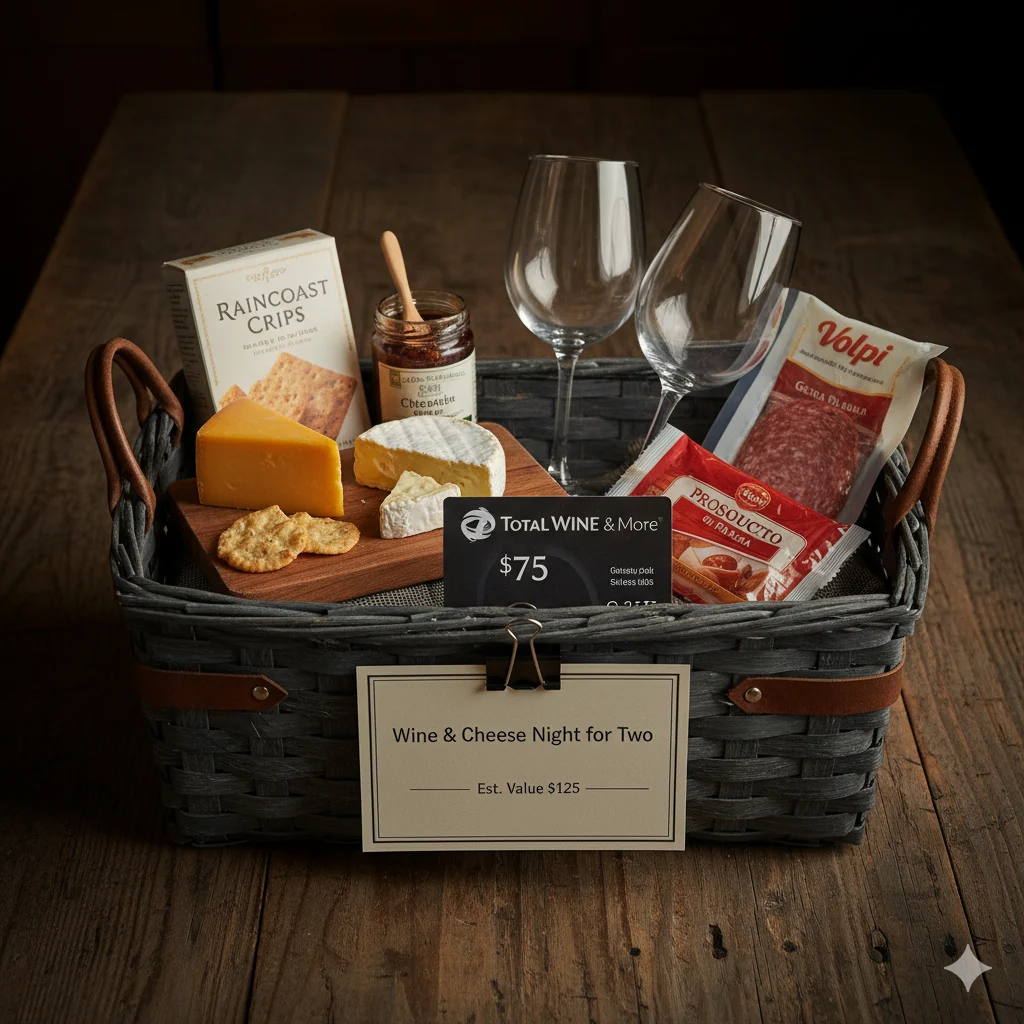
Wine & Cheese Night for Two
What's Inside
- $50 local winery or wine shop gift card
- Cheese board (wood or slate — can be donated)
- Artisan crackers and breadsticks
- Sealed charcuterie: salami, prosciutto, or similar
- Fig jam or honey jar
- Two wine glasses (keep sealed in box for display)
Works at any event but performs especially well at church and community dinners where the audience skews 35+. The local winery angle is important — it gives the basket a specific destination feel, not just a product collection.
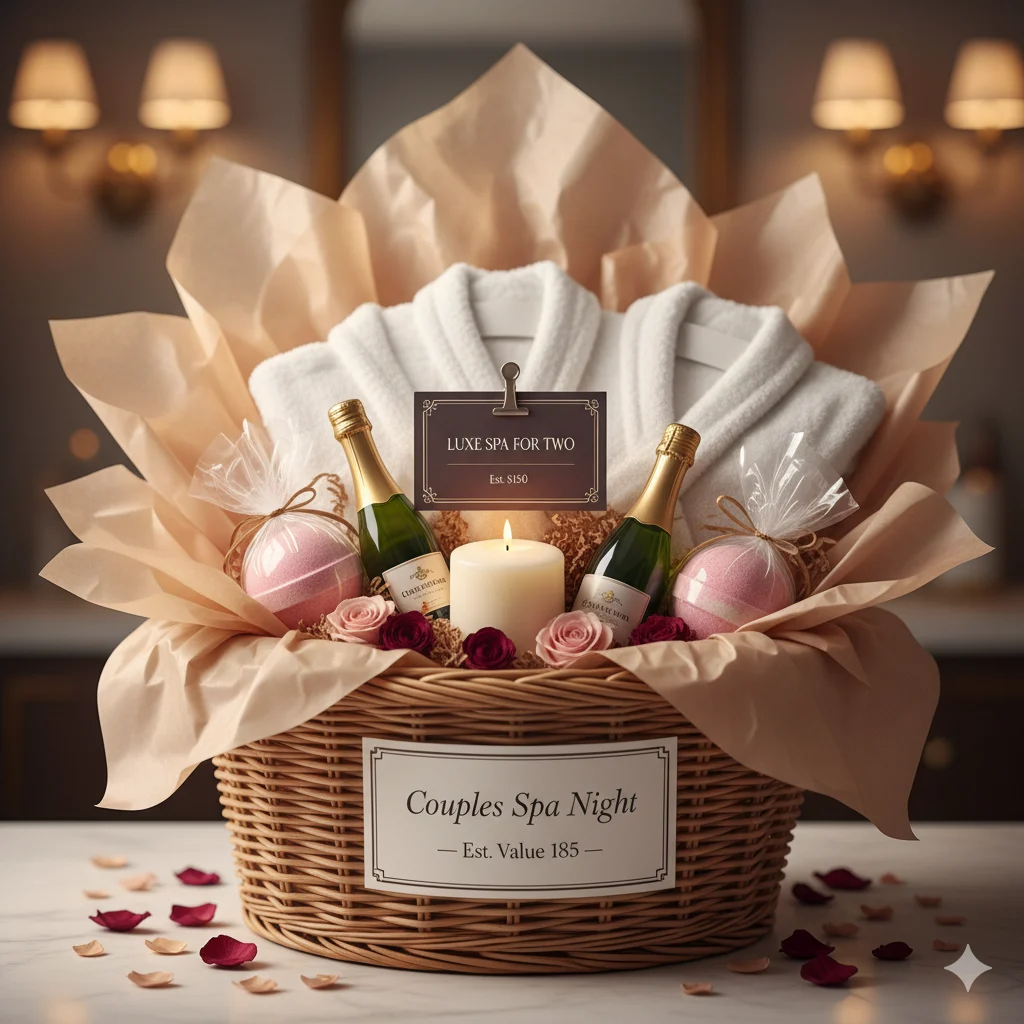
Couples Spa Night
What's Inside
- $100–$125 couples massage or spa gift card
- Two mini champagne splits or sparkling wine
- Bath bomb set for two (separate scents)
- Candle (premium, not drugstore)
- Linen bath towel or waffle robe (one donated)
- Silk sleep mask set
The premium date night basket. Requires a local couples spa or massage studio willing to donate. When available, this is frequently the top-grossing basket of the event. Dual-person services command a premium gift card amount that signals value visually.
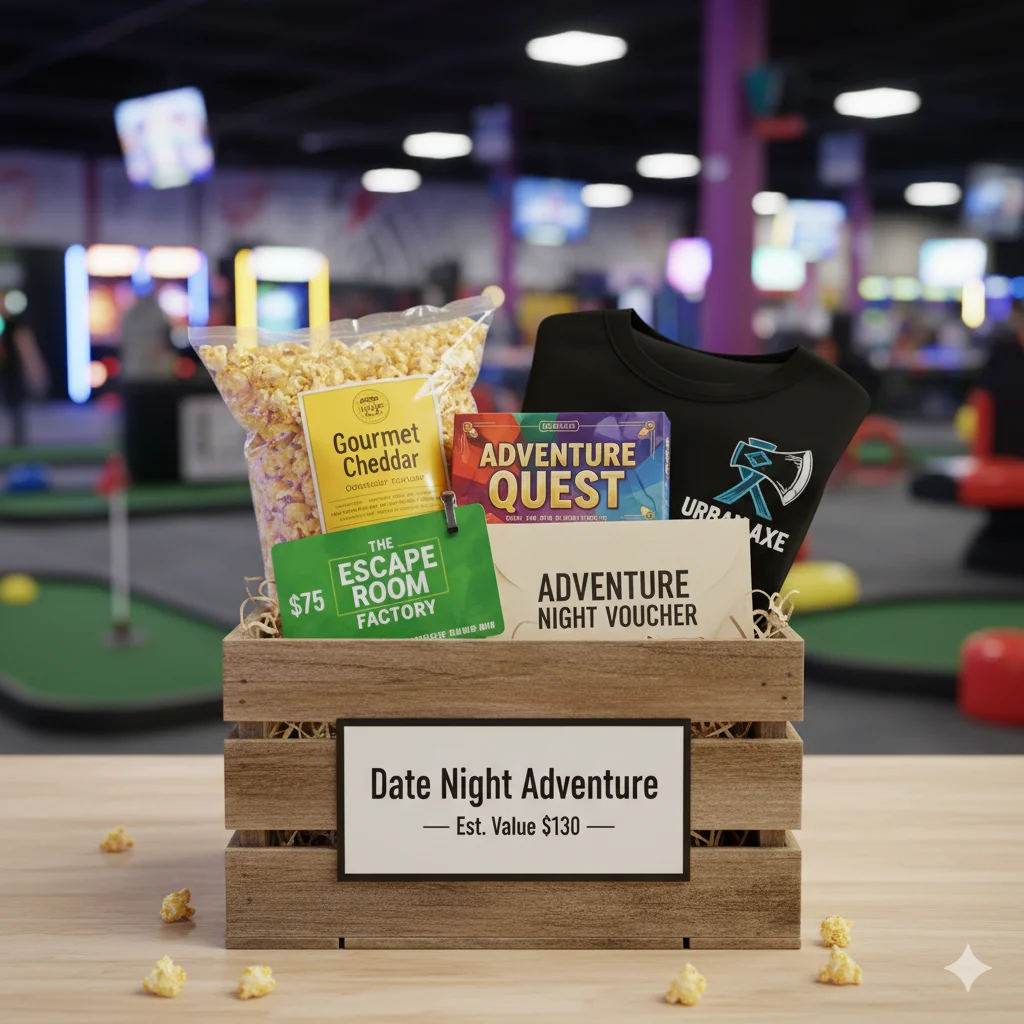
Date Night Adventure
What's Inside
- $50–$75 experience venue gift card (escape room, bowling, mini-golf, axe throwing)
- Gourmet snacks for the car/outing
- Quick card or dice game
- A "date night scratch card" from Target/Amazon (choose your adventure)
- Two insulated tumblers
Appeals to younger couples and early-married demographics who want something active rather than a quiet dinner. Escape room gift cards in particular are highly desirable and relatively easy to source — most escape rooms are happy to donate for the exposure.
How to Name Date Night Baskets — Experience Name, Not Item Name
The basket name is the first thing a supporter reads at the table. It has about three seconds to produce a want before they keep walking. A name that describes the experience creates the want. A name that describes the contents invites assessment.
Name the experience — never the items
✗ Item names — require assessment
Date Night Basket
Generic. Could mean anything. Buyer has to ask what's in it before desire forms.
✓ Experience names — create instant pictures
Dinner for Two at Marco's
Specific. Restaurant named. Experience vivid before the buyer reads another word.
✗ Too vague
Wine & Romance Basket
Vague destination. "Romance" is abstract. Wine is one item, not an experience.
✓ Specific destination
Wine & Cheese Night for Two at [Local Winery]
Specific venue. Specific activity. Buyer pictures the specific night immediately.
✗ Describes contents
Movie Snacks and Blanket Basket
Describes what's in the bag. Buyer sees items, not experience.
✓ Promises the night
Movie Night for Two — Recliner Edition
Promises an actual night. "Recliner Edition" signals comfort and intentionality.
What to Include and What to Leave Out
✓ Include These
- Local restaurant or experience gift card — the non-negotiable anchor. $75 sweet spot.
- One bottle of wine or sparkling cider — visually communicates "celebration."
- Quality chocolates — local chocolatier if possible. Godiva at minimum.
- One candle — creates ambiance signal. Avoid fragrance overload.
- A game for two — card game, dice game. Something to do together.
- Printed experience name label — with est. value. NOT handwritten.
- Small personal note — "Enjoy your night out" from the organizing team.
✗ Avoid These
- Product without destination — wine and chocolate alone = "nice things" not "date night."
- Scented products from multiple sources — candle + lotion + perfume sample = olfactory overload that turns off buyers.
- Perishables — cheese, fresh flowers. Wilt before the event or create display problems.
- Generic gift cards — Visa/Mastercard gift cards have no experience anchor. "$75 to spend anywhere" creates no picture.
- Too many items — more than 7 fill items dilutes the theme and makes the basket look unfocused.
- Alcohol without food items — just wine + chocolates reads as a consolation prize, not a date night.
The Restaurant Sourcing Script That Actually Works
Most restaurant donation asks fail because they are framed as charity requests. The more effective frame is a marketing opportunity: your event puts the restaurant's name in front of 200 families. Ask in person during a slow period, bring a letter, lead with the audience size.
The in-person ask — word for word
"Hi — I'm [name] from [organization]. We're running a fundraiser this spring for [cause] — we'll have about 200 families attending. We're building a 'Dinner for Two' basket and we'd love to feature [Restaurant Name] as the anchor. That means your gift card is the centerpiece of the basket, your name is in every promotional post we send, and the winning family comes in for a full dinner experience.
We're asking for a $75 gift certificate. Would you be willing to donate one? We can offer you a mention in our event program, our social media posts, and our email to [X] families."
Go in person. Ask for the manager, not a server. Bring your organization's letterhead. Come between 2–4pm on a Tuesday or Wednesday. Follow up by email the next day with the details in writing. Response rate from in-person asks with a clear marketing value proposition: 35–45%. Cold email alone: 8–12%.
From the Raffle Hotline · Nonprofit Fundraiser · "Nobody Would Donate a Gift Card"
"We reached out to about fifteen restaurants by email. Maybe one got back to us. I think restaurants just don't donate to this kind of thing."
Us: "Were these emails to a general contact address, or did you speak to anyone in person?"
Caller: "We found the contact info on their website and emailed. Seemed more professional."
Us: "Those emails almost certainly went to an inbox checked by someone who is not the decision-maker for donations. The restaurant owner or general manager is the person who says yes or no to this — and they are almost never reachable through the website contact form. You need to go in person, during a slow period, and ask the manager directly. Bring a one-page letter on letterhead, give them something to look at, and lead with your audience size — not with the cause."
Caller: "I feel like that's too pushy."
Us: "It's not pushy — it's how business is done. You are offering them a marketing opportunity in front of 200 families. That is genuinely valuable to a local restaurant. The in-person ask treats the conversation as a business transaction, not a charity request. The email treats it as a request for a favor. Restaurants respond very differently to each."
They went to seven restaurants in person over two weeks. Three said yes immediately. Two said they'd think about it and both followed up. One said no. They had three restaurant gift cards for three date night baskets — two dinner and one wine bar experience. Total date night basket revenue from those three baskets: $680.
In-person restaurant asks with a clear marketing pitch produce a 35–45% response rate. Email to a website contact form produces 8–12%. If you want the gift card, go get it. Bring the letter. Lead with the audience.
Audience Strategy — The Couple Decision Dynamic
Date night baskets are unusual in raffle lineups because they produce coupled purchase decisions. A parent walking the table sees the dinner basket and immediately thinks of their partner — "we should do this" is a shared thought, not a personal one. That couple decision produces more tickets per household than any individual self-interest prize because two people are deciding to enter, often pooling tickets from both their bundles.
At school events, this dynamic is particularly strong. Parents at PTA events are often in survival mode: childcare, carpools, extracurriculars, work. The promise of an actual night out — with no planning required because the gift card handles the restaurant part — is a genuine relief. The basket sells the night off as much as it sells the dinner.
2×
Ticket decisions per household from date night baskets vs. individual-interest baskets at school and church events.When both members of a couple want the prize, both members contribute tickets. A couple who each bought the 10-for-$25 bundle might allocate 6 tickets each to the date night basket — 12 tickets from one household, from a single $50 investment. An individual spa basket might get 4–5 tickets from the person who specifically wants it. The couple decision multiplier is the structural reason date night baskets generate more total tickets per lineup slot than most other themes at adult community events.
Event-type calibrationSchool / PTA events: Feature one strong dinner basket. The "night off from parenting" framing is implicit and powerful. Name it after a restaurant parents actually want to go to — not a trendy spot they've never been. Church events: Wine-based baskets need audience calibration — know your congregation. A "Sparkling Night for Two" using non-alcoholic sparkling cider works identically when the audience is mixed or abstemious. Nonprofit galas: Date night baskets compete against more premium options. Elevate to a couples spa night or a tasting menu experience. The $75 dinner basket that wins at a PTA event may feel modest at a black-tie gala.
Pricing Date Night Baskets — When to Use the 3-Ticket Multiplier
Date night baskets at the $120–$175 value range are the primary candidates for variable entry costs — the 3-ticket-per-entry model that signals premium value without creating a separate pricing tier. Here is how the math works with the standard bundle structure.
| Basket Build | Est. Value | Tickets / Entry | Entry Cost ($25 bundle) | Signal |
|---|---|---|---|---|
| Movie Night / Wine & Cheese ($100–$120) | ~$110 | 2 tickets | $5.00 | Mild premium — accessible |
| Dinner for Two ($140–$165) ★ | ~$150 | 3 tickets | $7.50 | Clear premium — most common for this tier |
| Couples Spa Night ($175–$210) | ~$190 | 3–5 tickets | $7.50–$12.50 | Elevated — signals top-tier competition |
The rule for variable entry costs on date night basketsOnly apply the multiplier when the premium value is visually obvious from the gift card amount on the label. "Est. Value $150 — Dinner for Two at [Restaurant], $75 Gift Card" makes the premium self-evident. A buyer who sees $75 printed on the gift card understands immediately why this basket costs more to enter. Without that visual evidence, the multiplier suppresses participation rather than communicating value.
Full variable entry cost guide →
Free Download
Raffle Planning Kit
Basket assembly checklist, bundle pricing guide, 7-touchpoint promotion calendar, and the pre-launch checklist — all in one 13-page printable PDF.
Download Free →What's inside
✓ Basket assembly checklist ✓ Bundle pricing structure ✓ Promo calendar template ✓ Pre-launch checklist ✓ Revenue diagnosticFrequently Asked Questions
What should go in a date night raffle basket?
The anchor is a local restaurant gift card ($75 is the sweet spot), clipped front-center at eye level. Supporting items: a bottle of wine or sparkling cider, quality chocolates, one candle, and a card game or activity for two. The restaurant name on the label does more work than all the fill items combined — it creates the specific experience picture that drives ticket purchases.
What if I can't get a restaurant to donate a gift card?
Purchase it. A $75 gift card as a basket investment typically returns $200–$400 in ticket revenue at a 150–200 person event. The math works in your favor. Go in person to local restaurants between 2–4pm on a weekday, ask for the manager, lead with your audience size and the marketing value. In-person asks with a clear pitch produce a 35–45% yes rate. Email to website contact forms produce 8–12%. See the full donation sourcing guide for the complete script.
How many date night baskets should I have in my lineup?
One strong build is usually the right answer. One focused date night basket creates competitive ticket density — when supporters see one "Dinner for Two" basket filling up, it creates urgency that drives more purchases. Two date night baskets split that attention and dilute both pools. The exception: large events (200+ attendees) or demographics where virtually all attendees are couples, where a dinner version and a lower-stakes movie night version can coexist without directly competing.
Do date night baskets work for online raffles?
Yes — among the best performers online. The shareable moment is immediate: a parent who sees the basket spotlight post thinks of their partner and forwards it directly. That personal share reaches entirely new buyers outside your direct audience. For online raffles, the hero photo must show the gift card with the restaurant name and dollar amount readable on a phone screen. That one piece of visual information is what triggers the share. See the online raffle guide for the three-photo standard.
Should I include alcohol in a date night basket?
Yes for most audiences — wine is the conventional visual signal for "celebration night out" and buyers expect it in a date night basket. The exception is events where you know a significant portion of attendees are non-drinkers: church events with mixed or conservative congregations, family-centered school events. For those audiences, substitute sparkling grape juice or sparkling cider — the visual presentation is identical, the ambiance signal is the same, and no one is excluded. Always label the basket honestly (sparkling cider, not champagne) to avoid any misrepresentation.
Related Guides
All Basket Themes
100+ basket ideas across every audience type. Browse themes →Spa Basket Ideas
The gift card anchor, what to include, and the $50 gift card problem explained. Read the guide →Wine Basket Ideas
Why naming matters and the bundle pricing breakthrough for wine builds. Read the guide →Basket Assembly Guide
The 9-step build, three evaluation tests, and the photo sequence. Read the guide →Pricing Guide
Variable entry costs, the $25 bundle structure, and when to use the 3-ticket multiplier. Read the guide →Donation Sourcing Guide
The in-person ask, the follow-up sequence, and the restaurant pitch that works. Read the guide →Run the system that makes date night baskets actually earn