How to Promote a Raffle (Without the Guesswork)
Most raffles don't fail because the baskets were bad or the cause wasn't compelling. They fail because supporters never saw them enough times to act. This is the promotion system we've watched work — and watched fail — across thousands of nonprofit raffles.
To promote a raffle effectively, start 3–4 weeks before launch, send weekly emails, post 3–5 times a week on social, and run daily content in the final 5–7 days. The single most common promotion failure is posting once and assuming people saw it — on Facebook, organic reach for nonprofit pages averages 2–5% per post, meaning most of your audience never sees a single post. Repetition across email, social, and in-person channels is what converts awareness into ticket sales. Supporters typically need 4–7 exposures before they buy, and the final week of a campaign consistently produces 30–50% of total revenue.
Most Raffles Don't Fail for the Reason You Think
Here's what usually gets blamed when a raffle underperforms: the baskets weren't good enough. The cause wasn't compelling enough. The audience wasn't engaged enough. The timing was wrong.
In 20+ years of running the raffle hotline, almost none of that turns out to be true. What we see, over and over, is the same pattern: good baskets, real cause, engaged audience — and a promotion plan that consisted of one launch post and a hope that "word would get around."
Word doesn't get around. Feeds are crowded. Inboxes are full. And organic reach on every major social platform has been declining for years — in most current nonprofit benchmark reports, Facebook page posts now reach only 2–5% of a page's own followers without paid boost. If you have 500 followers and post once, roughly 10–25 people see it. That's not a promotion strategy. That's an announcement to a handful of already-loyal fans.
The raffles that raise real money don't have better prizes. They have a plan for showing up 15–20 times over four weeks, across multiple channels, with the same core message told in different ways.
-
!Treating launch day as the start of promotion. By the time tickets go on sale, you should already have three weeks of teaser content in circulation. Starting promotion on launch day means starting from zero awareness and trying to convert cold buyers on first contact — a strategy that consistently underperforms baseline demand by 40–60% in our hotline data.
-
!Posting once and waiting for it to "go viral." The algorithmic reality for almost every nonprofit is that a single post reaches 2–5% of followers. "Going viral" is not a strategy — it's a lottery with worse odds than the raffle itself. Repetition is the strategy.
-
!Ignoring email because "everyone uses social now." Nonprofit email open rates are roughly 7–10× higher than Facebook organic reach. If you have a list of past donors, event attendees, or parents from last year's fundraiser — that is your single highest-conversion channel. Not using it is the most expensive mistake we see.
-
!Going silent in the final week. The last 5–7 days of a raffle consistently produce 30–50% of total revenue. Organizations that feel "we've already said a lot" and slow down in the final stretch leave the highest-converting window unworked. Urgency messaging in that window is what turns casual interest into completed purchases.
-
!Having no share mechanic. If your platform doesn't give supporters a one-tap share button after checkout, you're relying on them to remember to screenshot and post on their own. They won't. A platform with built-in social share after purchase multiplies reach without requiring any extra effort from your committee.

"Same baskets, same event, same audience — we just changed how often we showed up."
The Psychology Behind Why People Don't Buy the First Time
Marketing researchers have been studying the question "how many times does someone need to see an ad before they act?" for half a century. In 1972, researcher Herbert Krugman proposed that three exposures were enough — one to notice, one to recognize, one to act. That three-exposure theory was refined, challenged, and largely replaced in subsequent decades by the broader concept of effective frequency: the number of exposures varies by channel, by audience, by message, and by purchase complexity.
For nonprofit raffle promotion specifically, the real-world pattern we observe is closer to 4–7 exposures before a supporter converts. And those exposures need to come through different formats — the same message in a feed post, an email, a text from a friend, and a table at pickup hits four different cognitive triggers in the same person.
This is why one-channel promotion plans underperform so reliably. Posting only on Facebook means you're making one type of impression. Sending only one email means you're making one impression in one moment. Supporters who are gradually forming the decision to buy need many small reminders, not one big announcement.
-
1Awareness. The first exposure registers the raffle as a thing that exists. The supporter doesn't act. They may not even fully read the post. But something is now in their head.
-
2Familiarity. The second and third exposures build recognition. "Oh right, that raffle." At this stage, the supporter starts forming an opinion about whether they care. Still no action.
-
3Consideration. Around exposure 4 or 5, serious consideration begins. The supporter starts thinking about which basket appeals to them, whether they know anyone involved, and whether they want to participate. They still don't buy.
-
4Action. Somewhere between exposure 4 and 7 — often triggered by a deadline, a basket they personally love, or a friend mentioning they bought in — they finally buy. If your promotion stopped before this moment, you lost them entirely.
If your plan includes "3 social posts and 1 email" across a 4-week raffle, you're reaching each supporter roughly 1–2 times — below the threshold where most of them will act. Your plan isn't wrong because it's short. It's wrong because it's stopping before buyers are ready.
The organizations that raise real money aren't doing anything more creative. They're doing the same things 3–4× more often.
The 3-Phase Promotion System That Drives Revenue
Every high-performing raffle we've seen runs on roughly the same three-phase structure: pre-launch to build demand, active promotion to drive consistent ticket flow, and a final push to capture the procrastinators. Skip any one of these and you cap your revenue at a fraction of what the event could produce.
This pattern holds across school, church, VFW, community, and animal shelter raffles of every size. It's driven by a combination of procrastination and loss aversion — supporters who've been casually interested finally act when the drawing is imminent. The organizations that stop promoting in the final week are giving up their highest-converting window.
Source: Aggregated Chance2Win platform data across thousands of nonprofit raffle events.
Pre-Launch: Where Momentum Actually Starts
Pre-launch is the most skipped phase of nonprofit promotion and the single highest-leverage one. Three weeks of teasing before tickets go on sale converts launch day from a cold opening into a crowd that's already waiting.
The content is easy because you're not selling yet — you're building curiosity.
- "Something big is coming — save the date" post with event date only
- Sneak-peek photos of baskets half-wrapped, half-revealed
- Sponsor shout-outs as donations come in ("Huge thank you to…")
- Volunteer wrapping photos — behind-the-scenes authenticity
- Email: "Our raffle launches April 15 — here's what's coming"
- "Reveal" post for each major basket, spaced 2–3 days apart
- Launching with zero prior posts — you start at cold awareness
- Revealing all baskets in one post on launch day
- Skipping sponsor recognition — kills future donation pipeline
- Making the pre-launch too professional / polished (feels corporate)
- Starting pre-launch the week before — not enough runway
- Posting vague teasers with no date anchor ("coming soon…")
Active Promotion: Where the Real Volume Happens
Active promotion runs from launch day through the final push — typically 2–3 weeks in the middle of your campaign. This is where most organizations lose discipline. The launch excitement fades, the committee gets busy with event logistics, and posting quietly slows from "weekly" to "when we remember."
The antidote is a schedule. Not inspiration. Not clever content ideas. A schedule.
-
✓1 email per week, sent the same day each week (Tuesday or Wednesday morning tends to outperform other windows in nonprofit send data). Content rotates: basket spotlight → sponsor feature → supporter testimonial → update on revenue-to-date.
-
✓3–5 social posts per week, spread across different formats: a basket photo on Monday, a behind-the-scenes story on Wednesday, a sponsor thank-you on Friday, a quick countdown reminder on Sunday. Same raffle, different angles.
-
✓1 featured basket spotlight per week. Pick one basket, give it a full-length post with photo, item list, and the story of who donated what. This is the single most effective content format we've measured — it creates attachment to a specific prize.
-
✓Ongoing "ask for shares" content. Every post should make sharing easy. Committee members and volunteers should commit to sharing at least one post per week to their personal networks — that's where most new buyers come from.
The Channels That Drive Ticket Sales (And the Ones That Don't)
There's a common instinct to promote "everywhere" — Facebook, Instagram, TikTok, LinkedIn, Twitter/X, Nextdoor, flyers in coffee shops, everywhere a channel exists. This is a mistake. Consistency in two or three channels beats shallow presence in eight. Here's what the data actually shows about where raffle promotion pays off.
Message Templates That Actually Get Clicks
The biggest jump in conversion we've watched committees make isn't switching platforms or spending on ads. It's rewriting their promotion copy. Most nonprofit raffle messages read like announcements — formal, informational, passive. They tell people a thing is happening. They don't give supporters a reason to act right now.
Below are the templates we walk hotline callers through. Each one is structured around a specific moment in the campaign — use them as starting points, swap in your specifics.
Body: Dear supporters, we are pleased to announce that our annual basket raffle is now open for ticket sales. Please consider supporting our organization by purchasing tickets today.
Body: They're in the gym, they're wrapped, and they're ready. Start with the Coffee Lover Kit (full French press, gift card, the works) or the Family Game Night basket — those two are already the most-watched. Single tickets are $5, but the 5 for $20 bundle is what most people grab. Drawing is May 4 at 7pm. Buy tickets here →
Body: The drawing is tomorrow. Don't forget to buy your tickets if you haven't already.
Body: Ticket sales close at 6pm tomorrow — one hour before we draw. 14 baskets, 18 chances to win. Three baskets are still wide open (Garden Lover, Coffee Kit, Movie Night). If there's one you've been eyeing, now's the time. Bundles are 5 for $20 or 15 for $50. Link here →
The 4-Week Promotion Calendar (Built for Busy Committees)
This is the cadence we walk first-time organizers through on the hotline. Every task is scoped to under 30 minutes — a committee of 2–3 people sharing the load can run this whole plan in 2–3 hours a week. The point isn't to do more. It's to do the right things, on the right days, consistently.
This plan involves roughly 25–30 touchpoints across 4 weeks. Each one is a short task — a 2-minute post, a 15-minute email, a 30-second text. Two volunteers splitting the load are working about 2 hours a week each.
Organizations that run this full cadence consistently raise 2–4× more than organizations that do "some posts and an email." Not because they work harder in any given moment — but because they show up systematically.
Why Your Platform Is Part of Your Promotion
Most committees think of their raffle platform as the place people buy tickets — not as part of the promotion stack. That's backwards. The platform either multiplies your reach or silently caps it.
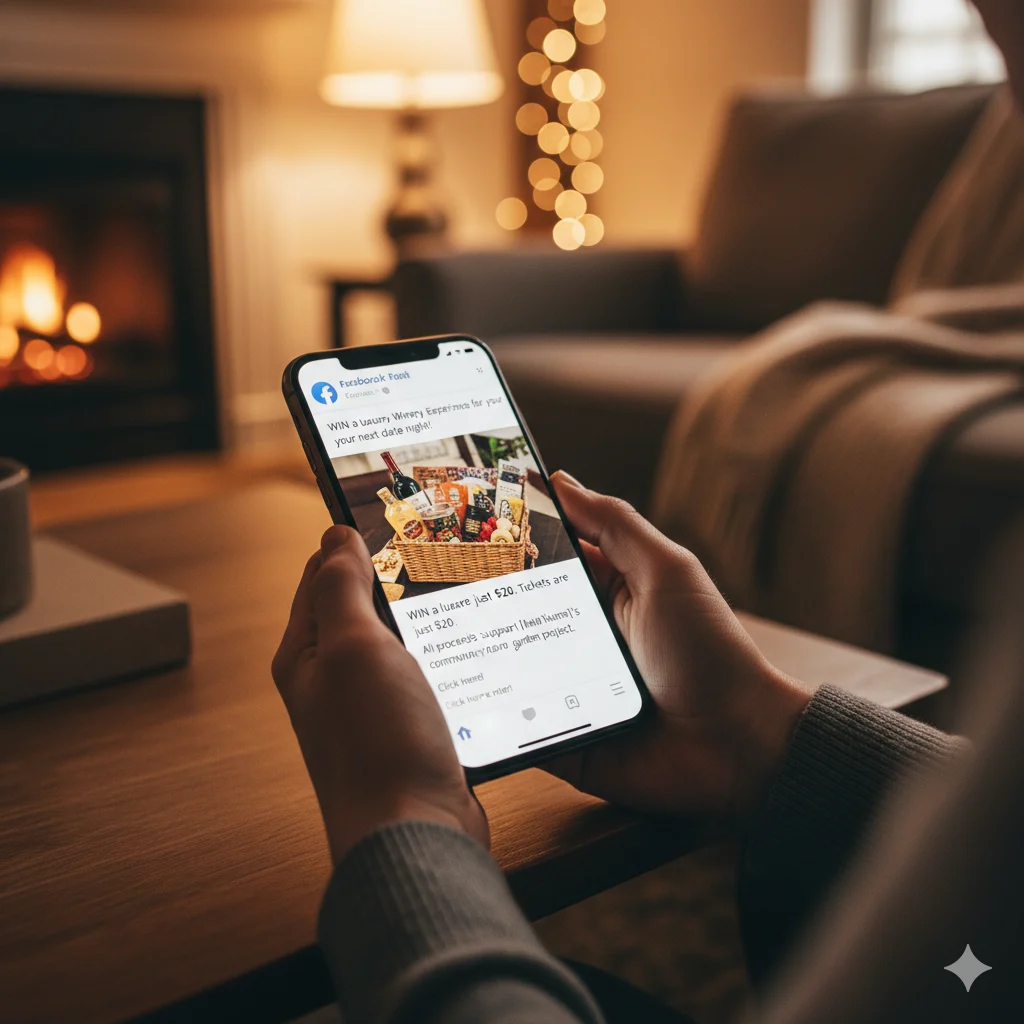
After a supporter buys tickets, the highest-leverage moment in the entire campaign arrives. They're enthusiastic. They care about the cause. They just financially committed. If your platform gives them a one-tap share button on the confirmation screen — "I just bought tickets for the [Nonprofit] raffle, join me!" — some meaningful percentage of them will click it. If it doesn't, that moment is lost.
Most free and generic nonprofit platforms don't have this. Supporters buy, close the tab, and the enthusiasm dissipates. Promotion has to restart from zero. A purpose-built basket raffle platform bakes the share mechanic into the checkout flow — turning every buyer into a micro-promoter without asking them to do anything except tap once. See the basket raffle software guide for the features to look for.
The Final Push: Where Revenue Actually Lives
If you take one thing from this entire page, take this: the last 5–7 days of your raffle is when most of the revenue gets decided. Every piece of platform data we've looked at across thousands of nonprofit events shows the same pattern — 30–50% of total ticket sales happen in the last week. It's not close.
This happens because of two psychological dynamics working at the same time. First, procrastination — supporters who've been casually interested put off buying because there's no urgency yet. Second, loss aversion — once they realize the drawing is imminent and the opportunity to win will disappear, the cost of inaction suddenly feels real. Both of these kick in during the final week. Neither kicks in earlier.
The practical consequence: organizations that stop promoting in the final week — because they "don't want to be annoying" or "feel like they've said a lot already" — give up the highest-converting window of the entire campaign. Don't do that.
-
✓Daily social posts. Countdown language ("3 days left"). Short, visual, one basket per post. Variety matters — don't just repost the same content with a new day number.
-
✓2–3 emails in the final week. Standard cadence: "final week" email on day 7, "3 days left" email on day 3, "drawing tomorrow" email on day 1. All three should be short — 100–150 words each.
-
✓The volunteer text tree in the final 48 hours. This is the single most effective tactic in the final push. 10 committee members each texting 10 friends produces ~100 high-trust touches in 24 hours. Pre-write the template so volunteers just copy, paste, personalize one line.
-
✓Surface baskets with lighter ticket allocation. "Three baskets still wide open" creates scarcity signaling on the raffle-wide level while also helping supporters who want better odds. This works because basket raffles have independent ticket pools per basket — every basket has its own drawing, so odds genuinely vary.
-
✓Hourly social posts on drawing day. Not posts about the raffle generally — just short ticket-closing countdowns. "Tickets close at 6pm — drawing at 7pm." Three or four of these throughout the day catch procrastinators.
"We were going to call it. We thought we'd hit the ceiling. Then the last three days happened."
Start promoting 3–4 weeks before tickets go on sale.
Pre-launch isn't optional — it's where demand gets built. Launching cold on day one and hoping for momentum is the single most expensive mistake we see. Teaser content, basket sneak-peeks, and sponsor shout-outs across 2–3 weeks means you start launch day with an audience already leaning in.
Use email. It converts 7–10× better than social.
Nonprofit email open rates run 28–35% in current industry benchmarks. Facebook organic reach runs 2–5%. If you have a list of past supporters, parents, or event attendees, email is the highest-ROI channel you have access to. Ignoring it because "everyone's on social now" is a top-five revenue mistake.
Run a volunteer text tree in the final 48 hours.
Nothing we've measured converts as well as a short personal text from someone the supporter actually knows. 10 committee members × 10 contacts each = 100 high-trust touches in a single day. Pre-write the template, give volunteers one line to personalize. This routinely produces more tickets than the entire social campaign.
Don't slow down in the final week. Speed up.
30–50% of total raffle revenue consistently comes from the last 5–7 days. Daily posts, countdown emails, urgency messaging, drawing-day hourly updates — none of this is "too much." It is exactly the amount that converts the people who were going to buy all along but hadn't yet.
Includes the 4-week promotion calendar in editable format, the five message templates from this page, the volunteer text-tree script, and the 60-day event checklist. Everything your committee needs to actually execute the plan — not just read about it.
Download Free →What's inside
✓ 4-week promotion calendar
✓ 5 copy-ready message templates
✓ Volunteer text-tree script
✓ 60-day event checklist
✓ 20 basket theme build sheets
Frequently Asked Questions
Related Pages
Your baskets are probably fine. Your promotion might not be.
"If your raffle isn't performing, don't change your prize. Don't change your pricing. Fix your promotion." — The Chance2Win Team