Faith-appropriate builds · The $1 ticket problem · Real congregation stories
Church Raffle Ideas That Actually Raise Money
Your congregation wants to support the church. They just need a structure that makes participating feel clear, natural, and worthwhile — not uncomfortable. This guide covers faith-appropriate basket builds, the post-service 5-second moment, why $1 tickets quietly destroy church raffle revenue, and the experience prizes no other organization can offer.
From $600 to $4,500 with the same 150-person congregation. What changed and why it worked.
7.5×Revenue jump from structure, not new donors
5 secThe post-service decision window
30–40%Lost to fees on $1 digital tickets
$0Cost of a Dinner with the Pastor prize
The short versionChurch basket raffles raise far less than they should — not because congregations are less generous, but because the structure doesn't match how church communities naturally give. The highest-performing church basket ideas are community and family baskets ("Sunday Dinner for Four," "Family Game Night," "Fall Harvest Basket"), seasonal baskets aligned with the church calendar, and church-specific experience prizes like "Dinner with the Pastor" that cannot be purchased or obtained anywhere else. The single biggest revenue change: replacing $1 single tickets with bundle pricing. The second biggest: naming baskets as specific community experiences rather than generic item collections. This guide covers both — and the hotline stories that show exactly what happened when churches made the shift.
The Appropriateness Question — Addressed Plainly
The question every church committee asks first
Is a basket raffle appropriate for a church fundraiser?
Yes — and it has been for decades. Church basket raffles (also called tricky trays in New Jersey, penny socials in the Mid-Atlantic, and Chinese auctions in some older regions) are among the most common parish and congregation fundraising formats in the country. Catholic parishes, Methodist churches, Baptist congregations, evangelical communities, and mainline Protestant churches all run them regularly.
The occasional "gambling concern" is understandable, but it typically resolves when the structure is explained: supporters purchase tickets and direct them toward specific prizes they want to win. This is more similar to a carnival draw or a fair game than to casino gambling. No money is staked against the house. No odds are hidden. Every dollar of ticket revenue goes to the church. If your specific denomination has guidelines on fundraising games of chance, consult those guidelines before planning — most permit basket raffles specifically, or permit drawing-based fundraisers generally. Some communities call them "gift basket socials" rather than raffles to avoid any concern with the word.
If leadership has questions or concerns, that conversation is worth having before the event — not mid-event when a committee member has already built eight baskets. Address it directly, explain the structure, and get a clear yes or no before proceeding.
From the Raffle Hotline · Parish Fundraiser · "It Just Felt Off"
"The raffle happened, people were polite about it, but it just felt... off. Like they were tolerating it rather than participating."
A parish fundraising chair called a week after their annual dinner. The raffle had been run — items on a table, some people dropped tickets in buckets, they raised about $580. Nothing went wrong. But nobody seemed engaged by it either.
Caller: "I think some people might have felt uncertain about whether they should be participating."
Support: "Did you announce it during the service, explain what the proceeds go to, and describe how it works?"
Caller: "We mentioned it was happening. But we didn't really explain it."
Support: "That's the hesitation you're seeing. Church audiences are more cautious about ambiguous situations. They need to know: what is this, why should I participate, where does the money go, and is this something we do here as a community? When those questions aren't answered explicitly from the front, people fill in the blanks with their own uncertainty."
Caller: "So we need to address it directly?"
Support: "Yes. Not defensively — just clearly. 'Tonight we have a basket raffle to support [specific program]. Each basket has its own ticket bucket. You buy tickets, put them in the bucket for the basket you'd like to win, and we draw one ticket per basket at the end of the evening. Every dollar goes directly to [cause].' That 30-second explanation removes every reason to hesitate."
The following year, the pastor made a 90-second announcement from the front explaining exactly what the raffle was, why the committee built it, and what the money would fund. He said: "I hope you'll participate — these baskets were built with real care by your fellow parishioners, and every ticket is a direct contribution to [ministry]." Revenue: $2,800. From $580 the prior year. Same crowd, same baskets, same structure — just a clear, pastoral invitation instead of an ambiguous table in the corner.
The "felt off" problem in church raffles is almost always an information gap, not a theological one. Congregation members who aren't sure whether they should participate won't participate. A clear, warm, pastorally-framed announcement from someone the congregation trusts eliminates that uncertainty immediately. The raffle doesn't need to be defended — it needs to be introduced.
The Post-Service 5-Second Window — When Participation Actually Happens
Service ends. People are warm from community, slightly unhurried, open to connection. Someone's holding coffee. The kids are milling. Two people are catching up about something that happened last week. This is the best possible moment for a basket raffle — and it lasts about five minutes before the energy dissipates and people start thinking about lunch.
In that five-minute window, the congregation drifts toward the raffle table. Each person gives it about five seconds. That's the decision moment. If what they see in those five seconds is a pile of items with handwritten labels and a note saying "raffle tickets $1" — they smile, feel vague goodwill toward the church, and drift away.
If what they see is a clearly labeled basket that immediately creates a complete picture — "Sunday Dinner for Four" with a restaurant gift card visible at the front — they stop. They lean in. They start thinking about whether they want to win it. That transition from "drifting past" to "considering" is the purchase trigger, and it happens in those five seconds.
What the table needs to communicate in 5 secondsWhat is this basket? (The name, not the items.) Who would want to win it? (The picture in their mind.) How do I participate? (A clear ticket price and bucket visible.) Why should I? (A small card explaining the cause.) That's it. Four questions, five seconds. If all four are answered at a glance, the conversation starts.
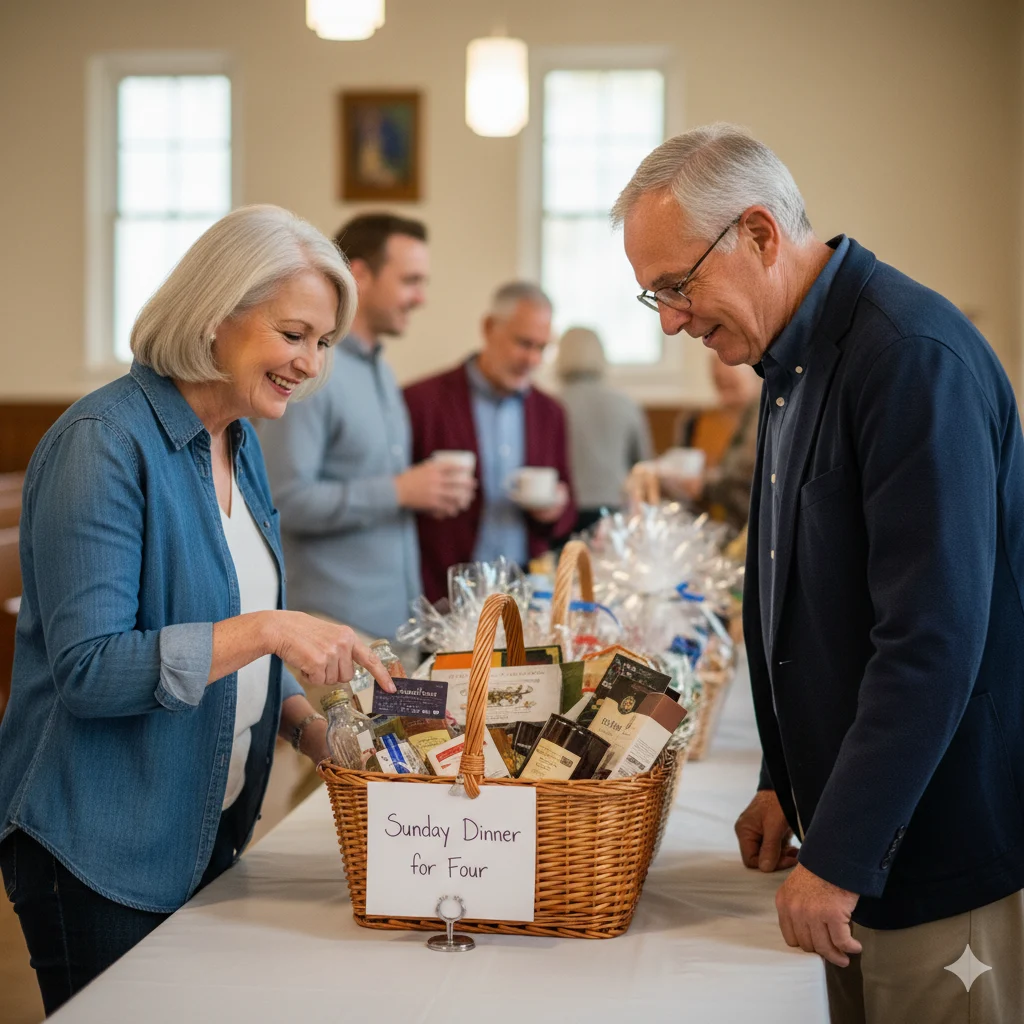
The church raffle context has one additional layer the brief doesn't address: congregation members are asking themselves a specific question that non-church buyers don't ask. "Is this aligned with who we are as a community?" Generic or visually messy baskets create a subtle mismatch between the church environment and the fundraising activity. Warm, clearly-themed baskets that fit the community's values — family dinners, fellowship, seasonal celebrations, meaningful experiences — resolve that question in the first glance. The basket that says "Sunday Dinner for Four" speaks the language of the congregation. The basket that says "Miscellaneous Gift Items — Value $95" does not.
Church Raffle Basket Ideas — What Actually Works Here
 Top Performer
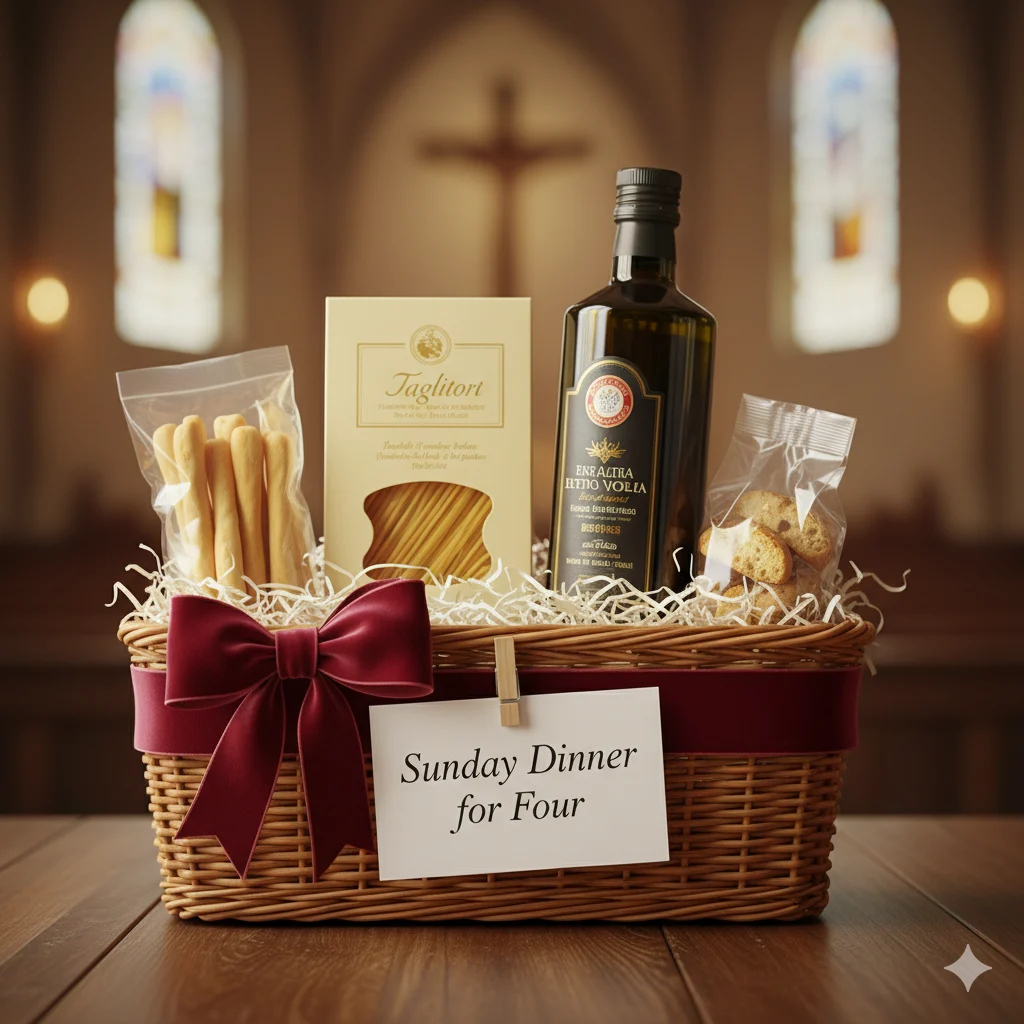
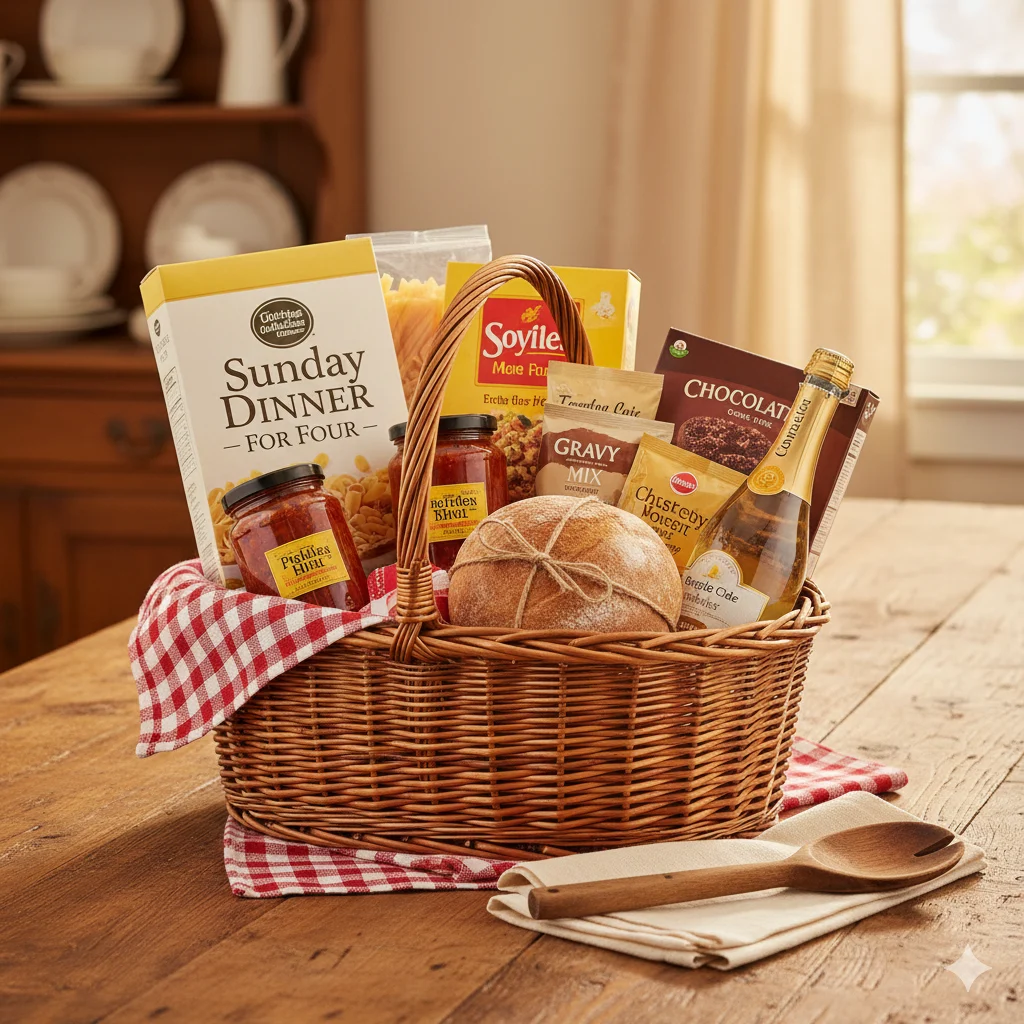
Sunday Dinner for Four
What's Inside
- $50–$75 local restaurant gift card
- Artisan pasta + premium sauce
- Quality olive oil (label facing forward)
- Breadsticks or artisan crackers
- Italian cookies or biscotti
Build Cost
~$70–$90
Revenue Range
$400–$900
Church-specific framing: "Sunday Dinner for Four" resonates more deeply in a church context than "Italian Basket." It names the ritual — Sunday dinner is already a cultural touchstone for most congregations. The community connection makes this basket feel like it belongs here, rather than like it was imported from a different kind of event. Source the gift card from a local restaurant the congregation already uses.
 Seasonal Anchor
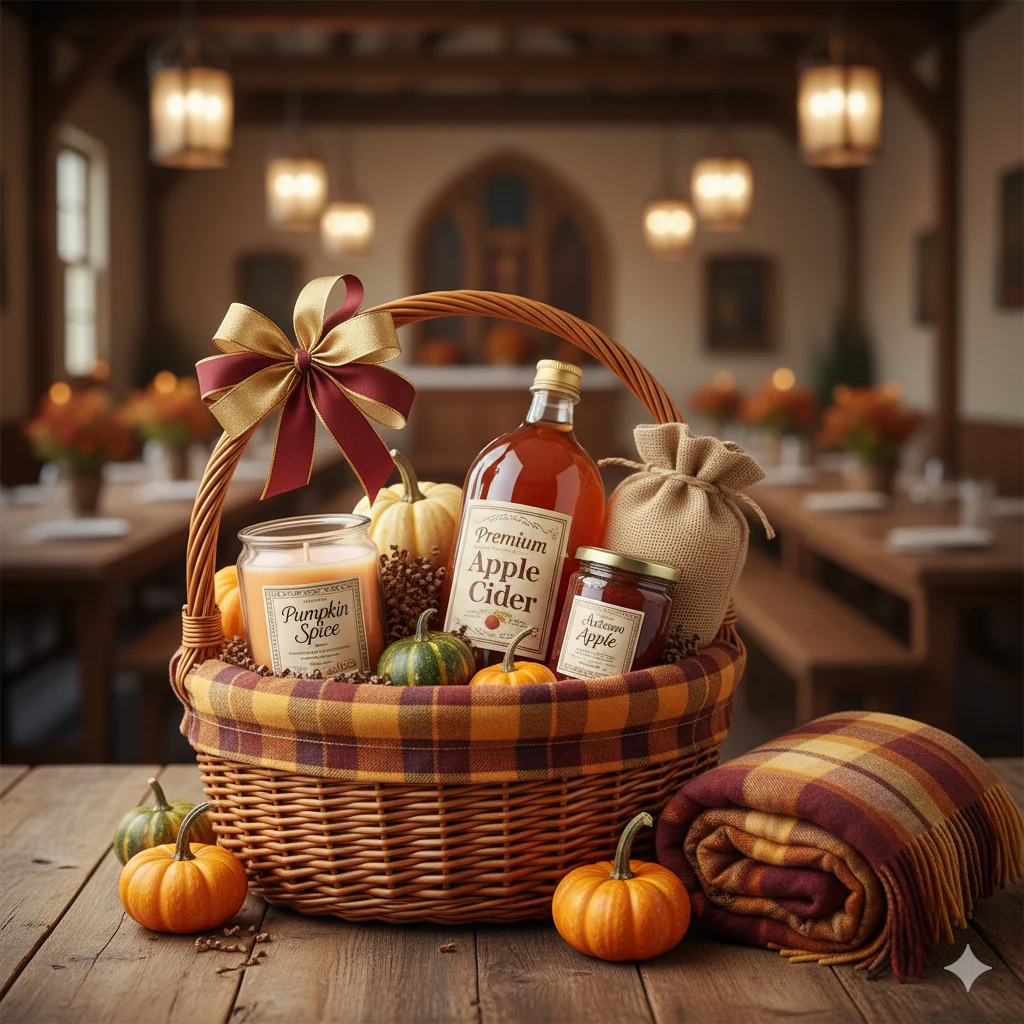
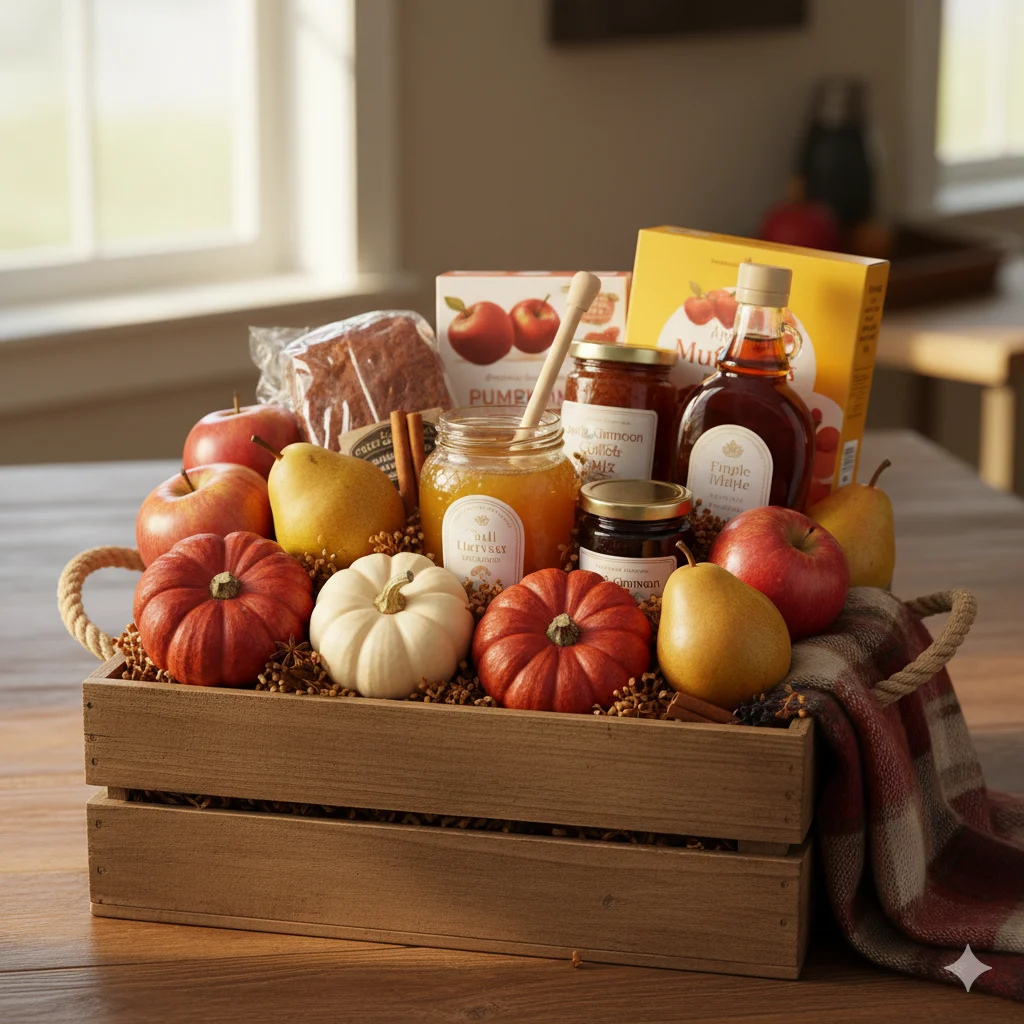
Fall Harvest Basket
What's Inside
- Premium apple cider or specialty beverage
- Pumpkin spice or harvest candle (quality brand)
- Artisan jam or preserves (2 varieties)
- Harvest snack mix (nuts, dried fruit)
- Cozy plaid throw blanket
Build Cost
~$55–$75
Revenue Range
$380–$800
The church calendar advantage: Seasonal baskets that align with the church's own calendar — Fall Harvest at the harvest dinner, Advent basket before Christmas, Easter Morning basket at the spring banquet — feel purposeful rather than arbitrary. The timing makes the basket feel like it belongs to the event, not like it was added to it. See the seasonal basket strategy below.
 Family Appeal
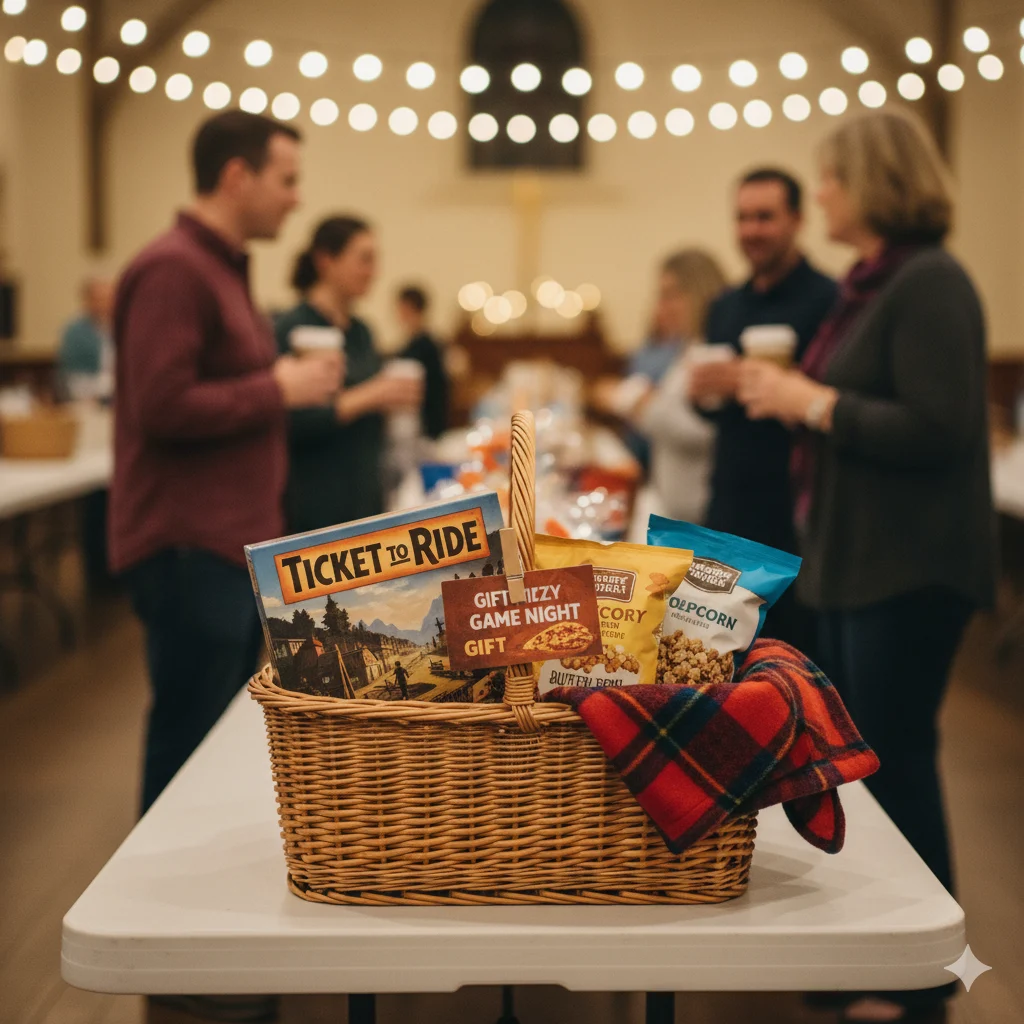
Family Game Night
What's Inside
- $30–$40 pizza or casual dining gift card
- Popular board game (Catan, Ticket to Ride, Codenames)
- Popcorn assortment + candy
- Cozy throw blanket
- Card game (Uno, Exploding Kittens)
Build Cost
~$65–$85
Revenue Range
$400–$900
Why this works at churches: "Family time" is a value most congregations actively affirm. A basket that enables it resonates as more than a prize — it feels aligned with what the community believes in. The pizza gift card anchors practical value; the games signal the intention. Families with children compete especially for this one, and church events tend to have strong family attendance.
 Faith-Aligned
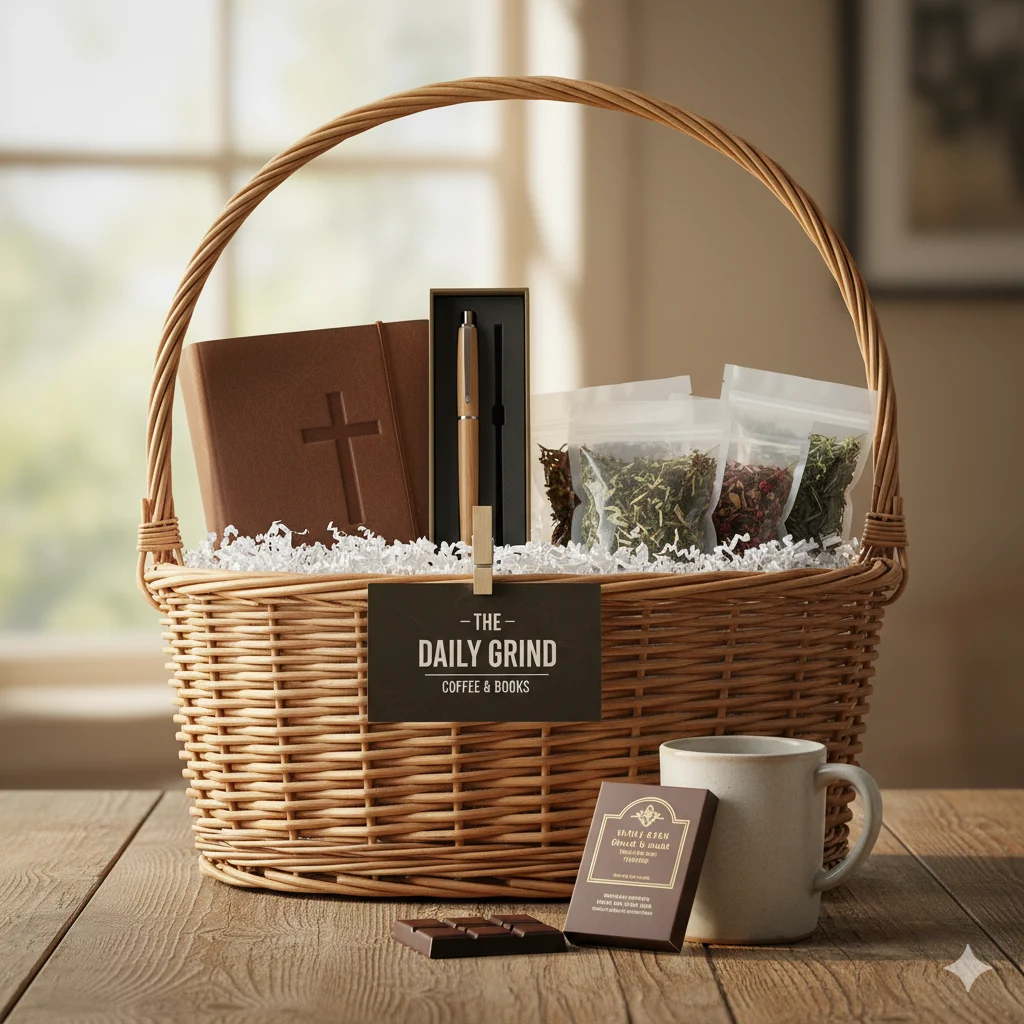
Morning Quiet Time
What's Inside
- Local café gift card ($30–$40)
- Premium devotional journal
- Quality pen set
- Herbal tea or premium coffee selection
- Small artisan chocolates
Build Cost
~$55–$70
Revenue Range
$350–$750
How to make faith-aligned baskets work: A devotional journal alone does not sell tickets. The same journal paired with a coffee gift card, premium tea, and chocolates — and labeled "Morning Quiet Time" — sells tickets to everyone in the congregation who wishes they had a better morning routine. The faith item supports an aspiration; the gift card and tea make it feel like an immediate, practical prize. This is how faith-aligned baskets succeed without feeling like obligations.
 Community Fit
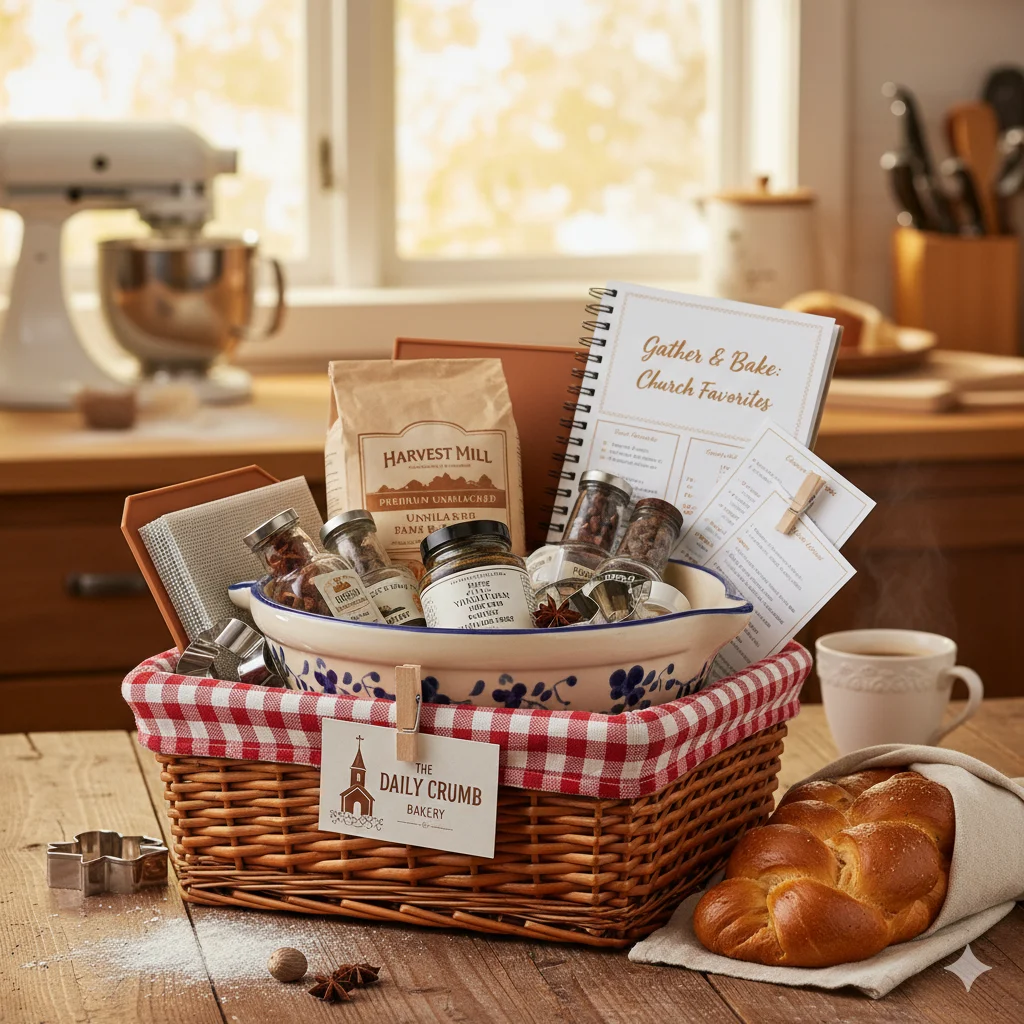
Baking & Fellowship Basket
What's Inside
- Local bakery gift card ($30–$50)
- Premium baking ingredients (artisan vanilla, specialty flour)
- Quality mixing bowl or baking dish
- Recipe book or card collection
- Artisan chocolates or specialty ingredients
Build Cost
~$60–$80
Revenue Range
$350–$800
Church culture fit: Baking is a church cultural touchstone in most congregations — the people who bring food to potlucks, who make dishes for new families, who organize the fellowship meal. This basket speaks directly to them and positions the purchase as an investment in their identity rather than a generic prize. Source the bakery gift card from a business the congregation already knows.
 Holiday Anchor
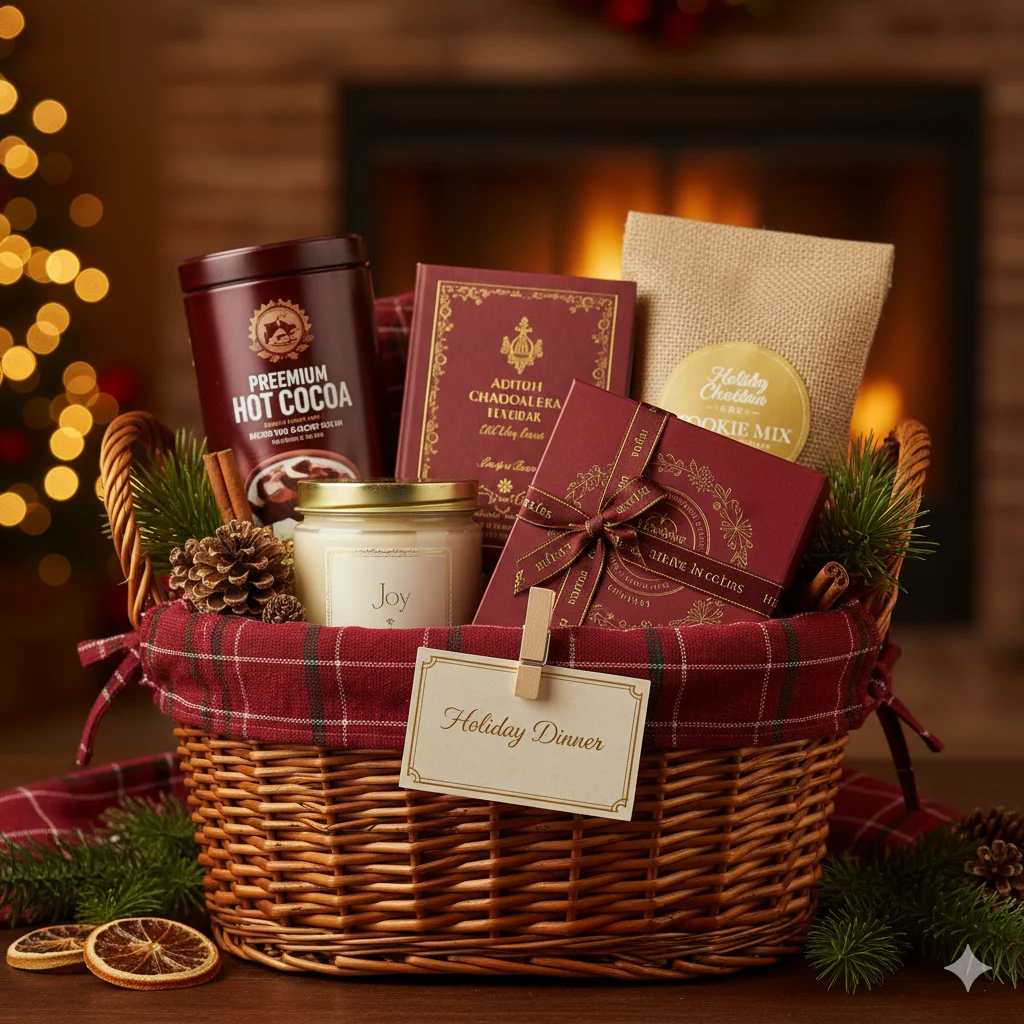
Advent & Holiday Basket
What's Inside
- Restaurant gift card ($50–$75) labeled "Holiday Dinner"
- Premium holiday hot cocoa set
- Quality holiday candle (dignified, not kitschy)
- Artisan chocolates in seasonal packaging
- Advent devotional or small seasonal book
Build Cost
~$75–$100
Revenue Range
$500–$1,100
Church timing advantage: November and December are the highest-performing months for church basket raffles because the congregation is already in holiday mode, gift-buying mode, and community-gathering mode simultaneously. A well-built Advent basket at a Christmas dinner or holiday concert isn't just a prize — it becomes a potential gift and a celebration of the season the congregation already cares about. It's the strongest basket of the year in nearly every church that tries it.
How to name baskets for a church audienceThe naming rule is the same as any raffle — name the experience, not the items — but in a church context, experiences that align with community values earn additional purchase motivation. "Sunday Dinner for Four" resonates more than "Italian Food Basket." "Morning Quiet Time" resonates more than "Coffee and Journal Set." "Family Night In" resonates more than "Entertainment Bundle." The words "Sunday," "Family," "Harvest," "Fellowship," and "Community" do real marketing work in a church context because they align the basket with things the congregation already values — not just items they might or might not use.
Church Experience Prizes — The Dinner That Beat the Anchor Basket
A basket of artisan goods is available at a gift store. A restaurant gift card can be bought anywhere. But a private dinner with the senior pastor — a meal prepared and hosted by the person who has baptized your children, presided at your parents' funerals, and spoken to your life for years — cannot be purchased anywhere at any price. That is what makes church experience prizes uniquely powerful.
These prizes cost the church almost nothing to offer. They require a pastor's evening, a volunteer's hospitality, or a deacon's time. The value they generate is disproportionate because scarcity and personal significance combine to create competition that no physical basket can replicate.
From the Raffle Hotline · Church Dinner · "The Dinner with the Pastor Raised More Than Anything Else"
"We almost didn't include it. We thought it might feel awkward. It raised more tickets than our $200 anchor basket."
A fundraising committee chair called after their annual dinner raffle to debrief. They had offered six physical baskets — each well-built and clearly themed — and one experience prize almost as an afterthought: "Dinner for Four with Pastor Michael, hosted at his home." They had worried it might feel presumptuous, or that it would attract awkward competition among long-standing members.
Caller: "The ticket bucket for the pastor's dinner was the fullest table in the room. Some of the families who entered it didn't buy tickets for anything else."
Support: "That's the scarcity effect combined with the personal significance effect. You cannot buy dinner with your pastor anywhere. The people who put tickets in that bucket weren't buying a prize — they were buying the possibility of a memory. That is worth more to most congregation members than any amount of artisan food or gift cards."
Caller: "The families who didn't win were genuinely disappointed. More so than about any of the physical baskets."
Support: "That's how you know the prize was working correctly. The emotional investment was real. If you'd offered three 'Dinner with the Pastor' slots instead of one, you might have captured all of that energy without the disappointment — and more revenue."
Caller: "The pastor was uncomfortable with it going in. Afterward he said it was the best conversation he'd had about why people really give to this church."
They offered three experience prizes the following year: Dinner with the Pastor (2 winners), Reserved Seating for Christmas Eve for a Family of Four, and a Private Communion Service with the pastoral team. Combined experience prize ticket revenue: $1,400 — over a third of total event gross. Total cost to the church: the pastor's time for two evenings.
Church experience prizes work for a reason that is specific to the church context: the relationships within a congregation have genuine, irreplaceable value. A dinner with the pastor is not a perk — it is access to a relationship that cannot be transacted anywhere else. When you offer that access as a raffle prize, you're not cheapening it. You're using the raffle as the delivery mechanism for something the congregation already wants and can't usually ask for directly.
Dinner with the Pastor
Dinner for 2–4 people at the pastor's home or a local restaurant, hosted by the pastor. Coordinate timing and any dietary considerations in advance. Limit to 1–2 slots per year to preserve the scarcity that makes it valuable. Revenue range: $400–$900 per slot. Cost: one evening of pastoral time.Reserved Seating at Christmas Eve or Easter
Prime reserved seating for a family of 4–6 at Christmas Eve or Easter services — the services where seating is most contested. Families who struggle every year to sit together will compete significantly for this. Easy to administer, impossible to buy elsewhere. Revenue range: $300–$700. Cost: four reserved seats and some signage.Private Prayer / Blessing Ceremony
A private prayer session, house blessing, or naming ceremony with the senior pastor. Especially meaningful for new families, new homeowners, or families navigating a transition. The personal ministry component makes this unlike anything commercially available. Revenue range: $250–$600. Cost: one pastoral visit.VIP Parking for One Month
Reserved parking in the most convenient space at the church for one month of Sunday services. Surprisingly competitive, especially at congregations with parking challenges. Simple to offer, administrate, and renew year over year. Revenue range: $200–$450. Cost: one cone and coordination.Song Selection at Service
Winner chooses one hymn or worship song to be sung at a service within the month. Coordinate with music leadership. Members who feel connected to specific hymns — often with personal histories attached — respond strongly to this. Revenue range: $200–$500. Cost: one conversation with the music director.Hosted Potluck with Church Elders
Winners are guests at a potluck dinner hosted by church leadership — deacons, elders, or the pastoral team. For newer families, this is meaningful access. For longtime members, it's an affirmation of their place in the community. Works at almost any congregation size. Revenue range: $300–$650. Cost: an evening of leadership time and modest food.The $1 Ticket Problem — Plain Math and Plain Psychology
This section may feel uncomfortable because $1 tickets feel generous and accessible — and they were, when most church members paid with cash from their wallet. That world has mostly ended. Now most payments happen digitally, and the math has changed in a way that quietly destroys church raffle revenue.
$1 Tickets — The Real Math
Supporter buys 10 tickets online: $10.00
$10.00 paid → $6.20 received
Payment processing fee: 2.9% + $0.30 = $0.59
If platform uses "free" tip model: 17–29% tip prompt
30–40% of buyers abandon checkout
Of buyers who complete: net per completed transaction ≈ $6–$7
Plus: psychologically, $1 invites $3–$5 spending per person.
Bundle Pricing — What Changes
Supporter buys a 10-ticket bundle: $25.00
$25.00 paid → $23.80 received
Same processing fee: 2.9% + $0.30 = $1.03
No tip-prompt if platform is fee-disclosed upfront
Per-person: psychologically invites $20–$40 decision
Same supporter. 4× the contribution.
From the Raffle Hotline · Church Fundraiser · The $1 Ticket Math Conversation
"We always use $1 tickets because we want it to be accessible for everyone in our congregation."
Caller: "We have some families on tight budgets. We don't want to price anyone out."
Support: "We hear this from almost every church. Here's the question: how many tickets does the average family buy at $1 each?"
Caller: "Maybe 5 or 10. Some families buy a strip of 10 for $10."
Support: "So $5–$10 per family is the ceiling under $1 pricing. Now — if you offered a 10-ticket bundle for $25, would your lowest-income families buy it?"
Caller: "...probably not all of them."
Support: "Right. And they wouldn't have to. The $5 single ticket is still there — it's the floor. The $25 bundle is the ceiling. You haven't priced anyone out by adding a higher option. What you've done is give the families who want to give more a way to express that. The family that would have spent $10 on $1 tickets will spend $25 on a bundle when the bundle exists. The family that can only spend $5 still spends $5. You serve both."
Caller: "That feels... obvious now that you say it."
Support: "It is. The $1 ticket structure is an artifact of cash culture and in-person events. It was never designed for digital payments, where processing fees take 30–40 cents per dollar. Most church committees haven't done that math because nobody told them the fees were happening. They just notice the check is smaller than expected."
They switched to $5 single, 3 for $10, 10 for $25 the following year. Raised the baseline ticket price but kept an accessible entry point. Average per-family spend increased from $8 to $24. Total event revenue: $3,800 from $1,100 the prior year. They reported that no family mentioned the pricing change as a barrier — several mentioned the bundles felt like a better deal.
Accessibility is about the floor price, not the only price. A $5 single ticket is accessible. A $5 single ticket with a $25 bundle option is equally accessible — and captures the families who wanted to give more but had no mechanism to do it. Adding a ceiling doesn't raise the floor. It just finally lets the families who've been wanting to give more actually give more.
30–40%
Checkout abandonment rate when digital raffle platforms use tip-prompt pricing at church and community events — versus 1–2% with fixed disclosed fees.Church audiences are particularly sensitive to unexpected checkout prompts because they've already decided how much they want to give. A pre-checked tip of 17–29% appearing at the final payment step — after they've committed to a bundle — creates a "should I donate separately instead?" hesitation that is uniquely damaging in a faith context. Fixed, disclosed platform fees produce 1–2% abandonment. The difference in revenue from that abandonment gap is often larger than the difference from pricing structure changes.
Promotion for Parish Communities — What Works Without Feeling Like a Sales Pitch
Church communities are acutely sensitive to the difference between invitation and pressure. The same communication that feels like a generous opportunity at a community event can feel inappropriate or commercial in a faith context if the tone is wrong. The good news: churches have access to communication channels and trust relationships that make gentle, repeated invitations more effective than aggressive single promotions.
Service Announcements
The most powerful promotion channel in a church context because it carries the implicit endorsement of whoever is speaking. A pastor or worship leader mentioning the raffle with genuine enthusiasm is worth ten email campaigns.Key: announce it at least three consecutive weeks before the event. Mention what the proceeds fund specifically — "to support our [youth program / mission fund / building project]." Include one basket name each week: "This week I want to tell you about the Sunday Dinner basket..."
Bulletin + Weekly Email
The church bulletin and weekly email are read by the most engaged members — exactly the people most likely to participate. Include a basket photo every week in the run-up to the event, not just an announcement.Photos outperform text in bulletin engagement. A small color photo of the "Sunday Dinner for Four" basket beside a two-sentence description converts better than a paragraph of copy about the raffle. If your bulletin is digital, link directly to ticket purchase.
Small Groups + Fellowship Time
The most underused promotion channel in churches. Small group leaders can mention the raffle at their weekly gathering. Fellowship time after service allows committee members to personally invite conversation about the baskets.Personal conversation is the highest-converting channel in any community. A committee member walking up to a couple after service and saying "Have you seen the Harvest basket? I thought of you when I put it together" is more effective than any email. Equip your committee with one talking point per basket.
Church Social Media + Community Groups
Church Facebook pages, community Facebook Groups, and congregation WhatsApp/text chains reach members outside Sunday attendance. Basket photos shared by individual members reach their extended networks organically.Ask committee members to share basket photos from their personal accounts. Tag local businesses who donated. A photo of the "Morning Quiet Time" basket shared by a church member reaches their friends who don't attend — and may bring new donors or new visitors to the event.
Home Visits + Personal Invitations
For older or less tech-connected congregation members, a personal invitation is the most effective — and most appropriate — communication approach. A deacon or committee member who calls or visits to personally invite a family communicates something no email can.This channel is particularly important for high-capacity donors who may not check email regularly. A personal call from the committee chair saying "I wanted to make sure you knew about our fundraiser — I think you'd love the dinner basket" is a dignified, community-appropriate outreach.
Event Invitation Cards
For congregations running the raffle as part of a dinner or special event, physical invitation cards mailed to the full congregation carry a weight that digital communications don't — especially for members who attend infrequently and might not receive digital outreach.A simple postcard with one basket photo, the event date and time, and the cause — mailed two weeks before the event — converts at higher rates with the over-60 congregation demographic than any digital channel. The physical nature of the invitation matches the community's relational culture.
What It Actually Looked Like — $600 to $4,500 with 150 People
Before — Same Parish Annual Dinner
$580
$1 tickets · items on table · one announcement · no bundle option · ~$4/person
→
After — Three Changes
$4,380
bundle pricing · named themed baskets · 3 service announcements + bulletin · ~$29/person
The changes: bundle pricing ($5 single, 3 for $10, 10 for $25), basket names changed from item lists to experience names ("Sunday Dinner for Four," "Morning Quiet Time," "Family Game Night," "Baking & Fellowship," "Fall Harvest"), and the pastor made a 90-second announcement three consecutive weeks before the event explaining what the raffle was, where the money went, and naming a specific basket each week.
No new donors. No larger crowd. The same 150 people who had always been there — and who had always wanted to support the church more than the structure let them.
What the pastor said the following weekHe called the committee chair after the dinner to debrief. He said: "I've been worried we were leaving money on the table for years. The congregation wanted to give. We just weren't making it easy." The raffle had become a moment of genuine community participation rather than an obligation people endured out of loyalty. Several families mentioned it specifically in the following week's fellowship conversation. When a fundraiser feels right for a community, it becomes part of the community's story. That is the real win — the revenue is secondary.
Free Download
Basket Raffle Planning Kit
Includes the 20-theme basket build sheet, the pre-event announcement script template for service use, the ticket pricing calculator, and the 60-day event checklist. Built for church and community fundraising teams.
Download Free →What's inside
✓ Service announcement script template ✓ 20 themed basket build sheets ✓ Ticket pricing calculator ✓ 60-day event checklist ✓ Donor outreach templatesFrequently Asked Questions
Is a basket raffle appropriate for a church fundraiser?
Yes — church basket raffles are among the most common parish and congregation fundraising formats in the country. Catholic parishes, Methodist congregations, Baptist churches, and evangelical communities all run them regularly. The occasional concern about gambling relates to the general concept, but basket raffles are typically distinguished from gambling by their charitable structure: all ticket revenue goes to the church, supporters direct their tickets toward specific prizes, and there is no house advantage. If your specific denomination has guidelines, consult them before planning. Many communities call them "gift basket socials" or "tricky trays" rather than raffles to avoid any concern with the word itself.
What are the best church raffle basket ideas?
The highest-performing church basket categories are community and family baskets ("Sunday Dinner for Four," "Family Game Night"), seasonal baskets aligned with the church calendar (Fall Harvest, Advent, Easter Morning), faith-aligned baskets with a practical anchor ("Morning Quiet Time" with a coffee gift card and devotional journal), food and fellowship baskets (baking, Sunday brunch, coffee and pastry), and church-specific experience prizes that are genuinely unavailable elsewhere (Dinner with the Pastor, Reserved Christmas Eve Seating). Experience prizes consistently outperform physical baskets in church settings because personal relationships with pastoral staff have deep significance that no commercial prize can match.
Should churches use $1 raffle tickets?
No — for two reasons. Mathematically, digital payment processing fees consume 30–40 cents of every $1 ticket sold, reducing net revenue dramatically. Psychologically, $1 tickets invite supporters to buy $3–$5 worth and feel like they've been generous, when the same supporters would often spend $20–$30 with a bundle option. The solution is not to remove accessibility — keep a $5 single ticket — but to add bundle tiers above it: 3 for $10, 10 for $25. This doesn't price anyone out. It gives the families who want to give more a clear way to do so. See the full pricing strategy guide for the detailed analysis.
What church experience prizes work best?
The most effective church experience prizes are: Dinner with the Pastor (dinner for 2–4 at the pastor's home or a restaurant, hosted by the pastor — this consistently earns more tickets than physical baskets), Reserved Seating at Christmas Eve or Easter services (families who struggle to sit together compete fiercely), a Private Prayer or Blessing Ceremony, VIP Parking for One Month, Song Selection at Sunday Service, and a Hosted Fellowship Dinner with church leadership. These cost the church almost nothing but create genuine competition because they are completely unavailable anywhere else. See the full experience prize section above for revenue ranges and administration notes.
How do you make faith-based gift baskets work without feeling like religious obligation?
Pair faith-aligned items with practical, universally appealing anchors. A devotional journal alone doesn't sell tickets. The same journal paired with a local café gift card, premium tea, and chocolates — labeled "Morning Quiet Time" — sells tickets to everyone who wishes they had a better morning routine. The faith item supports an aspiration; the gift card makes it feel like an immediate, practical prize. Faith-aligned items work as supporting items in a basket that has a clear experiential anchor — not as the sole item that must sell the basket on its own.
How do you promote a church raffle without feeling pushy?
Use the invitation frame, not the sales frame. In service announcements: "We'd love for everyone to take a moment to see the baskets after service — each one was built by your fellow parishioners to support [specific program]." In bulletin and email: photos of specific baskets with a two-sentence description and the cause clearly stated. In fellowship conversation: committee members personally telling families about a specific basket they think they'd love. The key distinction is language that assumes goodwill rather than soliciting a transaction. Church communities are generous — they respond to invitations, not pitches. See the full promotion strategy guide.
How much can a church basket raffle raise?
A congregation of 100–200 adults with proper bundle pricing, clear themed baskets, and multiple announcement touchpoints can realistically raise $2,500–$5,000. Smaller congregations of 50–100 with the same structure: $800–$2,000. Churches that have run $1-ticket raffles for years and raised $400–$800 from 150 members are not limited by their congregation's generosity — they are limited by structural decisions. See the case study above: same 150-person congregation, same donated items, different pricing and basket names. Revenue went from $580 to $4,380 in one year.
When is the best time to run a church basket raffle?
Church basket raffles perform best when attached to existing high-attendance events: the annual parish dinner, the fall harvest festival, the Christmas concert or holiday banquet, the spring fundraising gala. The event provides the assembled audience; the raffle provides a structured giving mechanism within it. The church calendar gives you specific timing advantages: Advent and Christmas season (congregation in gift-buying mode, food baskets become potential holiday gifts), harvest season (seasonal baskets resonate), and spring (renewal energy before summer attendance drops). Avoid standalone raffle events without an existing community gathering — the assembly of the congregation at a familiar event is a significant part of what makes church raffles work.
More Basket Ideas for Church and Parish Events
The Guides That Drive the Structural Changes
Basket Raffle Pricing Strategy
The $1 ticket fee math, the bundle pricing psychology shift, and the exact tier structure for church events that serves both low-income families and high-capacity donors. Read the guide →Raffle Promotion Strategy
The 4-phase promotion system adapted for church contexts — service announcement script, bulletin templates, fellowship-time talking points, and the urgency sequence. Read the guide →Why Basket Raffles Fail
The 8 structural failure points. Church events typically have failures #1 (underpayment), #2 ($1 pricing), and #3 (unnamed baskets) compounding simultaneously. Read the guide →Raffle Prize Ideas
The prize clarity rule, experience prize strategy, and the anchor prize concept — all relevant to church fundraising where one experience prize can outperform every physical basket. Read the guide →Basket Donation Sourcing
Scripts for local restaurants, coffee shops, and businesses familiar to the congregation. The marketing-partnership framing that gets local businesses to say yes to a church ask. Read the guide →Basket Raffle Software
For churches running hybrid online + in-person events. The per-basket pool requirement, cash entry support, and the tip-prompt problem that's especially damaging in faith-community contexts. Read the guide →Trusted by nonprofits, parishes, and faith communities