20+ years of raffle support calls · What actually converts browsers to buyers
Raffle Ticket Selling Tips That Actually Increase Sales
Most raffles don't have a traffic problem. People are walking up. Looking. Pausing. And then leaving. That gap — between stopping at the table and buying tickets — is entirely a selling problem. This guide covers exactly what happens in that moment, why silence is the most common (and most expensive) volunteer mistake, and the word-for-word scripts that convert browsers into buyers.
The 3-step selling flow. Objection scripts. Volunteer training. Why pointing matters more than talking.
1 sentenceseparates a $5 sale from a $25 one
5 secwindow before a buyer mentally checks out
#1table mistake: listing prices and waiting
Rovingsellers often outperform table sellers
Quick AnswerMost raffles don't have a traffic problem — they have a selling problem. People walk up, look at the baskets, hesitate, and leave without buying — not because they don't want the prizes, but because nobody guided the decision. The fix is one sentence: "Most people grab the 10 for $25 — it's the best deal and gives you a real shot at the basket you want." That sentence removes decision fatigue, names a popular option, implies social proof, and makes a recommendation without pressure. The buyer doesn't have to figure out what to do. They just have to agree or decline. Most agree. The rest of this guide covers the full system — the 3-step flow, the objection scripts, the power of pointing, and how to train 20 volunteers in 10 minutes.
What Actually Happens at the Table — And Why Silence Costs More Than You Think
Someone walks up to your raffle table. They're not in a hurry — they're at a community event, there's food, there's conversation. They pause in front of the baskets. They look. Maybe they lean in slightly to read a label.
In that moment, they are waiting for one of two things: a reason to buy, or a reason to leave. Silence gives them the reason to leave. They glance around, feel slightly awkward, and drift back to wherever they came from. The volunteer behind the table had no idea a sale just walked away.
This scenario — multiplied by every visitor who paused and left — is where most raffle revenue disappears. Not to bad baskets. Not to wrong pricing. To silence.
What Happens Without Engagement
Buyer walks up. Looks at baskets for 8–12 seconds. Volunteer says nothing — or says "Tickets are $5 each" and waits. Buyer calculates: "Is any of these worth $5 to me?" Feels no particular urgency or direction. Thinks "maybe later." Leaves.
Lost sale. Buyer will not come back.
What Happens With Active Selling
Buyer walks up. Within 5 seconds: "Hey — have you seen the spa basket? It's been really popular tonight, $75 gift card, full robe. Most people are doing the 10 for $25." Buyer thinks "Oh — I know what I want and what it costs." Decision is easy. They buy.
$25 sale. 5 seconds of engagement.
From the Raffle Hotline · Community Event · "A Lot of People Came Up but Not Many Bought"
"We had tons of foot traffic at the basket table. But ticket revenue was about $800 on a 300-person event. I know we left money on the table."
A fundraising committee chair called after a community dinner event. Great turnout, beautifully built baskets, strong promotion before the event. But the conversion from "stopped at the table" to "bought tickets" was low.
Caller: "We had three volunteers at the table. They were there the whole time."
Support: "What were they saying when people walked up?"
Caller: "...I don't know exactly. Probably 'can I help you' or explaining the pricing if someone asked."
Support: "So they were reactive — they waited to be asked. At a raffle table, reactive volunteers produce a fraction of what proactive volunteers produce. Your buyers weren't asking because they didn't know what to ask. They needed a recommendation, not a price list."
Caller: "They were there though. Isn't presence enough?"
Support: "Presence is necessary but not sufficient. A volunteer who stands at the table and waits is furniture. A volunteer who greets every person within 5 feet, points at a specific basket, and says 'most people grab the 10 for $25' is a salesperson. The difference in revenue between those two volunteers, at the same table with the same baskets and same crowd, is significant."
They briefed volunteers with a specific 3-step script for the following event. Same crowd size. Same baskets. Revenue: $3,200. The baskets were identical. The volunteers were different.
The traffic isn't the gap — the conversion is the gap. Three volunteers at a table producing $800 from 300 people is a selling problem, not a basket problem or a promotion problem. Once the volunteers had a specific script and the confidence to use it proactively, the same event produced 4× the revenue. Nothing else changed.
The Most Expensive Thing Volunteers Say — And the One Sentence That Fixes It
The default volunteer response when someone approaches the raffle table is: "Tickets are $5 each." Then they wait. It feels helpful — you've given the buyer the information they need. But what you've actually done is handed them a calculation to perform and walked away from it.
The buyer now has to: assess all the baskets independently, decide which ones they want, figure out the odds, decide how much they're willing to spend, and then initiate the purchase themselves. That is a lot of work for a casual attendee at a community event who was just browsing. Most people will not complete all of those steps. They'll feel vaguely overwhelmed, say "thanks," and walk away.
The Switch That Changes Everything
"Tickets are $5 each. We also have 3 for $10 and 10 for $25 if you want more."
"Most people grab the 10 for $25 — it's the best deal and gives you a real shot at the baskets you want."
The second sentence does four things simultaneously: names a popular choice (social proof), implies others have already decided this is worth it (validation), communicates value ("best deal"), and frames the purchase as a means to an end rather than a transaction. The buyer doesn't have to evaluate the pricing tiers — they've been told what most people do. That's the only information most buyers need to act.
$5 → $25
Typical average order shift when volunteers recommend a specific bundle vs. list all pricing options — same table, same event, same baskets.This is the selling equivalent of bundle pricing: the structure exists, but it only captures revenue when someone actively directs buyers toward the better option. A volunteer who says "most people do the 10 for $25" will consistently produce 3–4× the average order of a volunteer who says "tickets are $5 each." The buyers are identical. The recommendation is the variable.
The 3-Step Selling Flow — Use This Every Time Someone Approaches
Every successful raffle table interaction follows the same three steps. The sequence matters: acknowledge first, point second, recommend third. Skipping straight to the recommendation feels pushy. Acknowledging without pointing leaves the buyer without direction. All three together create a natural, low-pressure conversation that ends in a purchase decision most buyers are happy to make.
1
Step One · The Acknowledge
Open with engagement — not a question that invites "no"
What to say"Hey — have you had a chance to look at the baskets yet?" · "Have you seen this one?" · "Are you a spa person? This one's been really popular."
The opener does two things: it signals that you're available and engaged (not guarding a table), and it opens a conversation rather than a transaction. "Can I help you?" invites "no thanks, just looking." "Have you seen this one?" is a genuine conversational hook. The buyer's natural response is to look at whatever you're pointing at — which moves them into step 2.
2
Step Two · The Point
Pick ONE basket and tell its story — don't tour the table
What to say"This one's been really popular tonight — it's a full spa day, $75 gift card, robe included. People have been coming back to this one." · "The game night basket is great if you have kids — it's got Catan, a pizza gift card, and popcorn. My own family would love it."
The physical point focuses attention. Without it, the buyer's gaze scans the whole table and gets overwhelmed. With it, they're looking at exactly what you want them to consider. The basket story — specific prize, specific contents, specific reason it's worth winning — does the selling. You're not listing items; you're describing an experience. The "people have been coming back to this one" line is social proof without exaggeration.
3
Step Three · The Bundle Recommendation
Name the popular choice — don't ask what they want to spend
What to say"Most people are grabbing the 10 for $25 — it gives you a real shot at what you want." · "The bundle deal is 10 for $25 — that's what most people go for tonight."
Never ask "how many tickets would you like?" — that question requires the buyer to make a financial commitment without guidance, which creates hesitation. Instead, name the popular option. The phrase "most people" is powerful: it tells the buyer there's a social norm, that they won't be the only one spending this amount, and that this is a reasonable and popular choice. The buyer's job is now simply to agree with what most people are doing.
The complete 3-step in one exchangeVolunteer: "Hey — have you had a chance to see this one yet?" [points at spa basket] "It's been the most popular basket tonight — there's a $75 massage gift card in there, a full robe, candles. People are really competing for it." [brief pause] "Most people are grabbing the 10 for $25 — gives you a real shot at it."
Total speaking time: about 15 seconds. No pressure. No hard sell. Just acknowledgment, a specific story, and a recommendation. The buyer now knows what to want, why it's worth wanting, and how much most people are investing to win it. Everything they need to say yes.
The Power of Pointing — Why It Works and How to Use It
Physically pointing at a basket sounds obvious until you watch what happens without it. A volunteer who says "have you seen the spa basket?" while gesturing vaguely toward the table produces a different result than a volunteer who walks to the basket, stands beside it, and points directly at the gift card clipped to the front. The physical gesture does three things simultaneously.
First, it focuses attention. Without the point, the buyer's eyes scan the full table and get slightly overwhelmed. With it, they look at exactly what the volunteer wants them to consider. Their visual attention is now on a specific basket rather than on the general concept of "raffle."
Second, it makes the recommendation feel personal and deliberate rather than scripted. The volunteer isn't reciting a list of baskets — they're pointing at one specific thing for this specific person. That feels like advice from someone who thinks this basket suits them, not a sales pitch for whichever basket is closest.
Third, it physically repositions the volunteer: from behind the table to beside it, looking at the same thing as the buyer. That shift changes the dynamic from transaction to shared consideration. The volunteer is no longer selling at them — they're looking together at something worth competing for.
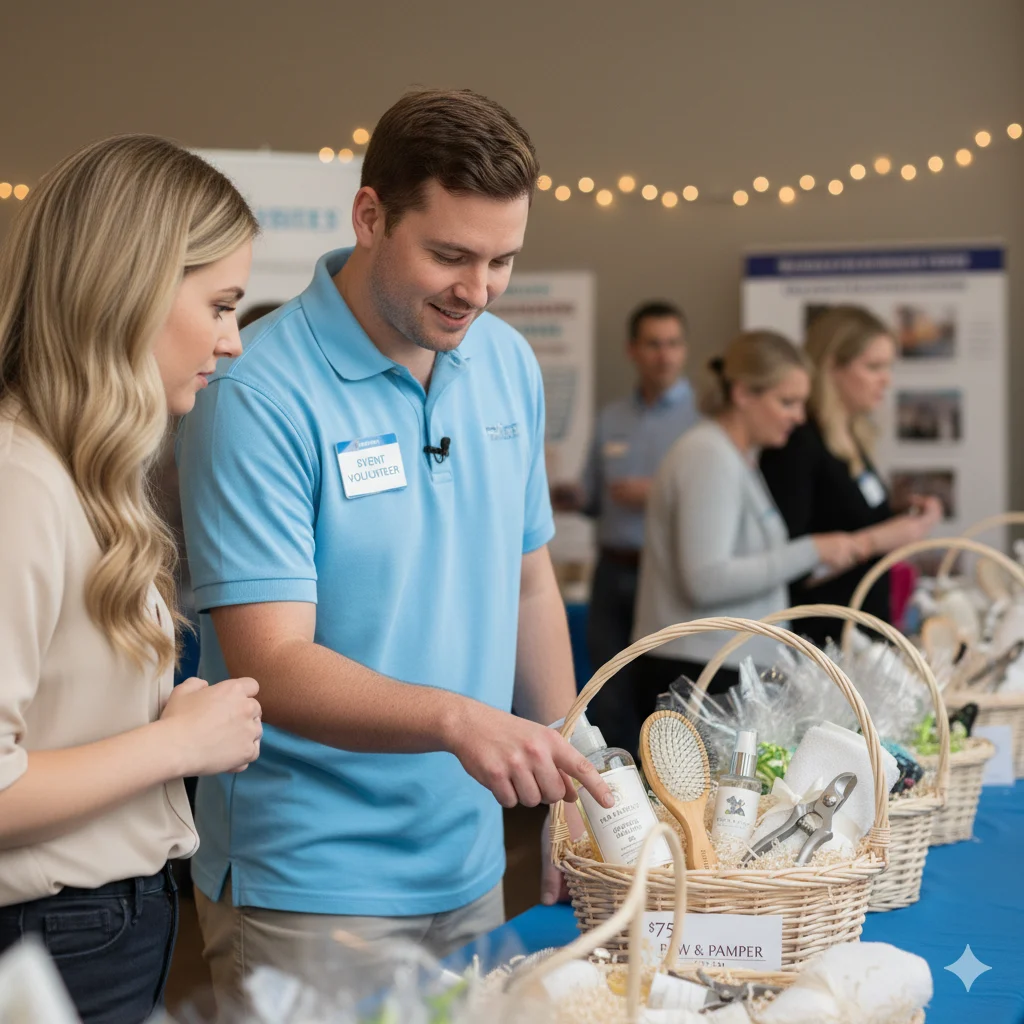
From the Raffle Hotline · School PTA · "We Told Volunteers to Highlight One Basket"
"We gave each volunteer one specific basket to champion. Not the table — one basket. Conversions went up immediately."
Caller: "We had three volunteers. I told each one: you're responsible for that basket. You know everything about it, you tell everyone about it, you point at it."
Support: "What happened?"
Caller: "The conversations got real immediately. Instead of 'here's the table,' each volunteer was having a specific conversation about a specific prize. They were enthusiastic because they knew the basket — they'd helped build it."
Support: "That enthusiasm is exactly what converts. A volunteer who is genuinely excited about a specific basket conveys that authentically. It's not a sales pitch — it's someone who actually thinks this basket is great telling you about it. Buyers can tell the difference."
Caller: "One volunteer who was assigned to the pet basket had a dog. She was telling people about the items like she'd picked each one herself. Her basket sold out fastest."
At their next event, they deliberately matched volunteers to baskets that reflected their own lives — the spa basket to the parent who'd been trying to get a massage for six months, the family game night basket to the parent who hosted game nights. Revenue per basket increased across the board. The baskets were the same. The authenticity of the stories was different.
Focus beats breadth. A volunteer who knows one basket deeply and talks about it enthusiastically will outperform three volunteers who know all the baskets shallowly and talk about none of them specifically. Give each volunteer ownership of a basket — ideally one that reflects something in their own life — and watch the conversations change.
The Scripts That Actually Convert
These are not templates to personalize — they're specific sentences that have been tested across thousands of raffle tables and work because of specific psychological mechanisms. The phrasing matters. "Most people grab..." is different from "You could also get..." and produces different results. Use them verbatim until they feel natural, then adapt the basket-specific details while keeping the sentence structure intact.
Opening Scripts — Getting the Conversation Started
"Can I help you?" or "Are you interested in any of the baskets?"
"Have you had a chance to see this one yet?" [point immediately at a specific basket]
The weak openers invite "no" or "just looking." The strong opener assumes they haven't seen the basket yet (true most of the time) and creates an obligation to look. You've started the interaction without any ask at all.
The Basket Story Script — Make Them Want It
"That one has a spa gift card and some lotion and a candle."
"This one is the spa basket — there's a $75 massage gift card in there, a full plush robe, and a Voluspa candle. It's called 'Spa Day for One.' A lot of people have been coming back to this one."
The weak version lists items. The strong version tells a story: what's in it (specifically, with values), what the experience is (a spa day), and social proof (people keep coming back). The experience name matters — say it. "Spa Day for One" creates the mental picture that converts.
The Bundle Recommendation Script — Closing Without Closing
"How many tickets would you like?" or "We have singles, 3 for $10, and 10 for $25."
"Most people are doing the 10 for $25 tonight — gives you a real shot at the baskets you want."
Never ask how many tickets they want — that forces a cold financial decision. Name the popular option. "Most people" is the most powerful phrase in raffle selling: it removes the awkwardness of committing to a dollar amount by normalizing the choice. They're not spending $25 — they're doing what most people are doing.
The Urgency Script — For the Final Hour
"The drawing is at 9." or "We're closing ticket sales soon."
"Drawing closes at 8:30 — this is your last chance to get in on the spa basket. It doesn't have that many tickets in it yet." [lift or gesture toward the bucket]
Two urgency mechanisms combined: the deadline is specific and imminent, and the visible (or implied) ticket count creates competitive urgency. "It doesn't have that many tickets yet" means the buyer's odds are actually good — which is a buying motivation, not a deterrent. This script is most effective in the last 30–60 minutes of ticket sales.
Objection Handling — What to Say When Buyers Hesitate
Most buyer hesitations at raffle tables are not genuine objections — they are expressions of uncertainty that are asking for help. "I never win these things" is not a declaration of philosophical opposition to raffles. It is someone who wants permission to spend money and needs a reason to believe it's worth trying. Every hesitation below has a specific response that acknowledges the concern and gives the buyer a forward path — without pressure.
"I'm just looking."
What to say
"Perfect — this one's been getting a lot of attention tonight." [point at a specific basket] Then let them look. You haven't pushed. You've given them direction — a specific thing to look at — and the social proof that it's worth looking at. If they continue to engage, resume the script from step 2. If they move on, let them.
This response works because it doesn't contradict or persuade. It simply agrees ("perfect") and adds information. The buyer doesn't feel pressured — they feel helped.
"I never win these things."
What to say
"The pet basket only has about 15 tickets in so far — your odds on this one are actually pretty good tonight." If you don't know the count, use: "Most of the baskets are still pretty open — this early in the evening the odds are good."
This objection is about hopelessness, not cost. Specific information about ticket counts dissolves abstract pessimism. You're not arguing — you're providing facts that change the calculation. If the count is genuinely high, pivot: "This one's popular but that just means it's a good basket. There's still room."
"I don't carry cash."
What to say
"We take cards — you can enter online right here." [show them the QR code or pull up the link on a tablet] If your event has QR codes on the baskets, point to the one on the basket they were looking at: "You can just scan this and you're in."
This was a genuine objection when cash was the only option. With QR codes and digital ticket purchasing, it's now a simple logistical question with a simple answer. Have the answer ready — don't shrug and say "we're cash only."
"It's a little expensive."
What to say
"We've got single tickets at $5 too — even a couple of tickets gets you in the drawing." Lower the floor without abandoning the bundle. Then: "But honestly, the 10 for $25 is what most people go for — the odds are just better when you have more tickets on a basket you really want."
Never argue with a cost objection. Acknowledge it, offer the floor price, and then give them a reason the bundle is actually the better value anyway. Most buyers who say "it's expensive" are negotiating their own internal hesitation — they often end up buying the bundle anyway once they have permission to spend less.
"Let me think about it / I'll come back."
What to say
"Drawing closes at [specific time] — so just come find me before then and I'll take care of you." Hand them a physical reminder card or show them where to purchase digitally. Don't follow them. Don't pressure. But create a specific callback: the drawing closes at a real time.
"I'll come back" is almost never true without a deadline. By giving them the specific closing time, you've turned a vague intention into a decision with a real expiration. Some will come back. Many who would have forgotten entirely will now check their watch at 8:15 and make a decision.
"My partner decides / I have to ask my spouse."
What to say
"Totally — they should come see it. Which one were you looking at? I'll save you the spot." If their partner isn't present: "The game night basket would actually be perfect for both of you — you could decide together and I can take care of you right here."
This is often a social permission-seeking response, not a genuine veto. Inviting the partner in makes it feel collaborative rather than unilateral. For absent partners, the gentle framing of "you could decide together" allows the buyer to take ownership of the decision.
The Roving Seller — The Highest-Converting Role Nobody Uses
What a roving seller does — and why they often outperform table sellers
The table seller waits for buyers to approach. The roving seller finds buyers who would never approach on their own. At any community event, a significant percentage of potential buyers are in the room and interested in the raffle — but they haven't walked to the table yet. They're in conversation with someone, they're eating, they're watching the room. They will not visit the table unless someone brings the table to them. A roving seller circulates the room with a simple opening: "Have you had a chance to see the baskets yet?" If yes: "Which one were you looking at? The spa basket still has room." If no: "Come with me for two minutes — I'll show you the one I think you'd love." The personal invitation to walk with them to the table converts at significantly higher rates than a solo buyer deciding to approach independently. The roving seller has already made the introduction.From the Raffle Hotline · Church Fundraiser · "We Had Too Many Volunteers and Low Sales"
"We had six people helping at the raffle. Revenue was $900. How does that happen?"
Caller: "Six volunteers, beautiful baskets, decent crowd. And we raised $900. I'm at a loss."
Support: "What were the six volunteers doing during the event?"
Caller: "Standing at the table. Talking to each other occasionally. Helping when someone came up."
Support: "Six people staffing a table and waiting is not selling. It's standing near products and hoping. How many of them were actively leaving the table to approach people who hadn't come over?"
Caller: "None. We thought the table was where we needed to be."
Support: "With 150 people in a fellowship hall, half of your potential buyers will never approach the table on their own. They need to be invited. Two active roving sellers circulating the room would have generated more revenue than all six people standing at the table."
They restructured: two volunteers stayed at the table with a clear script, two roved the room making personal invitations, two built the ticket buckets and handled logistics. Revenue at the same event the following year: $3,400. They had one fewer volunteer than before. The structure was the change, not the headcount.
Activity isn't effectiveness. Six passive volunteers produce less revenue than two active ones. The most valuable volunteer role at a basket raffle isn't "table guard" — it's the person circulating the room, having conversations, making personal recommendations, and physically walking interested buyers back to the table. Give at least one or two volunteers the specific roving role and the permission to approach anyone in the room.
The 10-Minute Volunteer Briefing — What to Cover Before the First Buyer Arrives
Most raffle committees spend zero time briefing volunteers on selling. They show them the table, explain which bucket goes with which basket, and turn them loose. The result is six people who know what the prizes are but have no idea what to say about them. A 10-minute briefing before the event covers the only four things volunteers need to perform at a high level.
1
The 3-Step Script — Teach It Verbatim
Walk through the acknowledge–point–recommend sequence once out loud. Then role-play it once with two volunteers facing each other — one playing buyer, one playing seller. One run-through is enough to make the words feel natural. Volunteers who feel awkward saying something for the first time will go silent in the field. Volunteers who have said it once already will find it easy.2
Assign Each Volunteer One Basket to Champion
Tell each volunteer: "You own this basket tonight. You know everything about it, you point everyone who comes near it toward it first, and you tell its story with genuine enthusiasm." Matching volunteers to baskets that reflect their own lives — pet owners to the pet basket, coffee drinkers to the coffee basket — produces authentic stories instead of recitations. Authentic enthusiasm converts; recitation doesn't.3
Designate 1–2 Roving Sellers — Give Them Permission to Approach Anyone
Name specific people as roving sellers and explicitly tell them: "Your job is to circulate the room and personally invite people to the basket table. You are allowed — actually expected — to walk up to anyone at this event and say 'have you seen the baskets yet?' You're not selling anything; you're inviting." Volunteers don't naturally do this without explicit permission because it feels like intrusion. The permission removes the hesitation.4
Cover the Three Most Common Objections
"I'm just looking" → "Perfect, this one's been popular." "I never win" → "The odds on this basket are actually decent tonight." "Let me think about it" → "Drawing closes at [time] — come find me before then." These three cover 80% of hesitations. Volunteers who know the responses don't freeze when they hear them — they have something confident and natural to say.The one thing that kills volunteer effectiveness more than anything elseUncertainty. A volunteer who isn't sure what to say will default to silence — and silence, at a raffle table, is the most expensive option available. The briefing doesn't have to be long. It has to be specific. Volunteers need to leave the briefing knowing exactly what to say, to whom, and when. If they can answer "what's the first thing you say when someone walks up?" with a specific sentence rather than a shrug, the event will perform differently.
Free Download
Basket Raffle Planning Kit
Includes a printable volunteer selling script card (the 3-step flow + objection responses on one laminated page), the ticket pricing calculator, and the complete 60-day event checklist.
Download Free →What's inside
✓ Printable volunteer script card ✓ Ticket pricing calculator ✓ 3-step selling flow reference ✓ Objection response guide ✓ 60-day event checklistFrequently Asked Questions
What should volunteers say to sell raffle tickets?
The most effective volunteer script has three steps: (1) Acknowledge — "Have you had a chance to see this one yet?" (2) Point to a specific basket and tell its story — "This is the spa basket — $75 massage gift card, full robe, candles. It's been really popular tonight." (3) Recommend a bundle — "Most people are grabbing the 10 for $25 — gives you a real shot at the baskets you want." Never open with "tickets are $5 each" — that puts all the work on the buyer. Name a specific basket, explain why it's worth winning, then name the popular option. Most buyers will simply agree with what most people are doing.
Why aren't people buying raffle tickets even when they stop to look?
When people stop at a raffle table, look, and leave without buying, the most common cause is no engagement from volunteers — buyers are waiting for a reason to buy or a reason to leave, and silence gives them the reason to leave. The second most common cause is decision fatigue: a volunteer who lists all pricing options without recommending one forces the buyer to perform their own financial analysis, which most people won't complete. The fix is active, proactive selling — approaching every visitor within 5 seconds, pointing at a specific basket, and recommending the popular bundle option. See the 3-step selling flow above.
What do you say when someone says they're "just looking"?
Say: "Perfect — this one's been getting a lot of attention tonight." Then point at a specific basket and let them look. This response works because it doesn't contradict or pressure — it agrees with them ("perfect") and adds information (this specific basket is worth looking at). You've given them direction without removing their agency. If they continue to engage, move into the basket story. If they move on, let them go — you've planted the seed without creating discomfort.
How many volunteers do you need at a raffle table?
For a 10–15 basket event: 2–3 table sellers with a clear script, plus 1–2 designated roving sellers who circulate the room making personal invitations. The roving seller role is frequently the highest-converting at any event because they reach buyers who would never approach the table on their own. Six passive volunteers at a table produce less revenue than two active sellers and two rovers. The number matters less than the specific behaviors: greeting, pointing, recommending, and actively circulating.
Does pointing at a basket really make a difference?
Yes — significantly. Physical pointing does three things: focuses buyer attention on one specific basket instead of the entire overwhelming table, makes the recommendation feel personal and deliberate rather than scripted, and physically repositions the volunteer beside the buyer looking at the same thing (shifting the dynamic from transaction to shared consideration). Tables where volunteers actively point at specific baskets consistently outperform tables where volunteers stand behind them waiting. The gesture itself is part of the selling technique.
How do you create urgency at a raffle table without being pushy?
Urgency is specific information, not pressure. The two most effective urgency tools: (1) A specific closing time — "Drawing closes at 8:30" is more compelling than "closing soon" because it creates a real decision point. Use this in the final 45–60 minutes; (2) Ticket count visibility — "This basket only has about 15 tickets in it so far — your odds are actually good" converts buyers who had written off their chances. Both are honest information, not manipulation. Real urgency — a real deadline, real visible competition — is the most effective conversion tool in the final hour of any raffle event.
Selling Works Best When the Structure Is Right
A volunteer who nails the 3-step script but is selling single $1 tickets for unnamed baskets will still underperform. And a perfectly structured raffle with bundle pricing and clear basket themes still needs active selling to reach its potential. These guides cover the structure that selling amplifies.
Basket Raffle Pricing Strategy
The bundle structure that makes "most people grab the 10 for $25" actually true. Why the recommendation script only works when the right bundles exist. Read the guide →Raffle Prize Ideas
The basket names and themes that make the story script easy to tell. "Spa Day for One" sells itself; "Gift Basket #4" doesn't. Experience names make selling natural. Read the guide →Raffle Promotion Strategy
Buyers who saw the baskets before the event arrive with pre-formed intent — they've already decided what they want. Promotion makes in-person selling dramatically easier. Read the guide →Why Basket Raffles Fail
The 8 structural failure points — silent volunteers are one. The others (wrong pricing, vague baskets, no urgency) compound the selling problem if left unfixed. Read the guide →Basket Raffle Ideas Hub
The baskets your volunteers need to sell. Clear themes, experience names, and anchor items that make the story script write itself for every basket at your event. Browse all themes →Raffle Case Studies
The real events where selling changes made the difference — including the community event that went from $800 to $3,200 with the same crowd after a volunteer script briefing. Read the case studies →The platform that makes every conversation count