Highest ROI range · $50–$100 build cost · Best per-dollar ticket yield · 8 proven builds
Basket Raffle Ideas Under $100 — The Range That Runs Your Revenue
Most organizers overspend on one anchor basket and underinvest in everything else. That’s the wrong allocation. The $50–$100 range is where most of your ticket revenue actually comes from — not because buyers love mid-range prizes, but because a lineup full of clearly themed, recognizable baskets generates more total ticket competition than a lineup anchored by one impressive basket surrounded by weak ones. Eight builds. The ROI math. The sourcing shortcuts that keep cost under $50 for a $90 basket.
2–4.5×ROI on a $75 basket with bundle pricing at a 200-person event
$35–$50typical org cost when gift card is donated
8–10mid-range baskets in an optimal 12–16 basket lineup
4–6×revenue multiplier from bundle pricing vs. $1 tickets, same baskets
The short versionThe $50–$100 basket is the highest-ROI build in most raffle lineups — not because buyers love mid-range prizes, but because a lineup of eight well-built $75 baskets generates more total ticket competition than a lineup of two $250 baskets surrounded by fillers. The anchor basket matters for promotional pull. The mid-range baskets are where your revenue actually happens. Build both well. Don’t sacrifice the range for the anchor.
Why Mid-Range Outperforms the Anchor on ROI
We’ve seen this pattern across thousands of basket raffle events on the Chance2Win platform. The organizer builds one extraordinary anchor basket — $250 in items, beautiful presentation, really impressive — and surrounds it with twelve underfunded baskets that weren’t given the same attention. The anchor generates great tickets. Everything else underperforms. Total event revenue looks disappointing relative to the effort.
The math tells the story clearly. The anchor basket represents 30–40% of total basket budget and generates maybe 20–25% of total ticket revenue. The mid-range baskets, built at $50–$100 each with donated gift card anchors, represent 50% of budget and generate 60–70% of revenue. Budget reallocation toward the mid-range — eight strong $75 baskets instead of two strong $250 baskets — consistently produces better total events.
This isn’t an argument against anchor baskets. A strong anchor serves a real function: it’s your lead social post, your event-night draw, your biggest single ticket pool. Keep one. Build it well. Then make sure the rest of your lineup gets the same level of attention, not the leftovers.
Budget Range
$25–$50
org cost
Est. basket value$45–$65
Typical ticket revenue$80–$150
ROI on org cost2–5×
Ticket desirabilityGood
Best ROI
Mid-Range
$50–$100
org cost
Est. basket value$80–$130
Typical ticket revenue$150–$350
ROI on org cost2–4.5×
Ticket desirabilityVery High
Anchor / Premium
$150–$300
org cost
Est. basket value$200–$400
Typical ticket revenue$350–$700
ROI on org cost1.5–2.5×
Ticket desirabilityHigh aspiration, lower allocation
The counterintuitive column is the anchor basket: higher desirability, lower ROI. Why? Buyers allocate fewer tickets to baskets where winning feels unlikely. A $250 basket at a $25-entry event feels like a long shot. A $75 basket at the same entry price feels winnable. Buyers who feel they can win put more tickets in. The psychology of achievability matters more than the psychology of desire when it comes to actual ticket allocation.
4–6×
More per-basket revenue from the same $75 basket under bundle pricing vs. $1 tickets.The pricing structure is the biggest variable in mid-range basket performance — bigger than the basket contents, the event size, or the audience type. A $75 basket priced with $1 single tickets at a 200-person event earns roughly $80–$120. The same basket under a 10-for-$25 bundle structure earns $250–$400. This isn’t a small optimization — it’s the single highest-leverage change available to any organizer. See the pricing strategy guide for the full mechanism.
From the Raffle Hotline · Hospital Auxiliary · “We Built an Amazing Anchor and the Event Still Underperformed”
“Our committee spent three weeks building the centerpiece basket. It was genuinely stunning — probably $400 in items, beautiful presentation, a $150 restaurant experience included. It generated the most tickets of anything on the table. And we still raised less than we expected. I don’t understand how that’s possible.”
Us: “How many baskets were in the lineup total?”
Caller: “Sixteen. But the anchor basket was really the centerpiece.”
Us: “Walk me through the other fifteen. What were the estimated values?”
Caller: “They ranged. Some were $40, some $60. We had a few nice ones around $80. Most were donated baskets that came in as-is.”
Us: “Did the donated baskets have a visible gift card or experience anchor?”
Caller: “No, they were product collections. You know — spa products, gourmet foods. Good stuff but no gift card.”
Us: “So your lineup had one exceptional basket and fifteen product collections. Your anchor drew tickets from buyers who wanted the best thing in the room. Your other fifteen baskets didn’t communicate their value clearly, so buyers who weren’t competing for the anchor simply didn’t engage. You had one basket doing its job and fifteen baskets leaving money on the table.”
Rebuilt their next event’s lineup: kept the anchor, added gift card anchors to ten of the fifteen remaining baskets by making five in-person donation calls to local businesses. Result: the anchor generated similar tickets to the prior year. The other baskets together generated 3.4× what they’d produced before. Total event revenue jumped 68% with the same crowd size and the same anchor investment.
The anchor basket is your headline. The mid-range baskets are your revenue. One exceptional basket and fifteen unclear ones is a bad lineup. One exceptional basket and ten clear, well-anchored mid-range baskets is how you hit real numbers. The work is in the fifteen, not the one.
The 8 Mid-Range Builds That Run Consistent Ticket Revenue
Each build below lists the anchor item, supporting fills, org cost with a donated gift card versus a purchased one, and the specific reason it generates competitive ticket allocation. The donated gift card scenario assumes you make the in-person ask described in the sourcing section below — 35–45% of local businesses say yes immediately.
 Top Seller
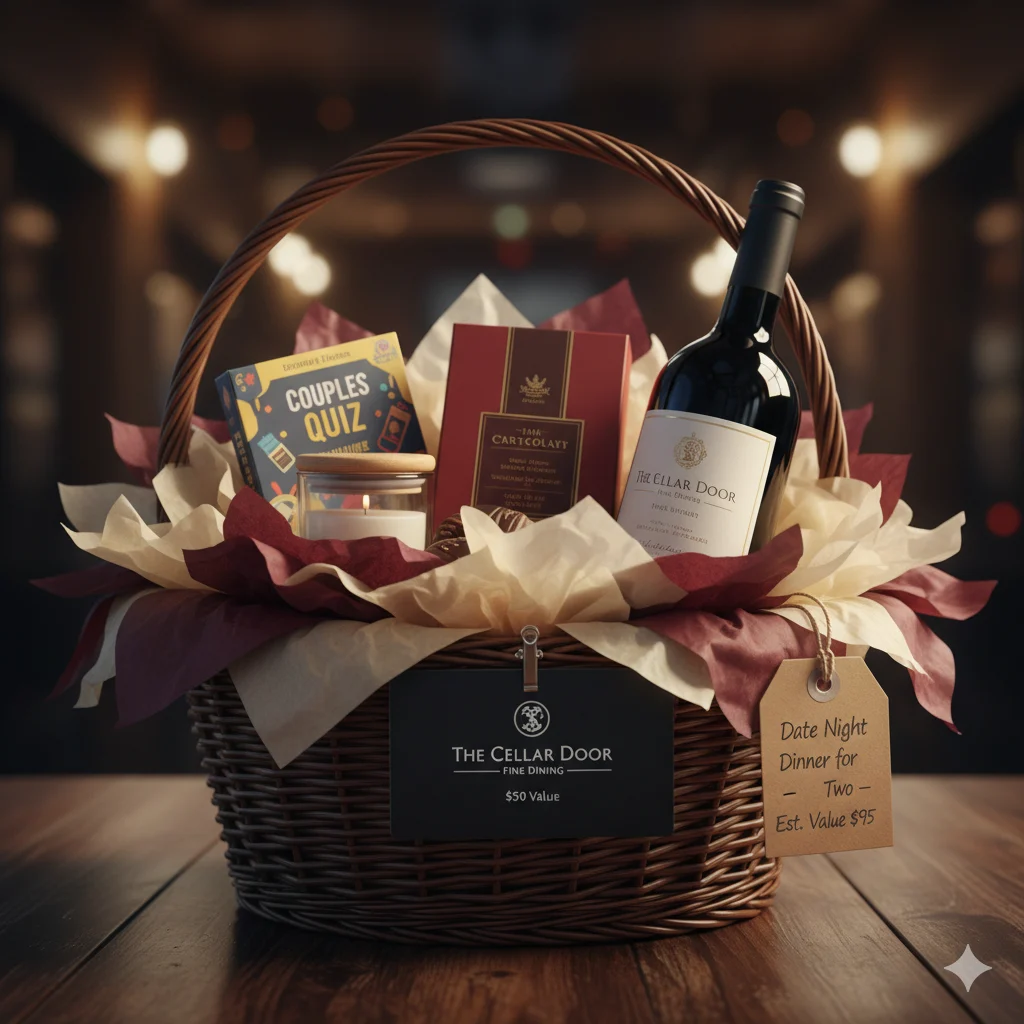
Date Night Dinner for Two
What’s Inside- $50–$60 local restaurant gift card (donated or purchased)
- Bottle of wine ($15–$20)
- Box of quality chocolates ($8–$12)
- Candle — warm scent ($8–$12)
- Card game for two (optional, adds depth)
The dinner gift card communicates the entire experience in four words: “dinner for two at [restaurant everyone knows].” Nobody has to read the other items to know if they want it. The wine and chocolates are obvious — they support the evening picture without needing explanation. This basket generates competitive allocation because buyers picture themselves using it specifically, not generically.
 Best ROI
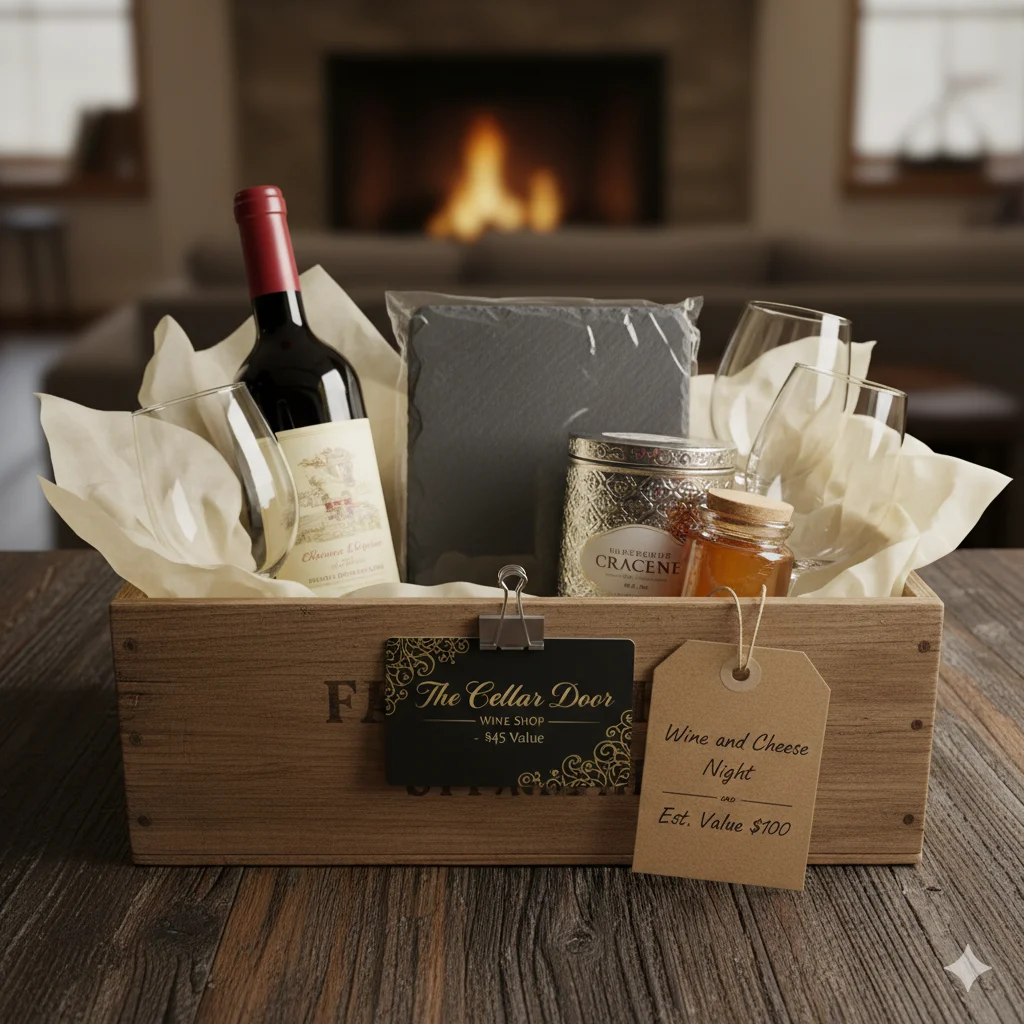
Wine and Cheese Night
What’s Inside- $40–$50 local wine shop gift card (donated)
- One premium wine bottle ($18–$22)
- Slate charcuterie board (HomeGoods, $12–$18)
- Artisan crackers and local honey ($8–$12)
- Two wine glasses (optional — adds perceived value)
Wine baskets are statistically the most competitive basket category we track. The combination of a local wine shop gift card and one good bottle creates an immediate, specific evening picture. The charcuterie board is the visual hero on the table — it photographs well and signals sophistication without pushing total cost above $55 with a donated gift card.
 Women’s #1
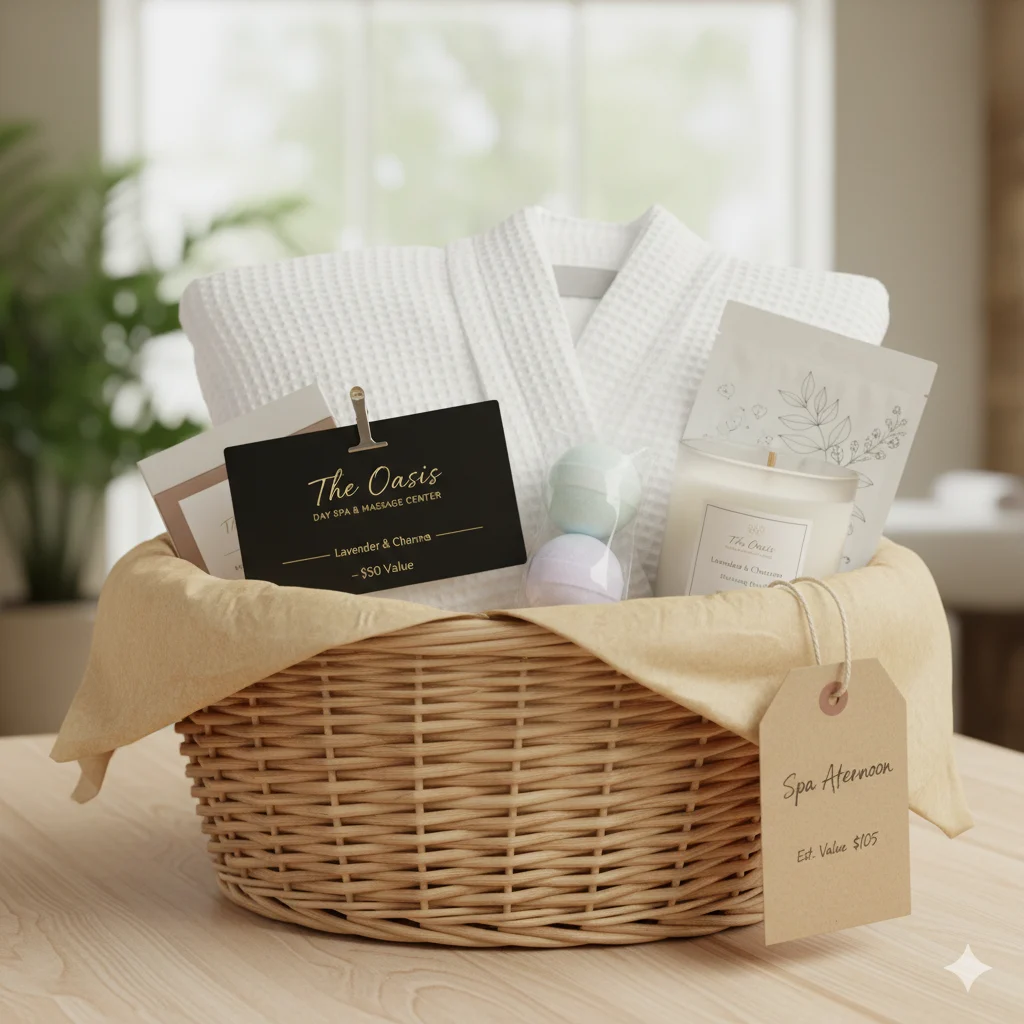
Spa Afternoon
What’s Inside- $50–$60 day spa or massage center gift card
- Waffle-knit robe or plush throw (HomeGoods, $18–$25)
- Premium candle — eucalyptus or citrus ($12–$16)
- Bath bomb set ($8–$12)
- Quality face mask two-pack ($5–$8)
Spa baskets perform above their price point because the psychological framing is “I deserve this” rather than “I want this.” That framing drives ticket allocation harder than desire alone. The robe is the visual hero — it signals luxury before a buyer reads the gift card. At mid-range, the key is not adding more products but making the existing five look intentional and premium.
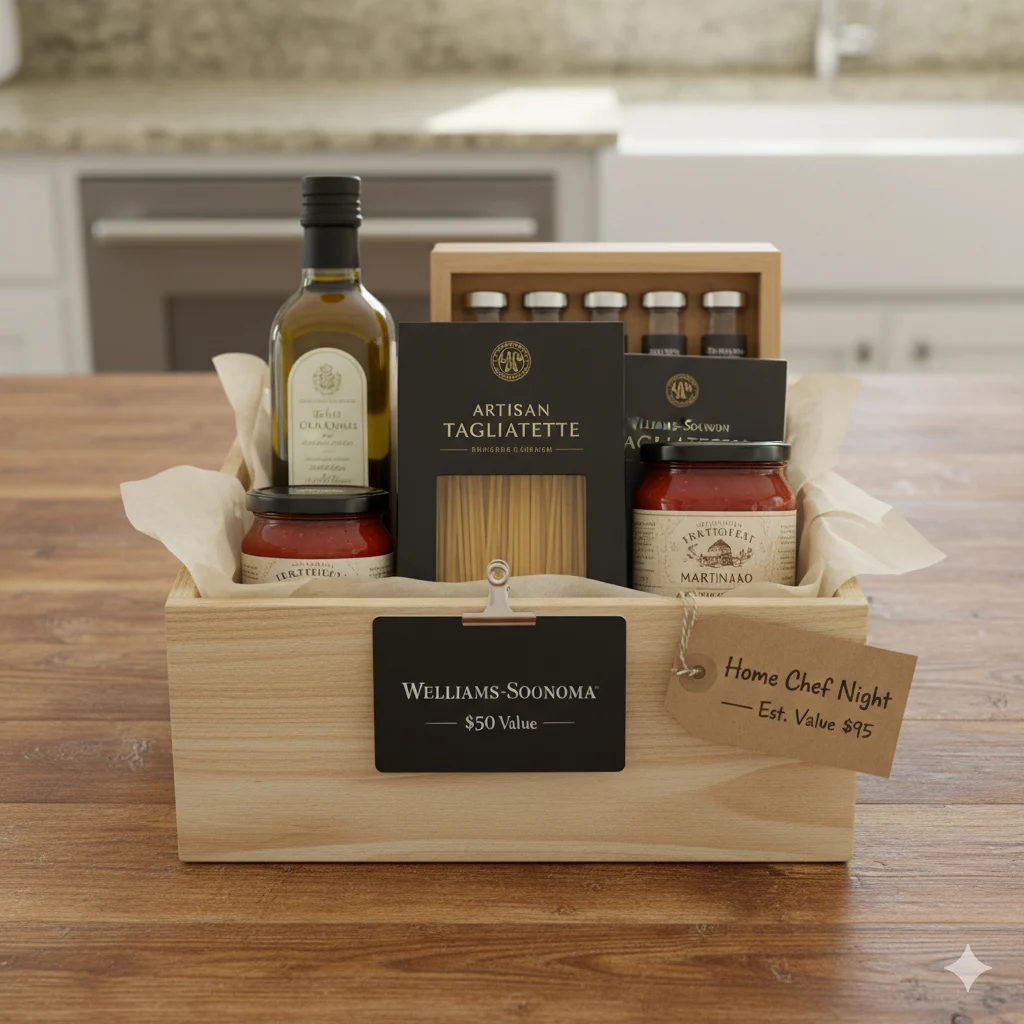
Home Chef Night
What’s Inside- $45–$55 specialty food or cooking store gift card
- Premium artisan pasta ($8–$12, specialty food store)
- Quality extra virgin olive oil ($12–$16)
- Artisan pasta sauce or jarred specialty item ($8–$10)
- Nice spice set or herb collection ($10–$14)
The “cooking for someone special at home” experience picture resonates across audiences. It positions itself against restaurant dining — “cook a restaurant-quality meal at home.” A specialty food store gift card is easy to source donated; these retailers value the association with community fundraising and tend to donate immediately to in-person asks.
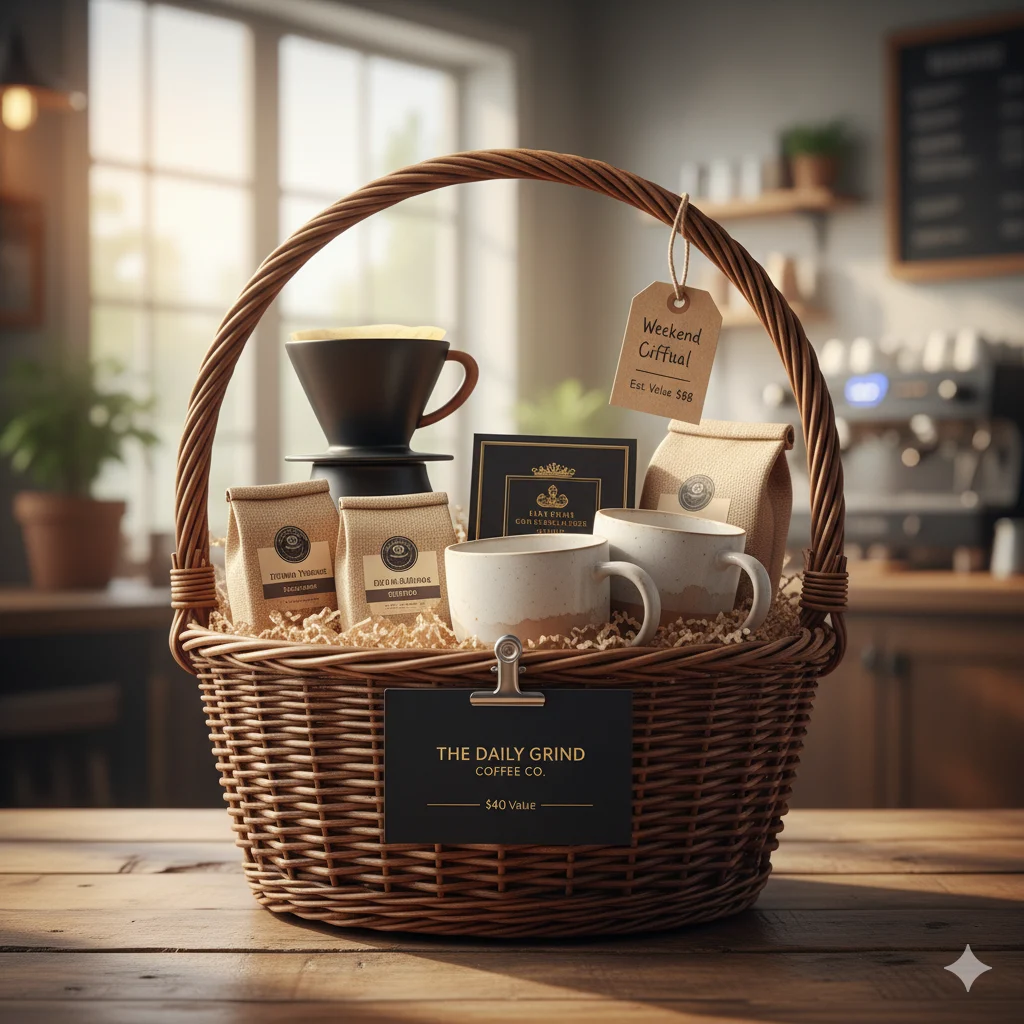
Weekend Coffee Ritual
What’s Inside- $40–$50 local coffee shop gift card
- Pour-over dripper or small French press ($18–$24, Target or HomeGoods)
- Two premium whole-bean coffee bags ($10–$16 total)
- Matching ceramic mug set (two mugs, $12–$16)
- Box of artisan chocolates ($8–$10)
This is the mid-range upgrade of the easy coffee basket — the pour-over or French press as the visual hero elevates the perceived value significantly versus just a mug. The experience picture is specifically “slow Saturday morning coffee ritual,” which resonates with anyone who values their weekend mornings. The local coffee shop gift card is the easiest donation ask in any community.
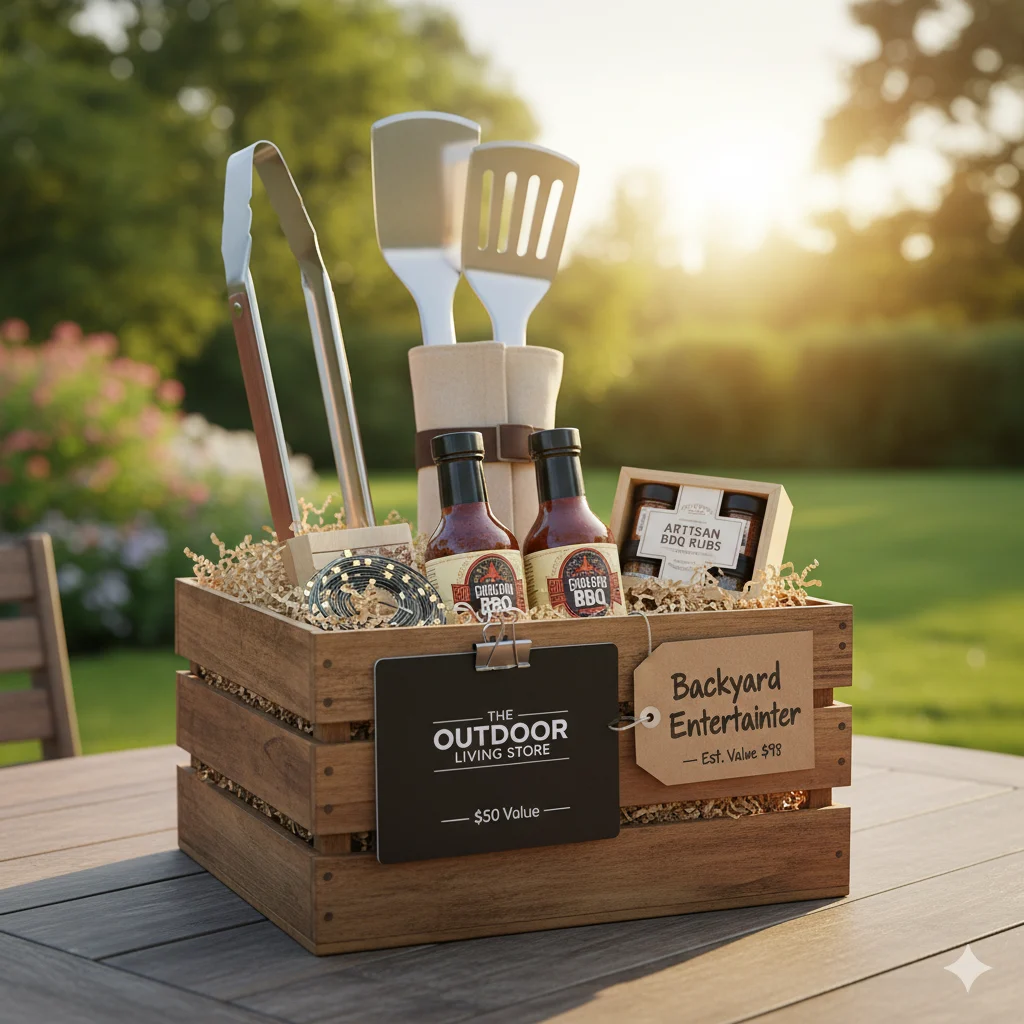
Backyard Entertainer
What’s Inside- $50 outdoor, home, or specialty food store gift card
- Quality BBQ tool set (tongs, spatula, brush — $16–$22)
- Premium BBQ sauce set (2–3 bottles, $12–$16)
- Artisan dry rub or seasoning set ($8–$12)
- Outdoor string lights, small pack ($8–$10, optional)
Underused in most lineups. Outdoor and grilling baskets pull strongly at mixed-gender events because they appeal to a demographic that often feels unserved by spa and date-night builds. The gift card from a recognizable outdoor or home store (Home Depot, Ace, REI) is easy to source. The BBQ tool set is the visual anchor that communicates the experience at a glance.
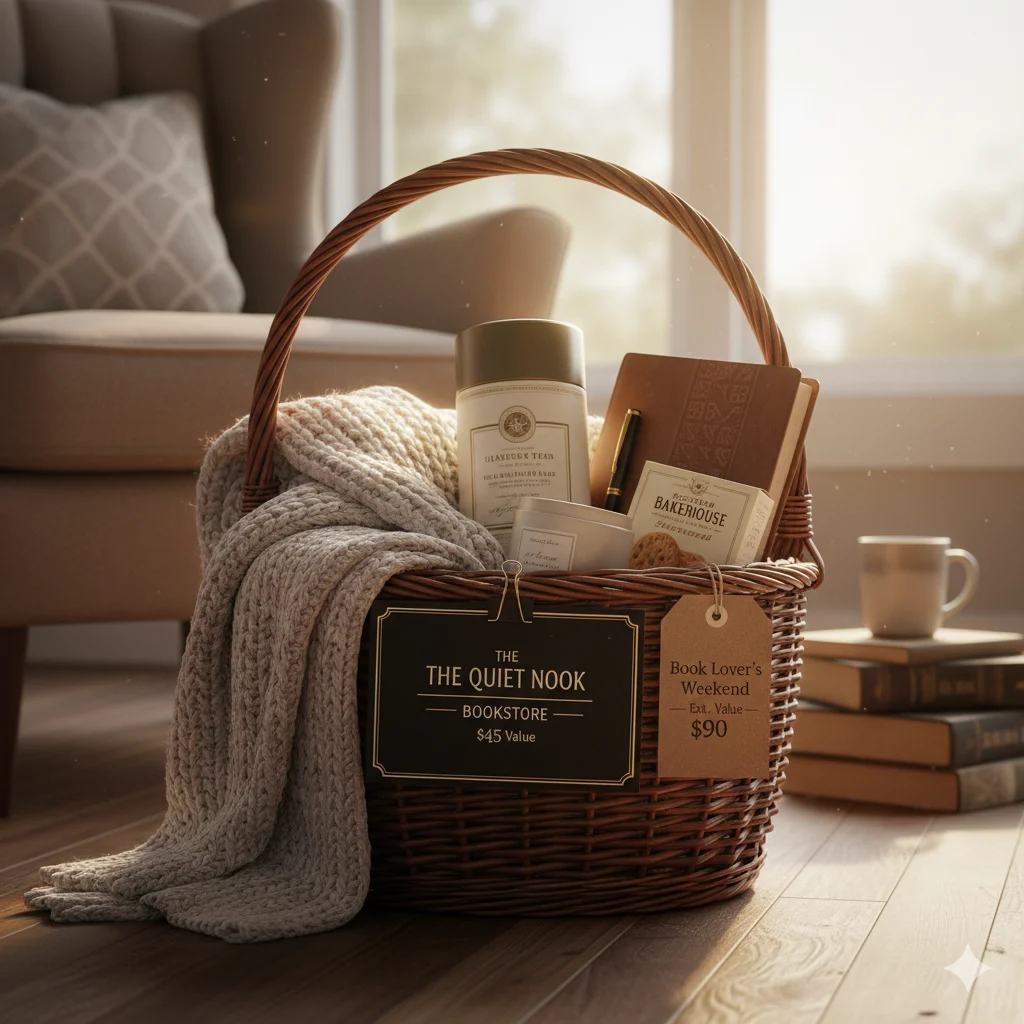
Book Lover’s Weekend
What’s Inside- $40–$50 local bookstore gift card (donated — local indie booksellers are enthusiastic donors)
- Lightweight throw blanket (HomeGoods, $16–$22)
- Premium tea variety tin ($10–$14)
- Nice journal or reading journal ($8–$12)
- Box of shortbread or fine cookies ($6–$9)
Readers are some of the most competitive raffle buyers we observe. The experience picture — “a full weekend morning with a new book, a good blanket, and a hot cup of tea” — is specific enough that the basket sells to a specific identity, not a generic desire. Local independent bookstores are often the most enthusiastic gift card donors you’ll encounter; they value community visibility.
 PTA Favorite
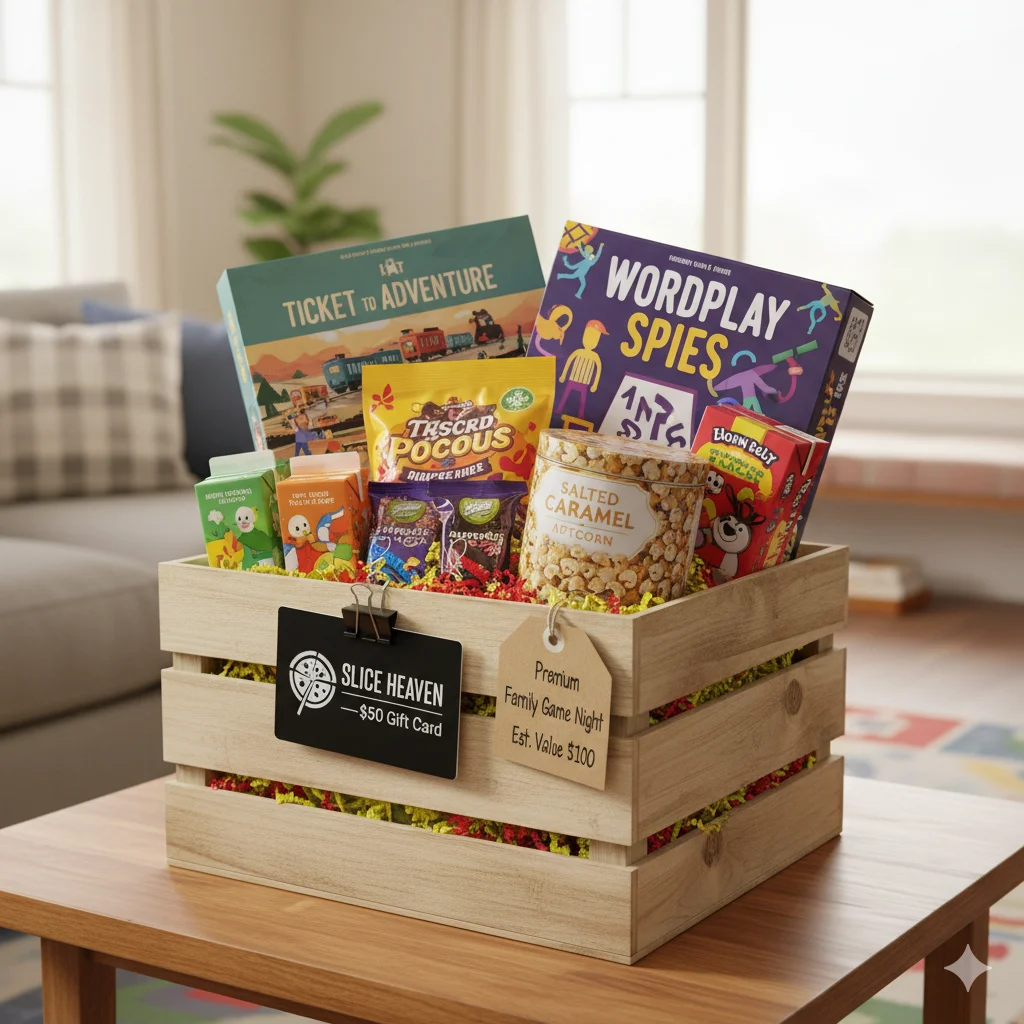
Premium Family Game Night
What’s Inside- $50 local pizza or family restaurant gift card
- Two popular board games ($30–$40 total — Ticket to Ride, Codenames, Exploding Kittens)
- Artisan popcorn tin ($10–$14)
- Family candy assortment ($6–$9)
- Juice box or soda variety pack ($5–$7)
The mid-range upgrade of the family game night: two games instead of one creates visible depth in the crate that photographs extremely well. Parents with kids picture a full Friday night immediately. The pizza gift card is the easiest donation call you’ll make — local pizza places say yes to community fundraiser asks at the highest rate of any business category.
Lineup Strategy — The Right Ratio for Any Event Size
The mid-range baskets should form the backbone of your lineup. The structure that produces the best results across event sizes of 100–500 people is roughly: 60–65% mid-range ($50–$100), 15–20% budget ($25–$50), and 15–20% premium anchor ($150+). Adjust the total count using the attendance-divide-15 formula — divide expected attendance by 15 to get your optimal basket count, then apply the ratio.
At 200 people: 14 baskets total — 9 mid-range, 3 budget, 2 premium. At 100 people: 7 baskets — 4 mid-range, 2 budget, 1 premium. At 400 people: 26–28 baskets, with 17–18 in the mid-range.
The common mistake is running all anchor baskets when the donor community is generous. Twenty strong $150 baskets sounds impressive. But twenty baskets at the same price point creates decision paralysis and reduces competitive ticket allocation per basket. The variety created by mixing budget, mid-range, and anchor levels gives every buyer in the room at least two or three baskets they genuinely want — which maximizes total ticket sales.
❌ Common lineup mistake
One anchor, everything else underfunded
Anchor basket1 × $250 cost
Mid-range3 × $75 cost
Underfunded fillers8 × $30 cost
Total basket budget$715
Typical ticket revenue$1,100–$1,600
ROI on budget1.5–2.2×
✓ Optimal allocation
One anchor, eight strong mid-range, three budget
Anchor basket1 × $175 cost
Mid-range8 × $55 cost
Budget (donated anchors)3 × $20 cost
Total basket budget$675
Typical ticket revenue$2,400–$3,800
ROI on budget3.5–5.6×
From the Raffle Hotline · Church Annual Gala · “We Had the Best Baskets We’ve Ever Built and It Was Our Worst Revenue Year”
“Every single basket in our lineup was beautiful. The committee worked for months. We had four baskets over $200 each. Our event raised $2,100. The year before, with baskets half as nice, we raised $3,400. I genuinely don’t understand.”
Us: “How many baskets total?”
Caller: “Twelve. All premium. We decided to go quality over quantity this year.”
Us: “What was the lowest-priced basket?”
Caller: “About $130 in items. Nothing under that.”
Us: “There’s your problem. You removed the accessible entry points. Not every buyer wants to compete for a $200 basket. Some buyers want a $75 basket — something winnable, something they’d clearly use, something they don’t feel like they’re reaching for. When your entire lineup is premium, you’re only selling to your most committed buyers. Everyone else mentally opts out.”
Caller: “So we actually hurt participation by making everything better?”
Us: “By making everything the same, yes. The variety is the point. Budget buyers need budget baskets. Premium buyers need premium baskets. If you only have one tier, half your audience doesn’t compete.”
Next year: four premium baskets, six mid-range, three budget. Same committee, same venue, comparable crowd. Raised $4,200 — their best year ever — by reintroducing accessible entry points into a lineup that had accidentally become exclusionary.
Premium lineups that remove budget and mid-range baskets consistently underperform mixed lineups. The audience is not uniform. Some buyers will compete hard for a $250 basket. Others will not — but they’d happily put $25 into a $75 basket they’re confident about. Serve both audiences. The mid-range exists to capture revenue from buyers who self-select out of the premium competition.
Sourcing the Mid-Range — The Gift Card Donation Is the Entire Strategy
The difference between a $90 basket that costs your organization $85 and a $90 basket that costs $45 is one in-person conversation. A donated $50 gift card from a local restaurant is worth $50 in basket value at $0 in organizational cost. Four minutes, one conversation, 35–45% success rate. The rest of the basket — $35–$40 in fill items from HomeGoods, TJ Maxx, and a Costco chocolate run — is straightforward.
Highest yield donation target
Local restaurants (dinner-for-two builds)
Ask for $50–$60 gift card. Frame it as: “Your gift card is the centerpiece of our basket, your name on the label and in all our posts, and the winning family’s first dinner out.” Success rate: 40–50% in-person. Most restaurants say yes without deliberation. The dinner-for-two gift card is the single most purchased item at community events — owners know this.
Best for spa and self-care builds
Day spas and nail salons
Ask for $50 gift card. Same framing. Day spas that have available appointment slots in their schedule donate readily — the gift card either sells them a new client or gets redeemed by someone who becomes a regular. Success rate: 35–45% in-person. Highest-value donation category because a $50 spa gift card is more desirable than $50 of retail products.
Best for wine and culinary builds
Local wine shops and specialty food stores
Ask for $40–$50 gift card. These retailers actively want the association with community fundraising — it positions them as local partners rather than chain alternatives. Independent wine shops are among the most consistently positive donation targets. Success rate: 45–55% in-person. Email follow-up is also strong for this category.
Best fill items per dollar
HomeGoods / TJ Maxx
Premium-branded bath items, candles, throw blankets, kitchen tools, wine accessories, and decorative items at 40–60% off retail. A $14 candle at HomeGoods photographs as a $28 candle. A $22 throw blanket displays as a $40 blanket. Shop the HomeGoods clearance section for additional markdowns on seasonal items. For basket building specifically, HomeGoods is the highest per-dollar fill item source available.
The in-person ask — word for word, under 45 seconds
“Hi — I’m [name] from [organization]. We’re running a community fundraiser for [cause] and I’m building the centerpiece basket for our event. I’d love to feature your restaurant — your gift card front-and-center, your name on the label and in every social post we run before the event, and the family that wins having a specific reason to walk in your door. Would you be willing to donate a $50 gift card? It takes about two minutes to print and goes directly into the hands of a family in the community.”
Go in person during a slow period — mid-afternoon Tuesday through Thursday. Ask for the owner or manager directly. Bring your organization name on a card or letterhead. The $50 ask is one table for a local restaurant. Most owners agree without a second thought. Those who say “let me check with my partner” — follow up by email the same afternoon with your event date and audience size. Close rate on follow-up emails after an in-person conversation: 55–65%.
Pricing the Mid-Range — Variable Entry Costs by Basket Tier
Variable entry costs — different ticket requirements per basket based on its value tier — produce significantly more revenue than flat pricing because they align buyer investment with basket desirability. A buyer who feels the $50 bundle is a reasonable investment for a $75 basket will commit. The same buyer facing $1 tickets toward a $250 basket may put in $5 and feel done.
The structure that works: budget baskets at 1 ticket per entry (standard pricing), mid-range at 3 tickets per entry ($75 entry point), premium anchors at 5 tickets per entry ($125 entry point). Under a 10-for-$25 bundle, this means: $25 buys 10 entries into a budget basket, about 3 entries into a mid-range basket, or 2 entries into the premium anchor. Most buyers allocate across tiers rather than concentrating everything into one basket.
The full mechanism — why variable entry costs produce 35–55% more per-basket revenue than flat pricing — is explained in detail in the pricing strategy guide. The short version: it aligns the “effort” of competing with the “feel” of what you might win.
$10 vs $64
Average bundle spend per person: generic ticketing platform vs. Chance2Win with bundle pricing enabled.Same events, same audiences, same baskets. The platform’s bundle structure accounts for most of the gap — but the variable entry cost feature drives the rest. At 200 people, that $54 difference per person is $10,800. The pricing structure is not a rounding error. It is the event. See the full platform comparison and the pricing strategy guide.
Free Download
Raffle Planning Kit
Basket build checklist, gift card donation scripts, bundle pricing calculator, and the 7-touchpoint promotion calendar — printable PDF, everything in one place.
Download Free →What’s inside
✓ Lineup planning sheet ✓ Donation sourcing scripts ✓ Bundle pricing calculator ✓ Promotion calendar ✓ Revenue diagnosticFrequently Asked Questions
Why do mid-range baskets produce better ROI than expensive anchor baskets?
Three mechanisms: psychological accessibility (a $75 basket feels winnable; a $250 basket feels like a stretch), quantity (eight $75 baskets generate more total competition than two $250 baskets), and sourcing efficiency (donated gift card plus HomeGoods fills = $35–$50 org cost for a $90 basket). The anchor earns more per basket but less per dollar invested. The mid-range earns less per basket but more per dollar — and at most events, you’re optimizing for total revenue, not per-basket maximums.
How many mid-range baskets should a raffle lineup have?
About 60–65% of your total lineup. At 200 people, that’s 8–10 mid-range baskets in a 14-basket lineup (one premium anchor, 8–9 mid-range, 3–4 budget). At 100 people: 4–5 mid-range in a 7-basket lineup. The basket count guide has the full formula for any event size.
What is the minimum spend to build a competitive $100 basket?
$35–$45 with a donated gift card. A donated $50 restaurant or spa gift card plus $35–$40 in fill items from HomeGoods and Costco produces a basket with $90–$100 in estimated value. Without a donated gift card — purchasing the anchor yourself — minimum build cost for a $100 basket is $65–$80 depending on fill item quality. The donation ask is the highest-ROI action available to mid-range basket builders.
Should I label the estimated value on mid-range baskets?
Yes — always. “Est. Value $95” on the label communicates what the basket is worth to buyers who won’t spend time assessing individual items. The gift card dollar amount is what buyers verify first — if the gift card says $50 and the label says est. $95, buyers trust the $95 because the visible anchor supports it. Labels without estimated values leave buyers to guess, and guesses skew low when buyers are in a browsing, not assessing, mode.
Do mid-range baskets perform better online or in-person?
In-person with a 10–14 day online presale is the highest-performing structure. Mid-range baskets need good photography and clear gift card visibility in online listings to compete — a photo where the gift card isn’t legible underperforms by 30–40% versus a photo where the business name and dollar amount are readable. Online pre-sale extends the buying window beyond event night and consistently adds 25–40% to total ticket revenue. See the online raffle guide for the photo system that makes mid-range baskets perform online.
Build the Full System
The platform built for mid-range basket lineups