20+ years of real raffle campaigns · The 4-phase system explained
Raffle Promotion Strategy That Actually Sells Tickets
Most raffles don't fail because nobody wanted the prizes. They fail because nobody saw them enough times to act. This guide breaks down exactly how attention works, why repetition is the mechanism — not spam — and the complete 4-phase promotion system that drives results before, during, and after launch.
Real campaign data. Copy formulas. Channel tactics. The hotline stories behind the strategy.
5×Revenue increase from proper promotion frequency
40–60%Revenue in final 48 hours with urgency
7+Touchpoints before most buyers act
10×Email conversion rate vs. cold social
Quick AnswerA high-performing raffle promotion strategy has four phases and runs across at least three channels. Pre-launch awareness (1–2 weeks before tickets open) builds anticipation before the first impression. Launch day creates initial momentum with a strong visual and a clear purchase link. Mid-campaign basket spotlights and donor recognition sustain visibility when most raffles go quiet. The final push — daily urgency posts and emails in the last 72 hours — generates the 40–60% revenue surge that separates good events from disappointing ones. Most raffles skip phases 1, 3, and 4 entirely. They announce, wait, and wonder why sales were flat.
From the Raffle Hotline · Online Fundraiser · "We Launched But No One Is Buying"
"We launched the raffle two days ago. Almost nobody has bought tickets. Something must be wrong with the platform."
A school PTA called 48 hours after launch, convinced there was a technical problem. Their basket raffle was live, the checkout worked, and the prizes were solid. But tickets were barely moving.
Caller: "We tested checkout ourselves and it works. So why isn't anyone buying?"
Support: "Where did you promote the launch?"
Caller: "We put it on our website and posted on Facebook."
Support: "Your website is not promotion. It is storage. People don't visit your website to check for new raffles — they have to be sent there. The Facebook post reached maybe 8–12% of your page followers organically, most of them once, two days ago. How many of those people do you think remember it right now?"
Caller: "Probably none."
Support: "Right. The raffle is invisible — not broken. Post again today with a basket photo. Send an email to your list tomorrow. Post again the day after. You haven't promoted once too many times. You've promoted once, and once isn't enough."
They ran five more promotional posts and two emails over the following week. Final ticket revenue: $4,200. Their first 48 hours of near-silence had generated $180. The platform was fine. The promotion was the missing variable the entire time.
The most common platform support call we receive is not a technical problem — it is a promotion problem that looks like a technical problem. When a raffle isn't moving tickets, the first question is always: how many times have people seen it? The answer is almost always: not enough.
How Attention Actually Works — And Why Once Is Never Enough
Most organizers think about promotion like an announcement: you say it once, people hear it, some of them act. That mental model is wrong — and understanding why it's wrong is what separates a $1,500 raffle from a $7,000 raffle with the same audience and the same baskets.
Here is what actually happens when you post about your raffle on social media: approximately 8–12% of your followers see the post at all (the organic reach ceiling for most nonprofit pages). Of those, most are scrolling and process it as background information. Some notice it and intend to engage later. A small percentage actually clicks. A smaller percentage actually purchases. The rest need to see it again.
A supporter who buys tickets on day 10 of a two-week campaign might have had this journey: saw the launch post, forgot. Saw the wine basket spotlight three days later, thought about it. Got the midpoint email, clicked but got distracted. Saw the "48 hours remaining" post, clicked again, and bought. That is four touchpoints before a purchase — and that is typical, not unusual.
Minimal Promotion — 1–2 Posts
Supporters reached400
Click to raffle page40
Consider buying12
Purchase tickets4
Revenue at $64/order: ~$256
7-Touchpoint Campaign
Supporters reached2,000
Click to raffle page200
Consider buying60
Purchase tickets20
Revenue at $64/order: ~$1,280
The spam concern that isn'tThe most common objection to posting 7–10 times about a raffle is: "I don't want to bother people." The data does not support this concern. Nonprofit email open rates on raffle communications decline minimally over 5–7 emails compared to 1–2 emails. Social media post reach is already limited to a fraction of your followers — posting more doesn't add annoyance, it adds reach. The people who want to participate need reminders. The people who don't want to participate ignore you whether you post once or ten times. You are not spamming your audience. You are giving your supporters multiple chances to say yes.
From the Raffle Hotline · Church Fundraiser · "We Don't Want to Spam People"
"We've already posted twice. We don't want to come across as pushy."
Caller: "We sent one email and posted twice. We feel like we've said it enough."
Support: "How many people opened the email?"
Caller: "About 22%."
Support: "So 78% of your list didn't open it. Of the 22% who did, maybe a third clicked. You've communicated with roughly 7% of your email list so far. You have 93% of your own audience left to reach. That is not overpromotion. That is the beginning of a campaign."
Caller: "But what if people unsubscribe from the extra emails?"
Support: "People unsubscribe because they don't want to hear from your organization at all — not because you sent three emails instead of one. The people who unsubscribe during a raffle campaign weren't going to buy tickets anyway. The people who might buy need to see the email."
They ran four more emails and posted daily in the final week. Unsubscribe rate over the full campaign: 0.4% — well within normal range. Revenue: $5,800. The prior year's single-email approach: $1,400.
The discomfort with repetition is one of the most expensive instincts in nonprofit fundraising. It protects against a problem that doesn't exist (annoying supporters) while creating a much larger one (raising significantly less money). Your supporters want to support you. Repetition gives them the opportunity to actually do it.
The 4-Phase Raffle Promotion System
Every high-performing raffle campaign follows the same four phases. Most underperforming raffles complete only one of them — Phase 2. Understanding what each phase accomplishes explains why skipping any of them costs money.
Phase 1
Pre-Launch
Days –14 to –1 before tickets open
Goal: Build anticipation before the first buy opportunity
- Mission storytelling post — why this fundraiser matters, who it helps, what the goal is. Establish the cause before you ask for the sale.
- "Coming soon" teaser — "Our biggest raffle lineup ever is launching this Friday. Wait until you see what we have." Creates anticipation without a purchase ask.
- Basket preview — one sneak peek image of an upcoming basket, clearly marked "Preview — tickets open [date]." Generates comments and shares before you even launch.
- Email to list — "Mark your calendar: tickets open [date]." Simple, short, creates the first touchpoint before any purchase friction exists.
Phase 2
Launch
Launch day + first 48 hours
Goal: Create early momentum and establish social proof
- Launch email — send at 9–10am on launch day. Subject line: "Tickets are live — [Top Basket Name] is up for grabs." Photo of the anchor basket, direct purchase link, clear deadline.
- Launch social post — real basket photo, the four-element copy formula (prize + cause + action + deadline), direct link. Pin it to the top of your page.
- Featured basket spotlight #1 — post the highest-value or most emotionally compelling basket as a separate standalone post within the first 24 hours. Two posts on day one is not too many.
- Volunteer share request — message your committee directly: "Please share the raffle post from your personal account today." A personal share reaches a new audience completely. Each committee member who shares extends your reach to their entire network.
Phase 3
Mid-Campaign
Days 3–10 of campaign
Goal: Maintain visibility — this is where most raffles collapse
- One basket spotlight per day (or every other day for smaller events) — each basket gets its own dedicated post with photos, contents listed, estimated value called out, and donor tagged if applicable.
- Donor recognition posts — "Thank you to [Local Business] for donating [item] to our [Basket Name] basket." Tags the business, which shares to their followers. Free reach extension.
- Mission reminder post — mid-campaign, bring it back to why. "Every ticket directly funds [specific program/outcome]. Here's a story about who it helps." Re-activates the cause motivation in buyers who had the promotional message but not the emotional one.
- Progress post (if appropriate) — "We're 60% of the way to our goal. Here's what's still up for grabs." Social proof that others are buying creates permission and urgency for those who haven't.
Phase 4
Final Push
Final 72 hours — do not skip this
Goal: Convert procrastinators — 40–60% of revenue happens here
- 72 hours post + email — "3 days left. These baskets are still up for grabs." Show all baskets in one image. Direct link. The deadline is the headline.
- 48 hours post — spotlight the top 2–3 baskets with "still available" language. Post showing competition: ticket counts if your platform shows them.
- 24 hours email — subject line: "Drawing closes tomorrow at [time]." Short, one basket photo, one sentence, one button. Nothing else. The specific time is the urgency mechanism.
- Morning of closing — final social post — "Today is the last day. Drawing closes tonight at [time]." Share the purchase link on every channel simultaneously.
- 2 hours before close — one final post and text to your committee: "Last call." Optional, but the spike in the final hours can be significant when reminded.
52%
Percentage of total raffle revenue generated in the final 48 hours of a campaign with proper urgency communications in place.This number is not an outlier — it is a behavioral constant across online fundraising. Half your revenue arrives at the end because that is when urgency is real and imminent. Without a deliberate final-push campaign, that surge simply doesn't happen. The 48-hour window is the most important promotion window in the entire campaign. Three posts and two emails over those 48 hours is not optional — it is the mechanism that unlocks the final surge.
The Complete 14-Day Promotion Calendar
This is the minimum viable promotion schedule for a 2-week online basket raffle. Every row is a deliberate communication with a specific purpose. If you skip a row, identify which phase and which buyer group it was designed to reach — then decide consciously whether that revenue gap is acceptable.
| Day | Channel | Content Type | What It Does | Priority |
|---|---|---|---|---|
| Day –7 | Save the date | "Our basket raffle launches next week. Mark your calendar." No ask yet. Just awareness. | Med | |
| Day –5 | Social | Teaser post | One basket preview photo — "Coming Friday." Comments generate organic reach before you even launch. | Med |
| Day –2 | Social | Mission story | Who you're raising money for. One real story. No purchase ask. Plant the emotional reason before the transaction. | Med |
| Day 1 · 9am | Launch email | Tickets are live. Top basket photo. Direct link. Specific deadline. 300 words max. One button. | HIGH | |
| Day 1 · 11am | Social | Launch post | Best basket photo. Copy formula. Direct link. Pin to top of page. Ask committee to share. | HIGH |
| Day 2 | Social | Basket spotlight #1 | Most emotionally compelling basket as a standalone post. Close-up photo. Name + estimated value. Direct link. | HIGH |
| Day 4 | Social | Basket spotlight #2 | Second basket — different demographic target than #1. Dog basket after wine basket, for example. | Med |
| Day 5 | Social | Donor recognition | Thank a local business donor. Tag them. They share to their audience. Free reach extension. | Med |
| Day 6 | Midpoint email | Show all remaining baskets. "Still time to enter." Progress toward goal if applicable. One link. | HIGH | |
| Day 8 | Social | Basket spotlight #3 | Third basket. Different category. Re-engages people who didn't connect with spotlights 1 or 2. | Med |
| Day 10 | Social | Mission reminder | "4 days left. Here's exactly who this fundraiser helps." Reactivates the cause motivation. Direct link. | Med |
| Day 11 | Email + Social | 72-hour warning | "3 days remaining." All baskets shown. Specific closing date + time in every sentence. Begin urgency phase. | HIGH |
| Day 12 | Social | 48-hour spotlight | Top 2–3 remaining baskets. "Still available." Ticket count if platform shows it. Urgency is the headline. | HIGH |
| Day 13 · AM | 24-hour email | Subject: "Drawing closes tomorrow at [time]." One photo. One sentence. One button. Specific time is non-negotiable. | HIGH | |
| Day 14 · AM | Social + Email | Final push | "Last day — drawing closes tonight at [time]." Post on all channels simultaneously. Text committee. | HIGH |
The rows marked HIGH are non-negotiableThe HIGH priority rows — launch email, launch post, basket spotlights 1–2, midpoint email, 72-hour warning, 48-hour spotlight, 24-hour email, and final push — are the minimum viable campaign. If you skip all the MED rows, your campaign will still perform reasonably. If you skip the HIGH rows, you will leave 40–70% of potential revenue on the table. The medium-priority posts extend reach and engage secondary audiences. The high-priority touchpoints are the mechanism that drives purchases.
Channel Strategy — What Each Platform Does Best
Highest Conversion Rate
Email
Your existing email list is your highest-converting channel — people on your list already chose to hear from you. Email converts at 10× the rate of cold social media reach. Send at least three emails per campaign: launch, midpoint, and final push with a specific deadline in the subject line.
- Launch email: 9–10am, basket photo, direct link, one clear CTA button
- Subject line formula: "[Prize Name] is up for grabs — [deadline]"
- Midpoint email: Show all baskets, progress update, one link
- Final email: Deadline in subject line — "Drawing closes tonight at 8pm"
- Keep it short: 300 words max — the photo and button do the work
Best Community Reach
Facebook
Facebook reaches the parent and community adult demographic that attends school, church, and community events. Groups are more effective than Pages — post in local neighborhood groups, school parent groups, and community groups for reach well beyond your existing followers.
- Page posts: Real basket photos only — no generic text graphics
- Pin the launch post so it stays visible for the full campaign
- Facebook Groups: Post in school parent groups, neighborhood groups, local buy/sell groups
- Event page: Create a Facebook Event for in-person events — guests see reminders automatically
- Ask committee to share personal posts — each personal share is a new audience
Visual Engagement
Instagram
Instagram rewards high-quality visual content. Basket photos with good lighting and clear labels perform exceptionally well here. Stories with polls and stickers create direct engagement. Pet basket content is uniquely shareable on Instagram — a great photo of a dog basket can reach audiences far outside your normal following.
- Stories with "link in bio": Update bio link to direct purchase link for the full campaign
- Carousel posts: 3–5 images per basket (full basket, gift card close-up, contents spread)
- Story polls: "Which basket do you want to win? 🍷 or 🧖" — drives engagement and algorithm reach
- Tag local donors: Donor shoutout posts reach their followers too
Highest Purchase Intent
Direct / Personal Outreach
This is the most underused channel in raffle promotion — and the highest-converting one. A personal text or DM converts at 3–5× the rate of a public post because the ask is direct and the relationship is real. Committee members personally reaching out to 10–15 contacts each can double event revenue from a single afternoon of outreach.- Committee text campaign: Each member texts their 10 most likely buyers personally
- Template: "Hey [Name] — our raffle is live! You'd love the [Basket Name]. Here's the link: [URL]. Drawing closes [date]."
- Follow-up texts: One reminder 24 hours before close to anyone who didn't buy
- DMs for engaged followers: Anyone who liked or commented but didn't buy gets a personal DM
In-Person / Hybrid Events
QR Codes + On-Site Promotion
At in-person and hybrid events, frictionless access is the conversion mechanism. A supporter who wants to buy tickets but can't find the link in the moment doesn't buy. QR codes eliminate this entirely — one scan takes them directly to the checkout page with no searching required.- QR code on every basket label — scan to buy tickets for that specific basket
- Signage at every table: Large QR code, "Scan to Enter," basket name visible
- Announcement script: "Tickets for tonight's baskets are available by scanning the QR codes at each display — or text [keyword] to [number] for the direct link."
- Volunteer with tablet at door: Process walk-in cash buyers immediately — don't let a "I'll do it later" become a lost sale
Rapid Response
SMS / Text Marketing
If your organization has a text list or uses a text marketing tool, SMS open rates run 95%+ within 3 minutes of delivery. Text is the fastest channel for time-sensitive urgency — "Drawing closes in 2 hours" performs better as a text than as an email because the open is almost immediate.- Use only for high-urgency moments: Launch, 24-hour warning, day-of closing
- Keep it under 160 characters with a direct link
- Template: "Our basket raffle closes tonight at 8pm! Tickets still available: [URL]"
- Build the list at in-person events: "Text RAFFLE to [number] for the direct link"
Visual Strategy — The Photography That Sells Tickets
The biggest visual mistake in raffle promotion is using a designed graphic instead of a real basket photo. A graphic that says "Win This Spa Basket!" with clip art earns a fraction of the engagement of a real photo of the actual basket with the spa gift card visible and items clearly arranged. Supporters need to see the prize to want the prize.
For online events, basket photography is promotion. Poor photos — dark, cluttered, gift card hidden — are the equivalent of no promotion. A supporter who can't see what they're winning won't buy tickets to find out.
The photo ruleReal photos outperform graphics 2–4× in click-through rate. Real photos of real baskets with visible items and a readable gift card are your highest-converting promotion asset. Take three photos of every basket before the event: full basket, gift card close-up, contents spread on a flat surface. Use all three in campaign posts.
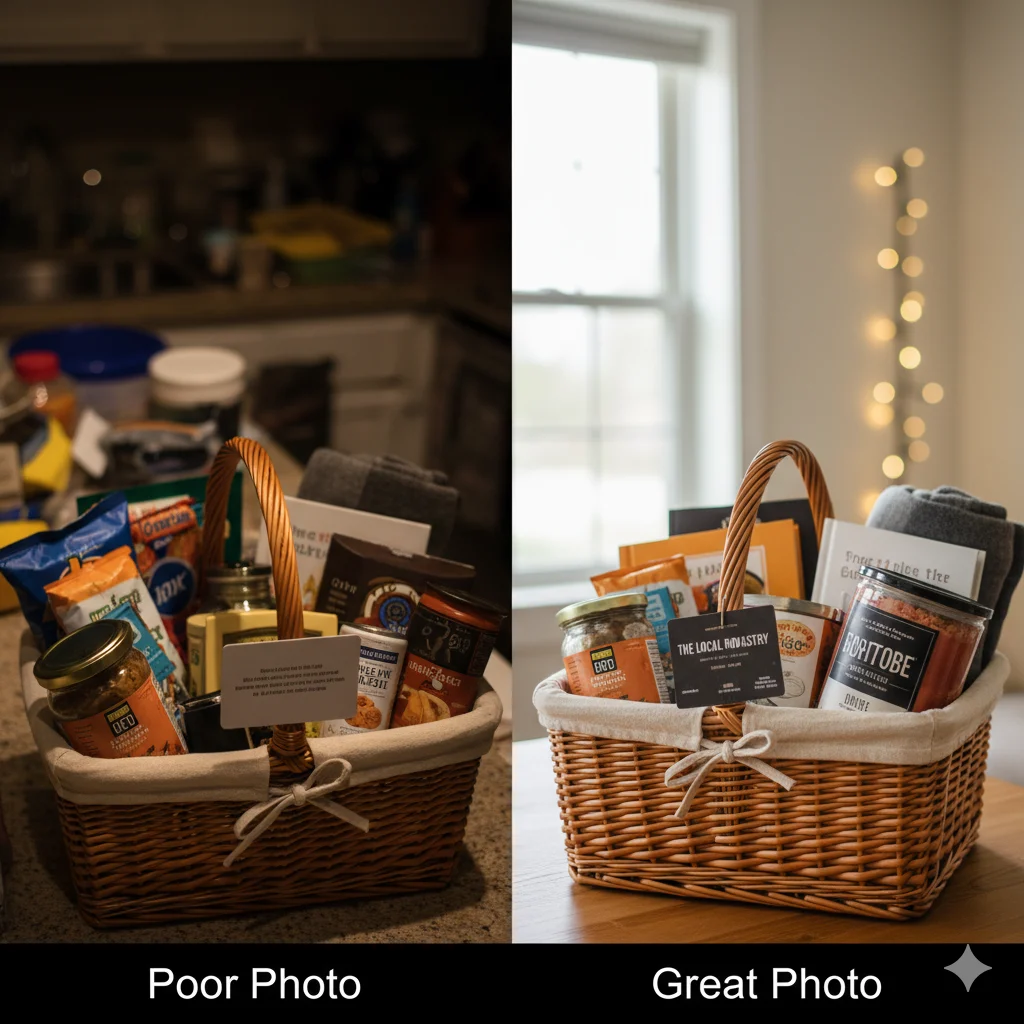
The three photos every basket needs for promotion
-
1The full basket — hero shot. Shot from slightly above and in front at a 45-degree angle. Natural window light from the side. Every item visible, labels facing camera. Gift card clipped to the front at eye level. This is your launch post and featured spotlight photo.
-
2The anchor item close-up. The gift card, premium bottle, or headline item photographed close — label readable, value visible if printed. This is your urgency post photo. "Still time to enter for this [Item]" with the item itself prominent drives more final-push clicks than any full-basket photo.
-
3The contents spread. All items removed from the basket and laid flat on a clean surface — a slate board, a linen cloth, a clean table. This is your carousel post photo #2 or #3. Supporters who can count the items and read each label understand the full value — and higher perceived value equals more tickets.
The Basket Spotlight — How to Keep Momentum Between Launch and Close
The mid-campaign phase is where most raffles collapse. The launch posts did their job — they got initial buyers. Now there's nothing new to say, so nobody posts. Supporters who saw the launch and didn't buy yet have forgotten about it. Sales go flat. The organizer assumes the market has spoken and waits for the drawing.
The basket spotlight technique solves this. Instead of talking about the raffle in general, you feature one specific basket per post — its name, its contents, its estimated value, who donated to it, and why someone would want to win it. This is new information presented about a specific prize, which re-engages supporters who weren't drawn in by the first basket they saw.
Anatomy of a High-Performing Basket Spotlight Post
1
The Photo (required)
Real basket photo. Gift card visible and readable at the front. Multiple images in a carousel if available. If you only have one photo, it better show the most valuable item clearly. No graphics, no clip art, no stock images.2
The Name and Value (first line)
"Up for grabs: The Ultimate Dog Lover Basket — Est. Value $175." Name first. Value second. These are the two things that determine whether someone stops scrolling. The name creates the scene; the value creates the purchase justification.3
What's Inside (2–4 lines)
Name the anchor item first: "Includes a $50 PetSmart gift card, Kong toy bundle, premium Blue Buffalo treats, and a grooming consultation." Name the items specifically — brand names signal quality. Estimated total value is stated after the list.4
The Donor Tag (if applicable)
"Gift card generously donated by @LocalPetStore." Tag the business. They will share it to their own followers — a free audience extension to an audience that is already pre-qualified as local pet owners.5
The Call to Action + Deadline (every time)
"Tickets available now — drawing closes [date] at [time]. Link in bio / [direct URL]." The deadline is not optional. Every piece of raffle content that doesn't include the specific deadline is a missed urgency opportunity.From the Raffle Hotline · Nonprofit Gala · "Sales Were Strong Then Stopped"
"We had a great first two days, then nothing. It's been five days and we've barely sold a ticket."
Caller: "The launch was strong. $1,800 in the first two days. Then it completely died."
Support: "What have you posted since launch?"
Caller: "Nothing. We thought the initial posts were enough."
Support: "The people who bought in the first two days are your fast movers — they saw it, they wanted it, they bought. The remaining 70% of your potential buyers need more exposure before they act. They saw the launch, thought 'I should do that,' and moved on. They're not gone — they just need to be reminded."
Caller: "So we should post again?"
Support: "Post a basket spotlight today. Feature one specific basket with a photo, what's inside, and the deadline. Post another one tomorrow. Send an email the day after. You still have 7 days left in your campaign. The mid-campaign phase is where you reach the buyers your launch didn't capture."
They ran basket spotlights every other day for the final week and sent two more emails. Final revenue: $5,200. The first two days had generated $1,800. The "dead" period that followed — with proper mid-campaign and urgency posts — generated $3,400 more from the same audience.
Momentum doesn't die because interest died. It dies because promotion stopped. The supporters who didn't buy in the first 48 hours are not lost — they are waiting for a different stimulus, a different basket, a different moment of attention. The mid-campaign basket spotlight is how you find them.
The Copy Formula That Drives Ticket Purchases
Every piece of raffle promotional copy that drives a purchase contains four elements: the prize, the cause, the action, and the deadline. Remove any one of them and conversion drops. Add unnecessary content around them and conversion drops. The formula is this simple because purchase decisions are this simple: I want this prize, it supports something I care about, I know what to do, and I know when I have to do it by.
The Four-Element Copy Formula
Prize + Cause + Action + Deadline
Wine Basket"🍷 Up for grabs: Wine & Cheese Night for Two — $100 steakhouse gift card, Silver Oak Cabernet, artisan cheese board, est. value $220. Every ticket supports [School Name]'s [Program]. Tap to enter → [link]. Drawing closes Friday at 8pm."
Pet Basket"🐾 Ultimate Dog Lover Basket — $50 PetSmart gift card, Kong toy bundle, Blue Buffalo treats, premium dog bed, est. value $175. Supporting [Rescue Name]'s medical fund. Enter now → [link]. Drawing closes Sunday at 6pm."
Family Basket — Urgency Version"⏰ 48 hours left — Family Game Night Basket is still up for grabs. $50 pizza gift card + 3 games + popcorn + blanket. This one's been getting a lot of tickets. Enter before Thursday at 9pm. → [link]. Proceeds to [Cause]."
Email Subject Lines"Tickets are live — Spa Day for One is waiting for you" · "Drawing closes tomorrow at 8pm (last chance)" · "Your Dog Lover Basket is still available — until Friday" · "We're 3 days away — here's what's still up for grabs"
From the Raffle Hotline · Community Fundraiser · "We Thought It Would Go Viral"
"We posted about the raffle and hoped it would spread organically. It didn't."
Caller: "We had good baskets and posted a nice graphic. We thought people would share it. Nobody did."
Support: "What was in the graphic?"
Caller: "It said 'Basket Raffle Fundraiser — Enter Now!' with our logo."
Support: "A graphic with a logo and a generic call to action gives no one a reason to share it. People share things that are visually interesting, emotionally relevant, or benefit someone they know. A photo of a beautiful wine basket with a $100 gift card visible? That gets shared because the viewer thinks 'my friend would love this.' A promotional graphic? Nobody thinks that."
Caller: "So we should never use graphics?"
Support: "Use real basket photos for anything you want people to engage with or share. Use graphics only for informational posts — event dates, drawing results, thank-you announcements. The photo is the product. If you were selling a product in a store, you wouldn't put up a sign that said 'Great Product — Buy It.' You'd show the product."
They replaced all graphics with real basket photos and rewrote all copy using the prize + cause + action + deadline formula. Engagement rate on posts increased 4×. Shares increased significantly. The raffle wasn't a viral moment — but it didn't need to be. Consistent reach with compelling visual content outperformed viral hope by a significant margin.
Viral is not a strategy. It is an outcome that occasionally happens to content that was already good. Consistency beats luck — and consistency means posting real basket photos, on a schedule, with clear copy, to a real audience that has a direct link to buy. That approach works every time. Waiting for a post to go viral works almost never.
Urgency Mechanics — How the Final Push Actually Works
Urgency is not manipulation. It is the honest communication of a real deadline. A supporter who wants to participate but doesn't know the drawing closes tonight will not participate tonight. The deadline is real — communicating it clearly is not pressure, it is providing the information someone needs to act before the opportunity closes.
No Urgency Communication
Flat Sales
Revenue distributed evenly across the campaign — or front-loaded on day one with a long flat tail. No final surge. 40–60% of potential final-push revenue never materializes.
72-Hour Urgency Sequence
40–60% of Revenue
Final 48 hours generates nearly half of total event revenue. This pattern is consistent across events. It happens when the urgency communication happens. It doesn't happen when it doesn't.
The psychology behind the final-push surge
-
✓Procrastinators become buyers when a deadline is real and imminent. "I'll do it later" shifts to "I have to do it now" the moment "later" has a specific time attached. A supporter who has been meaning to enter for 10 days will buy tickets on day 14 if they know it closes in 3 hours. The same supporter will not buy on day 8 unless they see communication that the deadline is approaching.
-
✓Visible competition drives additional purchases. If your platform shows ticket counts per basket, displaying those counts in your final-push posts creates organic urgency: "The wine basket already has 47 tickets entered — yours might be the one." Visible competition motivates buyers to add more tickets to specific baskets they want.
-
✓Specific times outperform vague urgency. "Closing soon" generates significantly lower click-through than "Drawing closes tonight at 8pm." The specificity makes the deadline real. "Soon" is abstract; "tonight at 8pm" is a decision point.
Free Download
Basket Raffle Planning Kit
Includes the full promotion calendar template, done-for-you email copy for launch, midpoint, and final push, the copy formula worksheet for each basket type, and the 60-day event checklist.
Download Free →What's inside
✓ Promotion calendar template ✓ Email copy templates (3) ✓ Copy formula worksheet ✓ 60-day event checklist ✓ Basket photography guideFrequently Asked Questions
How do you promote a raffle successfully?
Successful raffle promotion requires multiple touchpoints across multiple channels over the full campaign — not a single announcement. The framework: pre-launch awareness 1–2 weeks before tickets open, launch-day announcement with a clear purchase link and featured basket photo, mid-campaign basket spotlights and donor recognition at 2–3 posts per week, and a final push with urgency communications in the last 72 hours. Use the four-element copy formula in every post: Prize + Cause + Action + Deadline. Most raffles underperform because they complete only the launch phase and skip pre-launch, mid-campaign, and final push entirely.
How many times should you promote a raffle?
A minimum of 7–10 touchpoints across the full campaign, with the heaviest concentration in the first 48 hours after launch and the final 72 hours before closing. Research on consumer decision-making consistently shows 3–7 exposures before purchase action. For a 2-week online raffle: 2–3 pre-launch posts, 3–5 launch week posts plus one email, 2–3 posts per week mid-campaign, and daily posts the final 3 days. The final day alone warrants at least one email and two social posts. See the full 14-day promotion calendar above for the complete schedule.
What is the best platform for raffle promotion?
Email is the highest-converting channel — your existing list converts at 10× the rate of cold social media. Facebook reaches the parent and community adult demographic most effectively and supports Groups for extended reach. Instagram performs best for visual basket content and donor spotlights. Direct personal outreach (text, DM) converts at 3–5× public posts. The most effective campaigns combine all four: email to your existing list, Facebook for community sharing, Instagram for visual engagement, and personal outreach for high-value buyers.
What should a raffle promotion post include?
Every raffle promotion post needs four elements: the prize (a real photo of the basket, not a graphic), the cause (one sentence on who it benefits), the action (a direct purchase link — never post without a link), and the deadline (specific date and time). Formula: real basket photo + "Win [Basket Name] and support [Cause]. Tickets close [Date] at [Time]. Enter here: [link]." Posts with real basket photos outperform graphics by 2–4× in engagement. Every post without a purchase link is a missed conversion opportunity.
How do you create urgency for a raffle without being pushy?
Urgency is honest information about a real deadline — not manipulation. The most effective urgency tactics: state the specific closing date and time in every piece of communication ("Drawing closes Friday at 8pm" not "closing soon"); post countdown milestones at 72 hours, 24 hours, and the morning of closing; show live ticket counts per basket if your platform supports it; send a dedicated final-day email with the specific deadline in the subject line. Online raffles with proper urgency communication see 40–60% of total revenue in the final 48 hours. Without urgency posts, that surge simply doesn't happen.
What is a basket spotlight post?
A basket spotlight is a dedicated promotional post for one specific basket — posted mid-campaign to re-engage supporters who saw the launch but didn't buy. It includes: a close-up photo of the basket, the specific basket name and estimated total value, what's inside (anchor item named first), a donor tag if applicable, and a direct purchase link with the deadline. Running one basket spotlight per day in the week before closing is one of the most effective mid-campaign promotion tactics. Each spotlight reaches supporters who weren't drawn to the previous basket featured — building purchase intent across different audience segments.
When should you send the final raffle promotion email?
Send three emails in the final 72 hours: a "72 hours remaining" email highlighting 2–3 baskets with photos; a "24 hours remaining" email with the deadline in the subject line, sent the morning of closing day; and a "Drawing closes tonight at [time]" email sent 3–4 hours before closing. Subject lines with specific deadline times significantly outperform vague urgency lines like "Don't miss out." Each final email should have one photo, one sentence of context, and one button linked directly to the ticket purchase page. Nothing else — the urgency is the message.
Promotion Amplifies Everything Else
Promotion is the multiplier — not the foundation. A well-promoted raffle with single-ticket pricing earns more than an unpromoted raffle with bundle pricing. But a well-promoted raffle with bundle pricing, strong basket themes, correct platform architecture, and no checkout friction? That is where the 4–8× revenue gap opens. These guides cover what promotion amplifies.
Basket Raffle Pricing Strategy
The audience promotion brings in needs to be converted by a pricing structure that works. Bundle pricing takes the traffic from promotion and turns it into 6× the average order. Read the guide →Basket Raffle Ideas Hub
The baskets that get featured in spotlights. Themed experience names drive engagement rates. The right basket themes make promotion content write itself. Browse all themes →Basket Raffle Software Guide
Promotion drives traffic to checkout. If checkout has a tip-prompt driving 30–40% abandonment, half your promotion effort is wasted. Platform choice matters as much as promotion. Read the guide →How to Run a Basket Raffle
Complete 60-day countdown integrating the promotion calendar with basket building, pricing setup, and drawing night logistics. Read the guide →Why Basket Raffles Fail
Insufficient promotion is the #1 failure point — but it compounds with 7 others. Understanding the full failure map shows why fixing promotion alone doesn't capture the full opportunity. Read the guide →How to Source Basket Donations
Donor spotlights in mid-campaign posts extend reach to the donor's own audience for free. The right sourcing strategy makes promotion more effective. Read the guide →The platform that makes promotion work