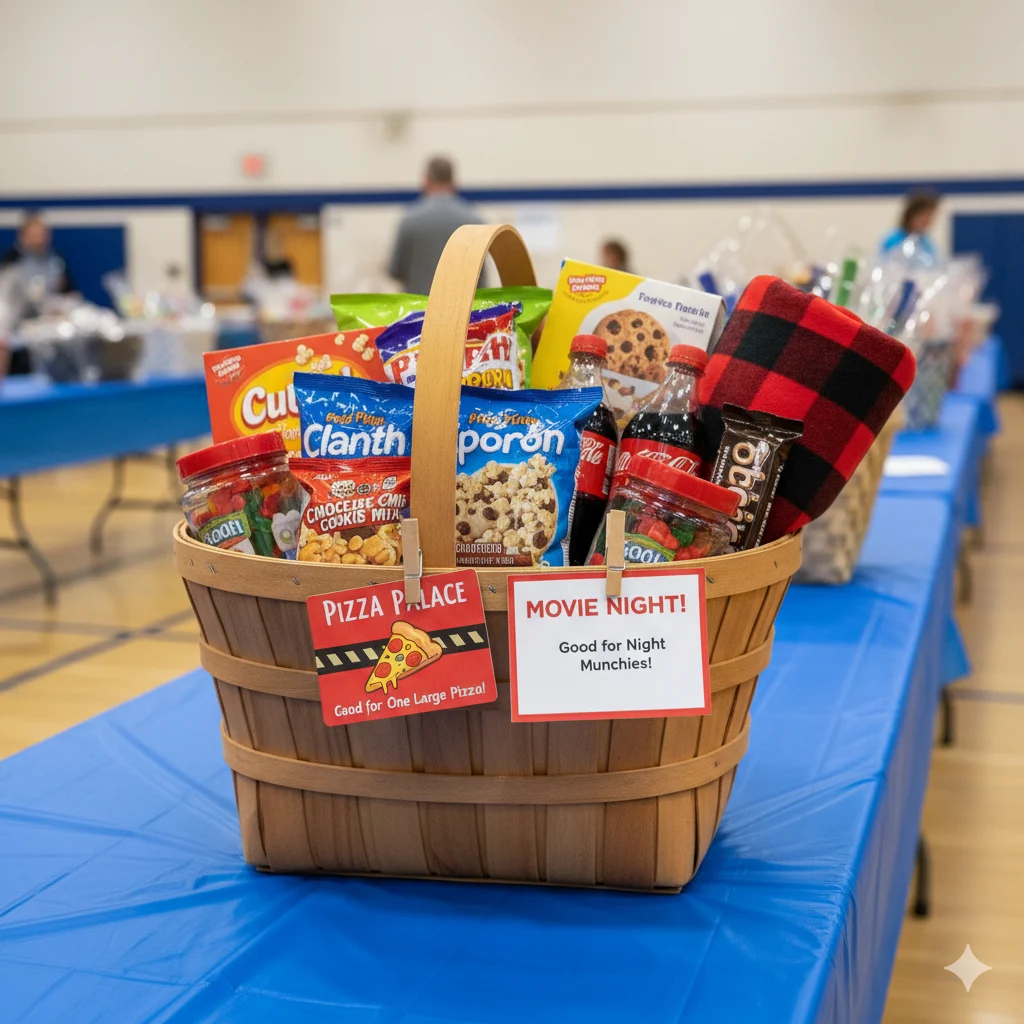
Quick Answer for PTAs in a hurryThe best school raffle ideas are themed basket raffles (family game night, kids activity, pizza night, spa for parents), classroom-built baskets with one item per family, and school-specific experience prizes that can't be purchased anywhere else. The difference between a school raffle that raises $800 and one that raises $8,000 is almost never the quality of the prizes — it is the pricing structure ($1 tickets vs bundle pricing), the basket names (generic vs specific experiences), and how many times parents actually hear about it before the event. This guide covers all three, with specific tactics that only work because you're a school.
The unfair advantages most PTAs don't fully use
Why School Raffles Should Outperform Every Other Event
School PTAs have structural advantages that no other nonprofit type enjoys. A church reaches its congregation once a week. A community organization relies on opt-in volunteers. A shelter depends on donor lists that lose interest. A school has something none of them have: a captive community of deeply motivated people whose children directly benefit from the fundraiser, with built-in daily access to those people at drop-off and pickup.
When a PTA raises $800 with 360 parents in the gymnasium, it is not because the parents don't care. It is because the event structure failed to convert care into spending. The same parents, the same cause, the same evening — with bundle pricing and clear themed baskets — routinely produces $8,000–$12,000. The gap between what school raffles raise and what they could raise is one of the most consistent patterns in nonprofit fundraising.
📧
Built-in Email List
Every parent at the school is already on the communication list. Weekly newsletters, school announcements, and teacher emails reach a pre-qualified audience of motivated supporters at zero cost. No other nonprofit has this.
🚗
Daily Physical Access
Drop-off and pickup happen every school day. A volunteer with a sign, a banner near the entrance, or a teacher mentioning the raffle to families at the door reaches people in ways no email or social post can replicate.
👧
The Most Effective Messengers
Children tell their parents things. A child who is excited about a basket at school — especially their class's own basket — will tell their parent about it at dinner. That word-of-mouth channel is more powerful than any email a PTA president sends.
🏫
Exclusive Experience Prizes
"Principal for a Day," "Lunch with Your Favorite Teacher," "Homework Pass Week" — prizes that cannot be purchased anywhere else. These drive ticket competition in a way that no physical basket can, because scarcity creates urgency.
👨👩👧
Emotionally Invested Buyers
Parents aren't spending money on a cause — they're spending money directly on their child's school. That emotional directness eliminates the "should I really spend this?" hesitation that limits spending at other nonprofit events.
🤝
Volunteer Scale
A school PTA can mobilize 20–40 parent volunteers for an event. That volunteer force can actively sell tickets during the event in a way that no other organization type can — turning the raffle from a passive display into an active sales experience.
From the Raffle Hotline · PTA · "We Worked So Hard and Only Raised $800"
"Our committee put in 200 hours on this fundraiser and we barely made $800. I don't understand."
This call comes in a few times a year. The committee worked genuinely hard — they solicited donations, built the baskets, decorated the gymnasium, set up tables, ran a bake sale alongside the raffle. And they raised less in a room full of 350 parents who care about their school than a well-run lemonade stand at a festival.
Caller: "We had 17 donated items and prizes. Good stuff too. People just didn't buy many tickets."
Support: "How were your prizes displayed? What did the labels say?"
Caller: "We used paper bags with handwritten numbers. People walked up, looked at the items, dropped tickets in whichever bag they wanted."
Support: "What was ticket pricing?"
Caller: "Dollar a ticket. We thought lower would mean more people would buy."
Support: "Dollar tickets means your best-case average spend is $5–$8 per parent. With 350 parents, that's a theoretical max of $2,800 if every single person buys. Most don't. The $800 makes complete sense. The pricing structure created the result. This has nothing to do with how hard you worked or how much your parents care. It is a mathematical ceiling you built into the event."
Caller: "Our parents can't spend more than a dollar per ticket."
Support: "You don't know that yet. You've never asked. A parent who spent $5 on $1 tickets because that's all the options were would likely have spent $25 on a bundle if the bundle existed. The ticket price doesn't determine how much parents want to give — the options available determine how much they can give at once."
Next year: bundle pricing ($5, $20 for 5, $40 for 10), themed baskets with printed labels, and two pre-event emails with basket photos. Same school, same parents, same gymnasium. Revenue: $8,400. The committee worked fewer hours because they stopped running the bake sale alongside it and focused entirely on the raffle structure.
200 hours of effort in the wrong structure will always produce less than 50 hours in the right structure. That is the hardest thing to tell a PTA committee that worked incredibly hard. But it is also the most liberating — because it means next year can be completely different without working harder. Just differently.
The behavioral insight most school organizers miss
The Kid-Pointing Moment — Your Secret Sales Force Is Already There
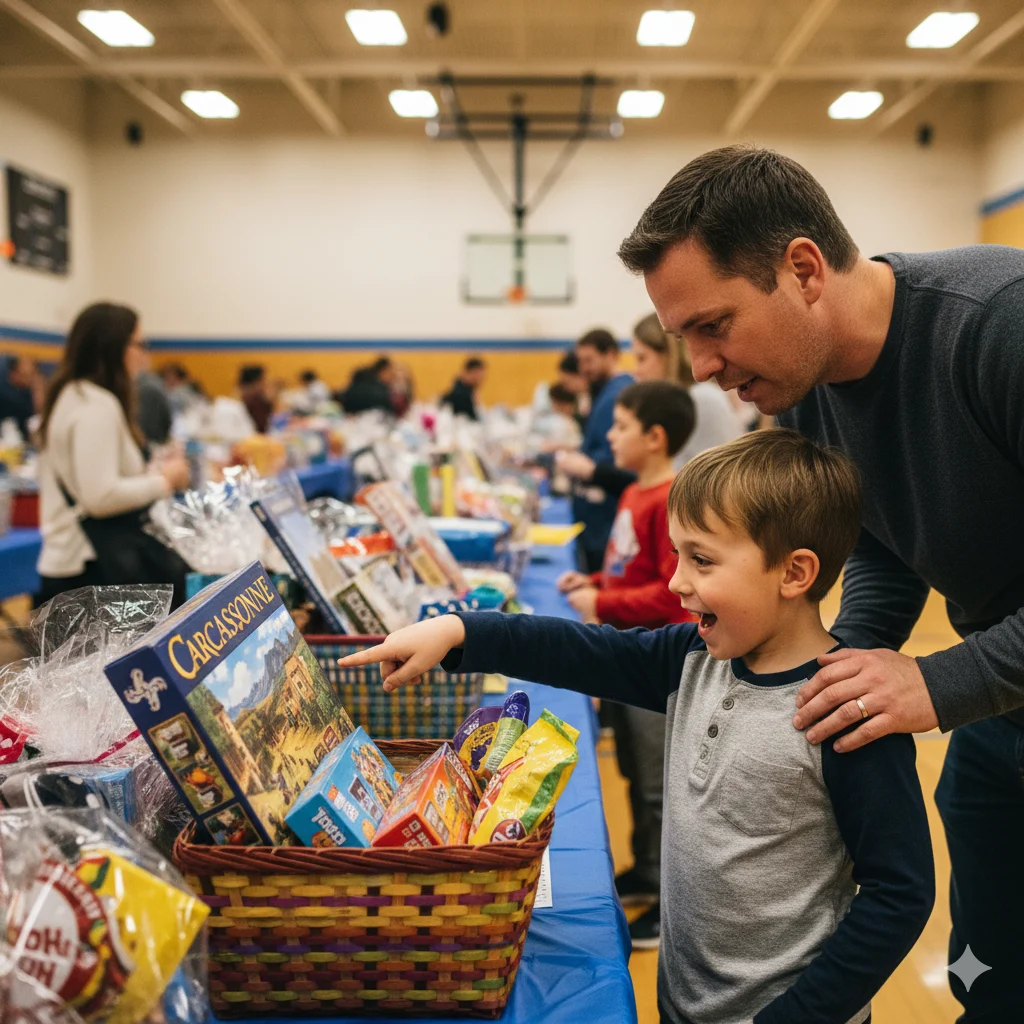
Here is something we have seen described in dozens of calls from school events over the years. A parent walks into the gymnasium, distracted. They're managing a child. They're scanning the room for someone they know. They're not in buying mode.
Then their kid stops walking.
Points.
"Mom. Look at that one."
The parent stops. Looks at the basket the child is pointing at. Reads the label. Starts thinking: "That would be a fun game night." Or: "That's the basket Mrs. Kim's class made." Or: "That looks exactly like something we'd actually use."
They lean in. They are no longer distracted. They are considering.
That moment — the kid pointing at the basket — is worth more than any promotional email you will ever send. The child converted the parent from browser to buyer in four seconds. The parent didn't need persuading. They needed a specific, visible reason to stop.
This is why basket design for school events has a specific additional requirement that other raffles don't: baskets need to appeal to children visually as well as to parents in value. A spa basket earns heavily at adult events. At a school event, it earns mostly from parents who actively seek it out. A family game night basket earns from parents — but it also earns from every child in the room who points at the game box on the front. That pointing creates the parent engagement.
The practical implication: at school events, place your most colorful, most visually exciting baskets at child eye level. A board game box with familiar characters facing outward. A STEM kit with a bright lid showing. Colorful candy and snack items. These are not the most expensive items — they are the items that make children stop. And when children stop, parents stop with them.
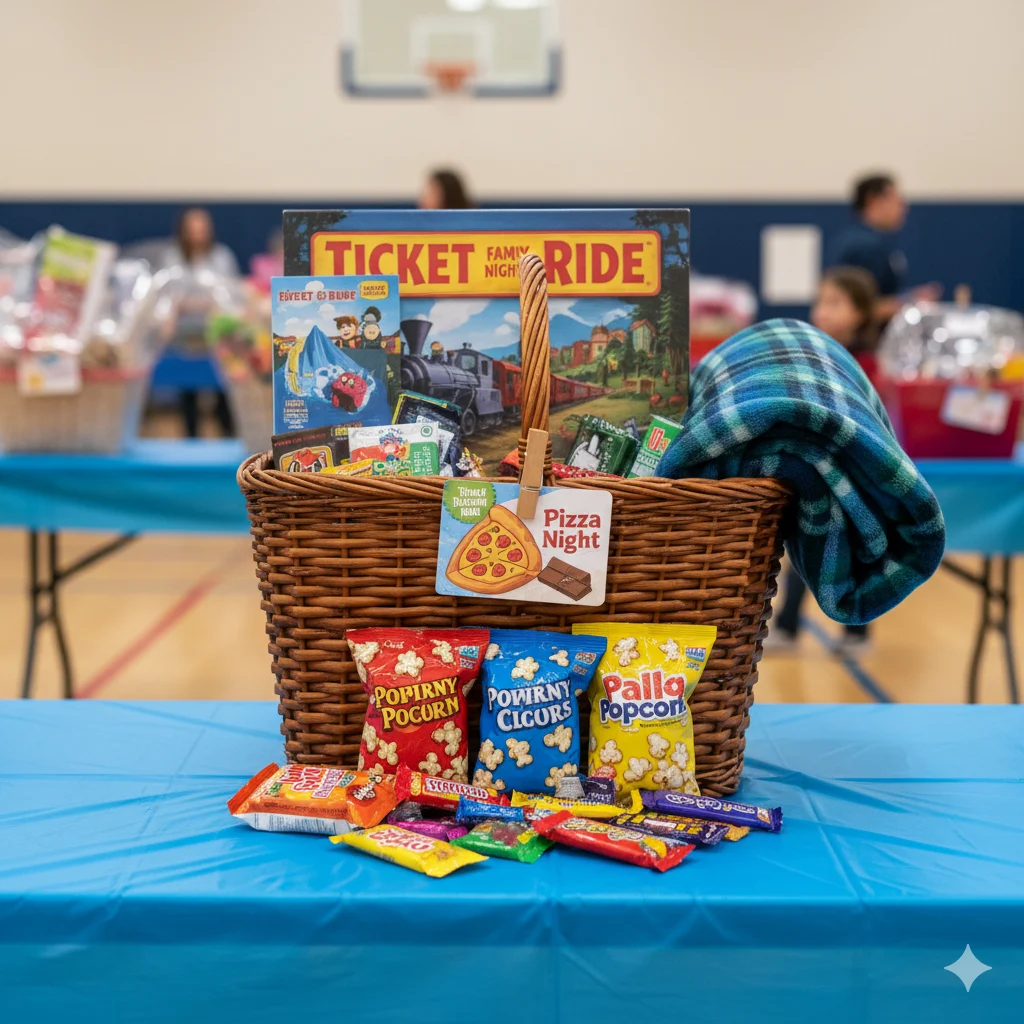
The one basket that carried the eventA caller described an event where one basket earned more tickets than all the other baskets combined. It wasn't the most expensive. It was a family game night basket with Catan clearly visible on top, a pizza gift card clipped to the front, and a stack of popcorn bags arranged in front of it. The reason it dominated: every child in the room recognized the game. Every child wanted it. Every parent had a child pulling on their arm. The basket that makes children stop is worth more than any anchor prize you could buy.
The strategy that solves sourcing, promotion, and engagement at once
The Classroom Basket Strategy — Your Best Idea and Nobody Uses It Fully
★ The School Raffle's Unfair Advantage
"Mrs. Rodriguez's 3rd Grade Basket" — Why Class Baskets Outperform Purchased Ones
A classroom basket is built by the class. Each family contributes one item — the teacher suggests a theme and a price range, and 25 families each bring in something worth $5–$10. The teacher adds a personal touch: a handwritten note, a class photo in a frame, a small token from the classroom. The basket is labeled with the class name and the teacher's name.
This single strategy solves three problems at once: sourcing (25 families each contributing one item costs the PTA nothing), promotion (every family in that class now has a personal stake in the basket — they mention it to other parents, they share photos, they show up at the event specifically to see their contribution on display), and emotional engagement (parents with a child in 3rd grade will allocate their tickets disproportionately to Mrs. Rodriguez's basket because it feels personal and connected to their child's specific experience at school).
The practical setup is simple: send home a sheet four weeks before the event listing the basket theme and asking for one item per family at a suggested value of $8–$12. Most families participate because the ask is small and the cause is direct. A class of 25 students builds a $200–$300 basket at zero cost to the committee. A school with 8 classrooms builds 8 baskets this way and the committee's only job is assembly and labeling.
From the Raffle Hotline · Elementary School · "We Let Each Class Build Their Own Basket"
"We tried something different this year — each class built their own basket. We weren't expecting much. It changed everything."
A PTA president called a week after their event to debrief. They had read about the classroom basket strategy and decided to try it alongside their regular donated baskets. The classroom baskets used the same theme (family night) but were built by the class and labeled with the teacher's name. The donated baskets were better quality — more expensive items, more carefully curated.
Caller: "Mrs. Kim's 2nd grade basket raised $840. The $200 donated gourmet basket raised $180. The classroom basket cost us nothing."
Support: "That's the emotional investment effect. Every parent with a child in 2nd grade is predisposed to want that basket. It's not just a prize — it's a piece of their child's school year. The items inside are almost irrelevant. The name on the label is doing all the work."
Caller: "Half the parents who bought tickets for it didn't even have kids in that class."
Support: "Because those parents could see it was the most competed-for basket in the room. When buyers see a bucket filling up with tickets, they add more. You created social proof around a classroom basket that then attracted buyers outside the class. That's exactly what you want your anchor basket to do."
They ran classroom baskets for all 9 classes the following year. Total revenue from classroom baskets: $5,600 of $11,200 total event gross. The donated baskets raised the other $5,600 at a significantly higher build cost per dollar raised. The classroom strategy produced more than half the event revenue at essentially zero committee cost.
The classroom basket wins not because of what's inside — it wins because of what it represents. Parents with a child in that class want to support their class. Parents who see heavy ticket allocation to a basket are drawn to it. Teachers who helped build it promote it to their families. The classroom basket activates every social dynamic in the school community simultaneously.
$0
Cost to the PTA committee to build a classroom basket — and typically $600–$900 in ticket revenue from parents of children in that class alone.One item per family at $8–$10 each. The teacher adds a personal touch. The PTA assembles and labels. Average classroom basket revenue at events with 20+ students per class: $600–$900 from in-class parents alone, plus additional tickets from parents outside the class drawn to the visible social proof of a filling ticket bucket. It is the highest return-on-investment sourcing strategy in school fundraising.
What to build and why it works for school audiences
School Raffle Basket Ideas — By What Actually Performs
 Top Performer
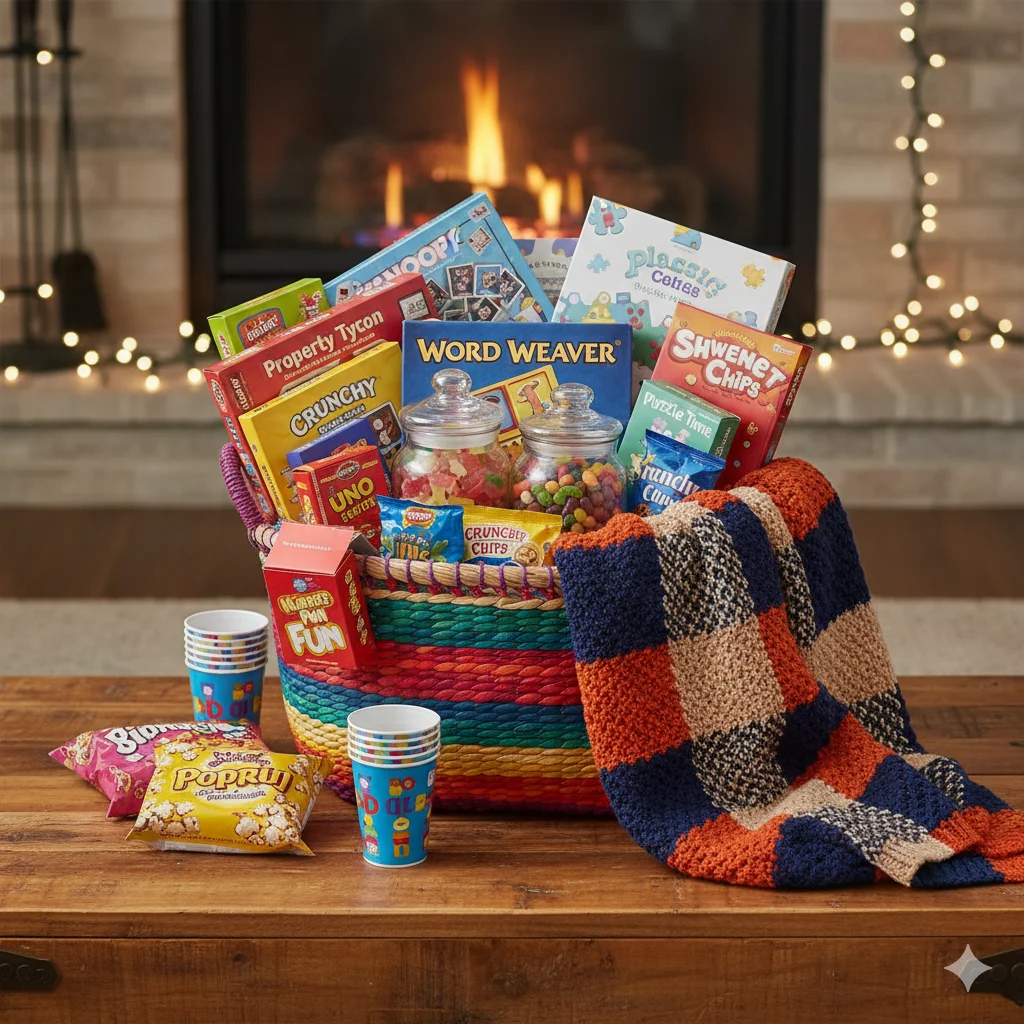
Family Game Night
What's Inside
- $25–$40 pizza or casual dining gift card
- Popular board game (Catan, Ticket to Ride, Codenames)
- Popcorn assortment + candy selection
- Cozy throw blanket
- Card game (Exploding Kittens, Uno)
School-specific tip: Put the game box label-forward at the front of the basket where children can read it. This is the basket kids point at. The kid-pointing moment converts more tickets than the gift card at a school event. See the full
family basket guide.
 Parent Favorite
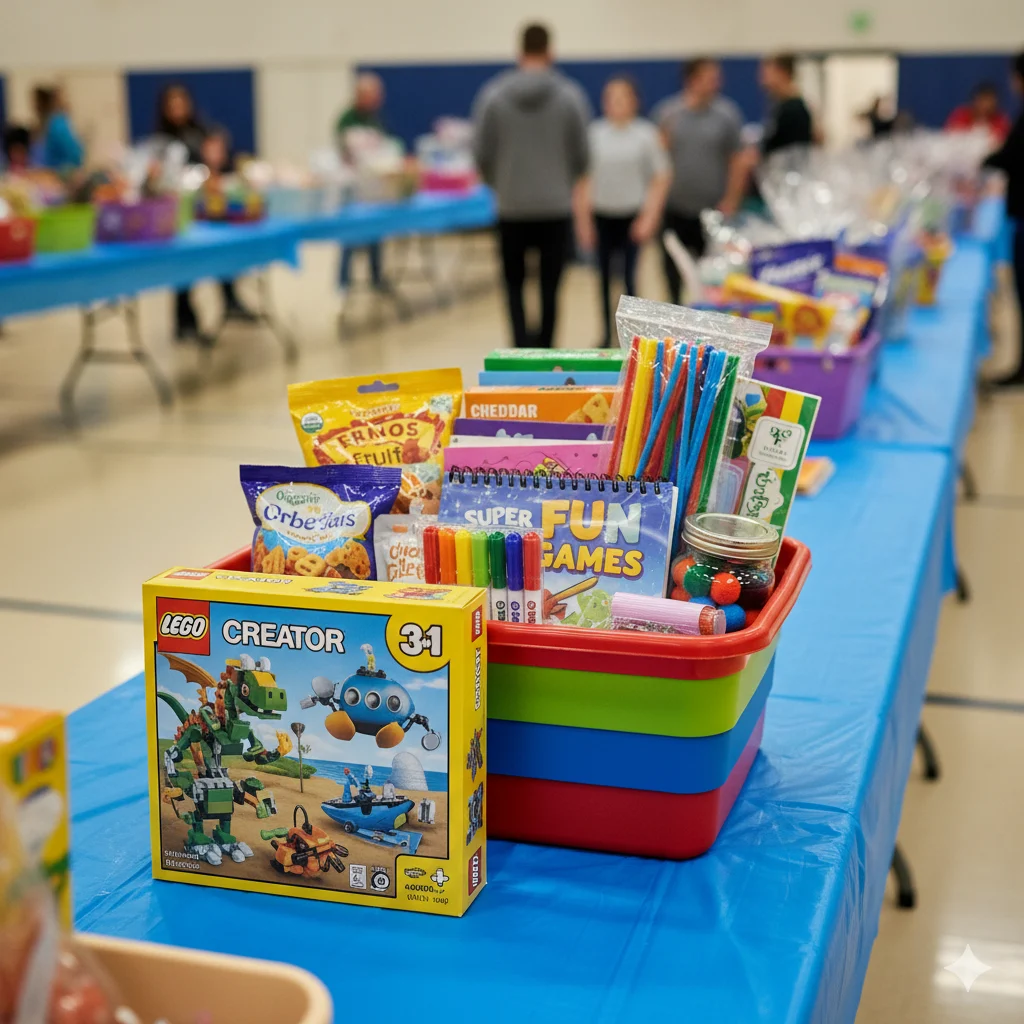
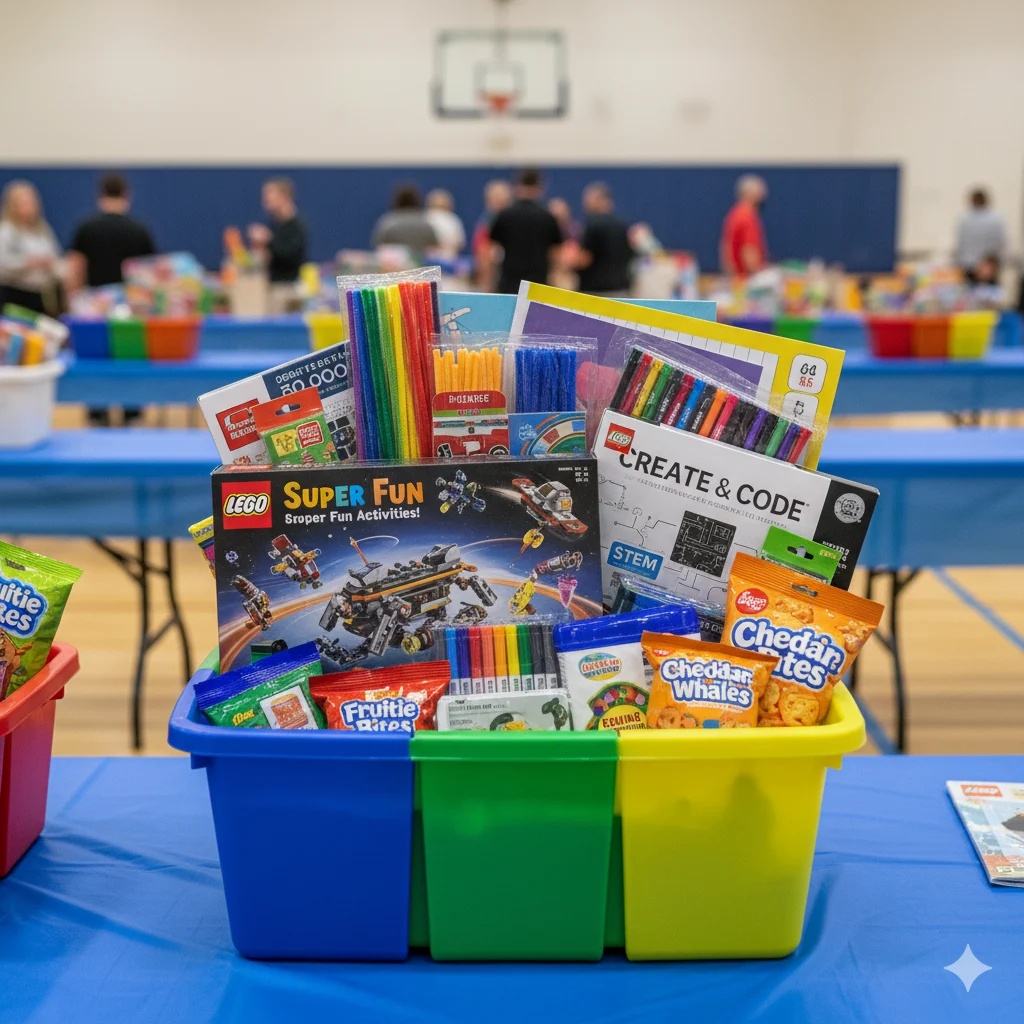
Kids Activity Night
What's Inside
- LEGO set or STEM kit (age 7–10)
- Craft supply bundle (markers, paint sticks)
- Premium activity or puzzle book
- Premium snack pack for craft night
- Colored pencils or art set
Why it works: "It's for the kids" removes every spending hesitation a parent has. Parents don't evaluate this basket as a personal purchase — they evaluate it as educational enrichment for their child, which unlocks a completely different mental spending category. Budget for children's education feels different than budget for personal indulgence.
 Universal Appeal
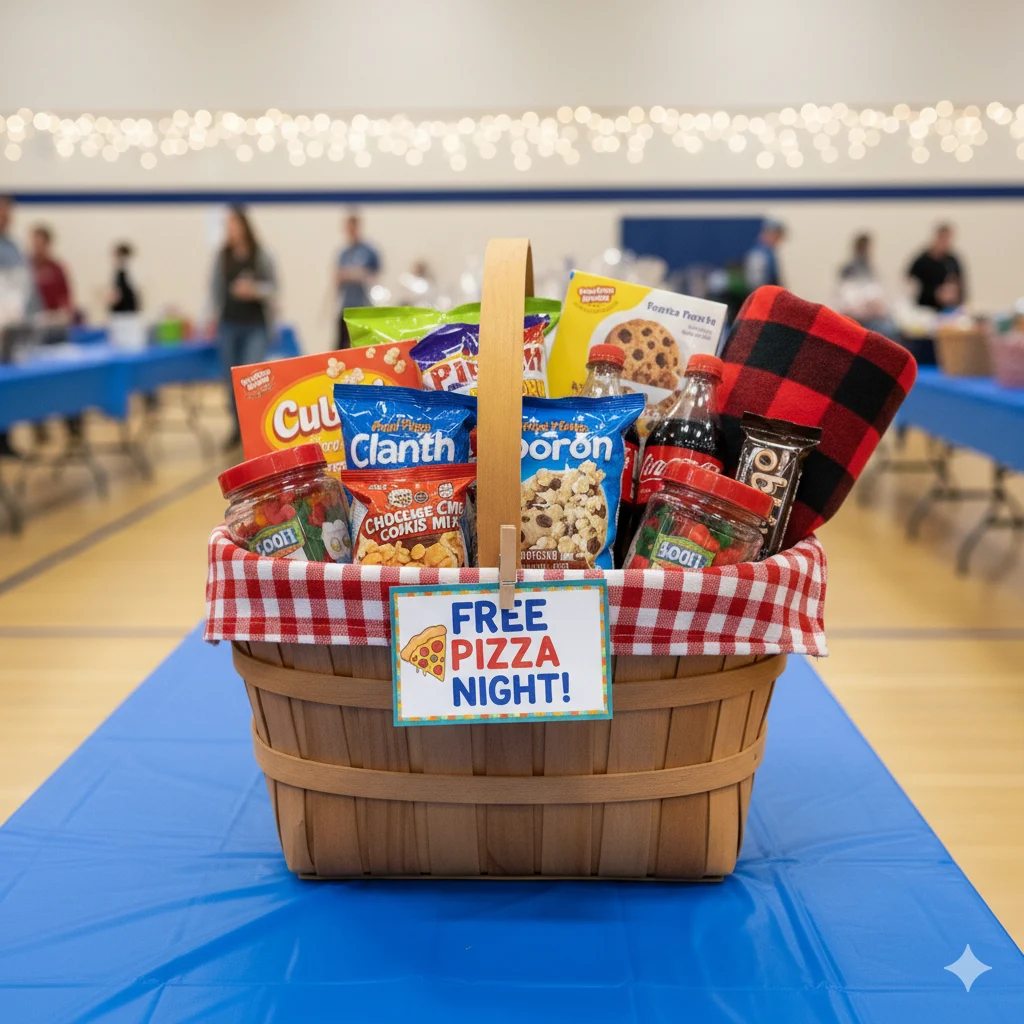
Pizza Night for Four
What's Inside
- $40–$50 local pizza restaurant gift card
- Movie-night popcorn variety pack
- Soda mix or sparkling drink selection
- Premium dessert item (brownies, cookies)
- Paper plates and napkins (branded funny ones work)
Sourcing note: Local pizza places donate to schools constantly — they see it as neighborhood marketing. Call during off-peak hours (2–4pm weekday), ask for the manager, and mention the school by name. Most local pizzerias will provide a $40–$50 gift card plus a few extras within 24 hours of asking. The school name alone is usually enough.
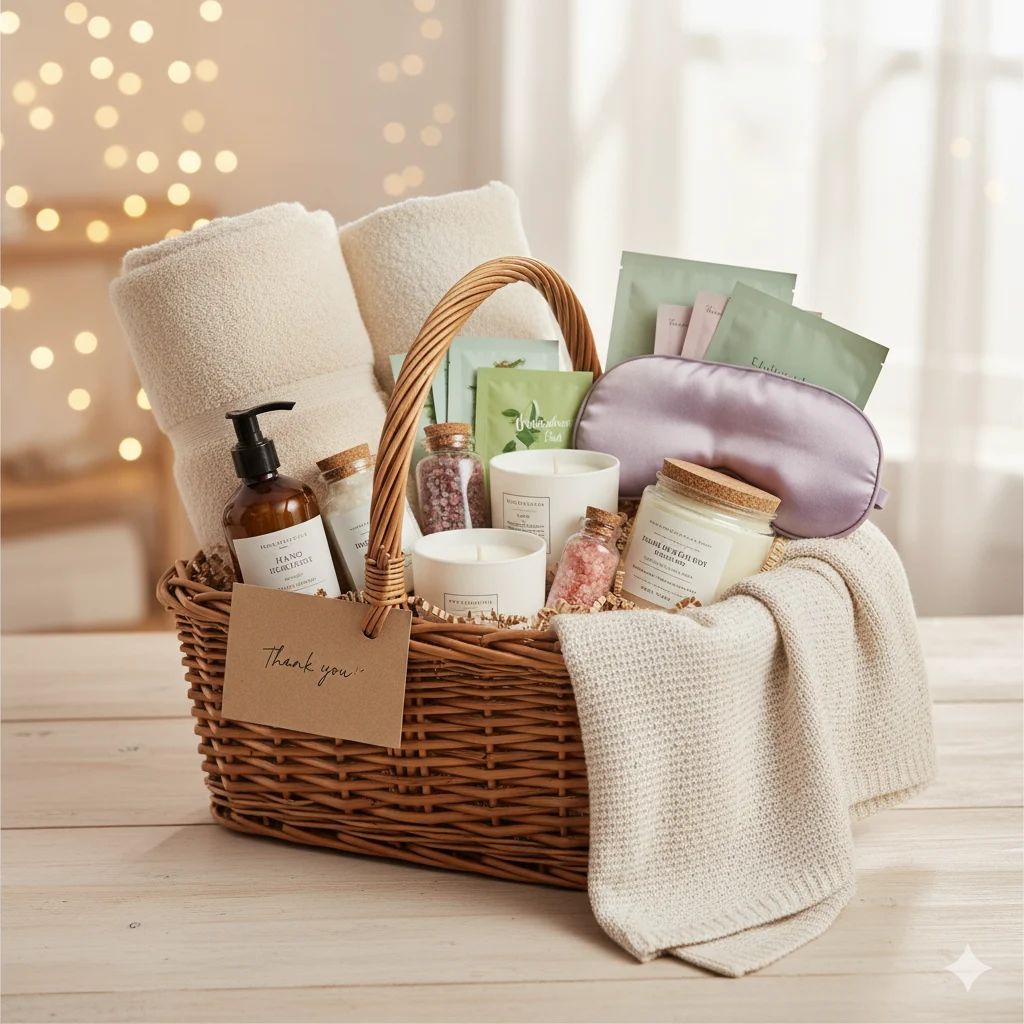 Parent Self-Care
Parent's Night Off
What's Inside
- $60–$75 local massage or spa gift card
- Plush robe or cozy blanket
- Premium candle (neutral scent, gift-grade)
- Artisan chocolates
- Herbal tea selection
School-specific framing: Name it "Parent's Night Off" rather than "Spa Basket." At a school event, the "night off" framing resonates specifically with parents who feel they're always on. It's permission to want something just for themselves, from an event they're attending to support their kids. The guilt-free self-care angle is uniquely powerful in the school context. See the full
spa basket guide.
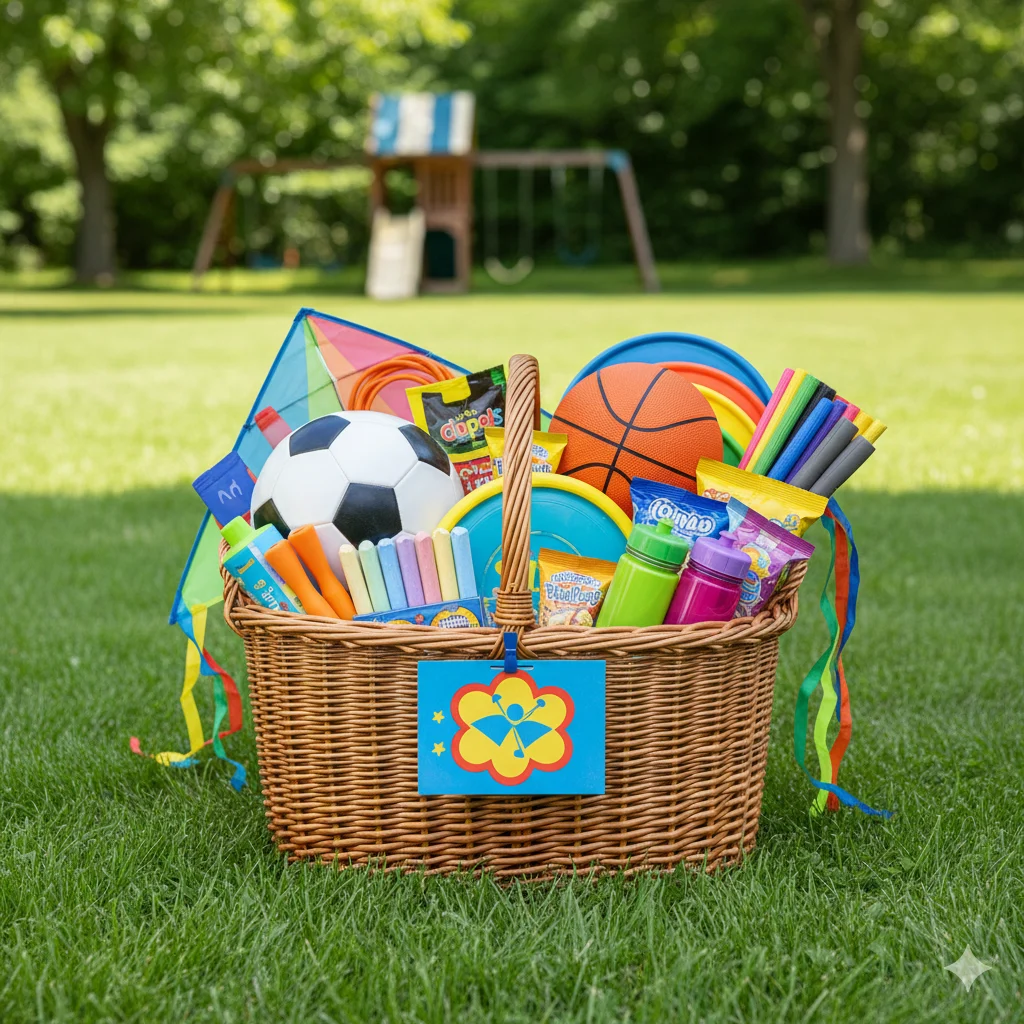 Kids Choose This
Backyard Adventure Kit
What's Inside
- Local activity center or mini golf gift card
- Sports ball (frisbee, football, or soccer ball)
- Bubbles and outdoor activity set
- Sidewalk chalk bundle
- Trail mix or outdoor snack assortment
Who points at this: Kids. Every child in the gymnasium will recognize the frisbee, the sports ball, and the outdoor items as something they want to do. Strong at spring events when outdoor activity is top of mind. The activity center gift card anchors the adult value. The colorful outdoor items are what make children stop in front of this basket.
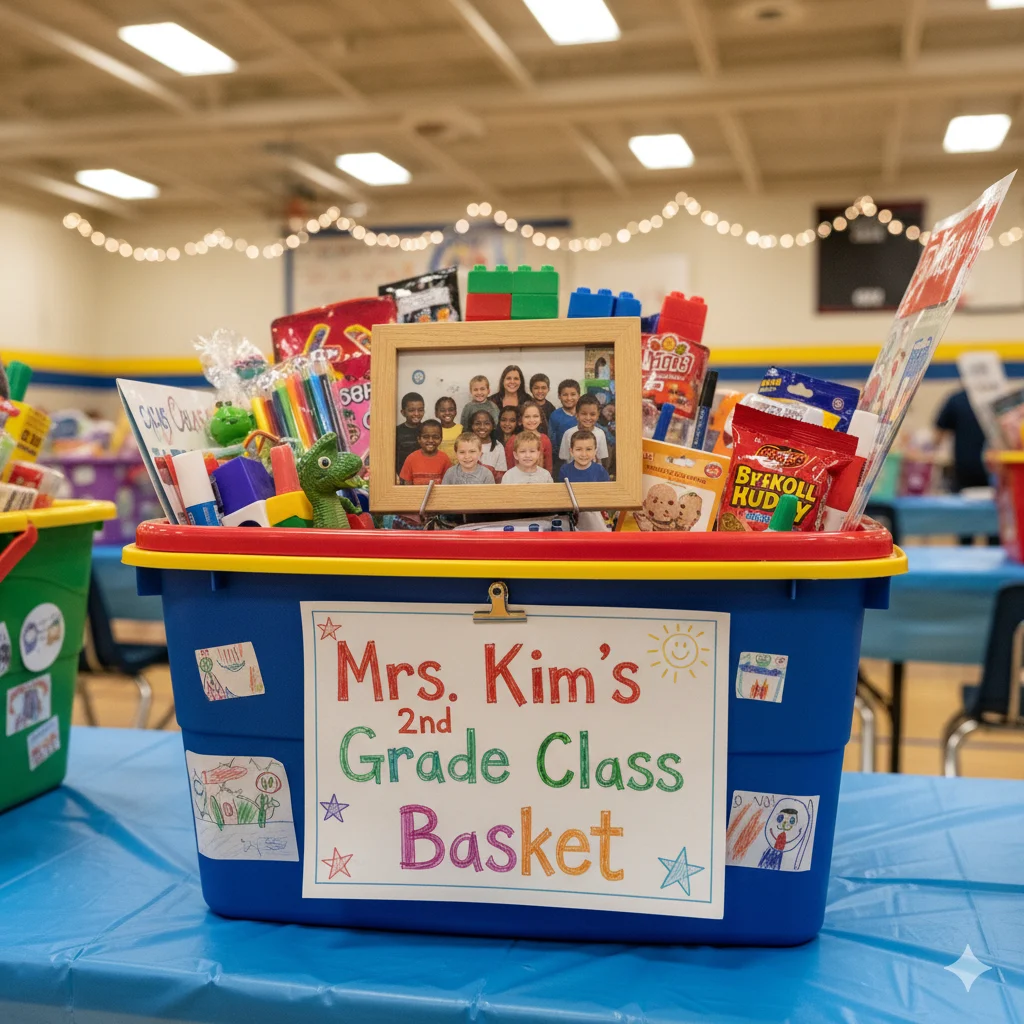 Highest ROI
Classroom Basket (per-grade)
Structure
- Class photo in a small frame (teacher-provided)
- One item per family ($8–$12 each, class-themed)
- Teacher's handwritten note or small personal addition
- Printed label: "[Teacher's Name]'s [Grade] Class Basket"
The mechanism: Every parent with a child in that class has a personal stake in that basket winning. They'll buy tickets for it specifically. And when other parents see heavy ticket allocation to that basket, they're drawn to it. The classroom basket activates both emotional buying (class parents) and social proof (everyone else). See the full classroom basket strategy above.
The prizes no other organization can offer
School Experience Prizes — These Are Only Available at a School Raffle
The most powerful prizes at any school raffle are not the ones that cost the most money. They are the ones that cannot be purchased anywhere else. A child who wins "Principal for a Day" cannot buy that experience at a store. A parent who wins "Reserved Drop-Off Parking for One Month" cannot get that from a gift card. The scarcity of truly school-specific prizes creates a competitive dynamic that physical baskets simply can't match.
These prizes cost the school almost nothing. They require a teacher's time, a principal's participation, or a small administrative acknowledgment. The value they generate in ticket revenue is disproportionate to any cost — because supporters are willing to spend more to win something they genuinely cannot get anywhere else.
👑
Principal for a Day
One student becomes principal for a morning. They arrive early, sit at the principal's desk, help with the morning announcements, and shadow the principal through real decisions. Coordinate timing with the principal. Limit to one per year to preserve scarcity.
Revenue potential: $400–$800. Cost: 2 hours of principal time.
🍕
Lunch with Your Favorite Teacher
Winner and 2–3 friends have a special lunch with a chosen teacher — in the classroom, with a special tablecloth, slightly better food than the cafeteria. Teachers participate voluntarily. The personalization (chosen teacher) is the key driver.
Revenue potential: $350–$700 per ticket. Run multiple with different teachers.
🚗
VIP Drop-Off Parking — One Month
Reserved parking in the closest spot to the school entrance for one full month of drop-off. This prize is intensely practical and parents who have experienced drop-off chaos will compete fiercely for it. Simple to offer, impossible to buy anywhere else.
Revenue potential: $300–$650. Cost: one traffic cone and coordination with staff.
📚
Homework Pass Week
Winner is excused from homework assignments for one full school week (excluding tests). Clear rules, teacher cooperation needed, and the prize is only meaningful at the age of the child — which makes it incredibly compelling to kids who then tell their parents about it.
Revenue potential: $250–$500. Especially strong when kids know about it before parents do.
📖
Name the Class Pet or Project
If any class has a pet, plant, or recurring project, the winner gets to name it for the year. Simple, memorable, and deeply personal to families in that specific class. Works especially well as a classroom-level prize run within grade basket fundraising.
Revenue potential: $200–$400. Unlimited in originality — any classroom asset works.
🎤
Read the Morning Announcements
Winner gets to read the school morning announcements over the PA system on a chosen day. Elementary and middle school students place enormous social value on this — it is visibility in front of the entire school. The announcement moment is shared with families, extending social reach of the raffle itself.
Revenue potential: $300–$600. Zero cost. Pure scarcity-driven value.
From the Raffle Hotline · Elementary School · "The Teacher Lunch Beat the Big Basket"
"We offered a 'Lunch with Mrs. Thompson' prize almost as an afterthought. It raised more tickets than our $200 anchor basket."
Caller: "Mrs. Thompson is the most beloved teacher at the school. We thought maybe 10–15 families would be interested. We ended up with over 60 ticket purchases specifically for that prize."
Support: "That's the scarcity effect in a school context. No parent can walk into a store and buy their child a private lunch with Mrs. Thompson. The moment you offer something genuinely unavailable elsewhere — regardless of its monetary value — you create competition that physical items can't produce."
Caller: "Some parents who entered that prize didn't buy tickets for anything else."
Support: "The experience prize extended your reach beyond the parents who were already interested in the baskets. Some parents came specifically for the lunch prize and nothing else — which means the experience prize didn't just compete with baskets for tickets, it attracted new buyers who wouldn't have participated otherwise."
They added experience prizes the following year: Principal for a Day, Lunch with Three Teachers, and VIP Parking for One Month. Combined ticket revenue from experience prizes: $1,800. Build cost: $0. They now treat experience prizes as dedicated line items in their raffle revenue plan rather than afterthoughts.
Experience prizes do two things physical baskets can't: they create genuine scarcity (nobody can go buy "Principal for a Day" elsewhere) and they attract buyers who aren't interested in any of the physical prizes. An event with both basket raffles and school experience prizes reaches the entire parent community — not just the parents drawn to the baskets.
The single change that moves the most money
Bundle Pricing for School Events — What Happens When You Add the Option
The most consistent finding across school raffle calls over 20+ years: PTAs that switch from $1 single tickets to bundle pricing see average parent spend jump from $3–$8 to $25–$40. Same parents. Same event. Same school. The willingness was always there — the option to invest more didn't exist.
Parents at school events have a specific spending psychology: they feel the purchase is justified because the benefit goes directly to their child's school. That justification is already primed when they walk in. Bundle pricing is the mechanism that lets them express how much they actually want to give — which is almost always more than $1 tickets allow.
$1 Single Tickets Only
$3–$8
average spend per parent · $1,000–$2,800 gross on 350 parents · ceiling is structural
→
Bundle Pricing Added
$25–$40
average spend per parent · $8,750–$14,000 gross same 350 parents · same cause
The recommended structure for school events: $5 for 1 ticket · $20 for 5 tickets · $40 for 10 tickets. The $40/10 bundle is the one most parents will choose once they've identified a basket they want to win. At $40, a parent is spending more than they would have with $1 tickets — but they feel like they made a strategic investment in a specific prize rather than bought a handful of long-shot tickets. That psychology difference is everything.
The concern every PTA has — and the answer"Our parents can't afford $40 tickets." You don't know that until you offer it. The parents who spent $3 on $1 tickets were not spending $3 because they couldn't afford more — they were spending $3 because that's what the pricing implied was appropriate. The $5 single ticket is still there for families who want to participate at a lower amount. The $40 bundle is there for families who want to invest more. You haven't raised the floor. You've added a ceiling — and some parents will surprise you with how high they reach for it.
From the same event, same parents, same gym
What It Actually Looks Like When It Works — Before and After
Before — Same School, Same Event
$820
$1 tickets · numbered buckets · one flyer home · ~$2.30/parent
→
After — Three Structural Changes
$10,200
bundle pricing · themed baskets · 2 pre-event emails · ~$28/parent
The three changes: bundle pricing (added $20 and $40 options above $5 single tickets), themed basket names (replaced numbered buckets with "Spa Day for One," "Family Game Night," etc.), and two pre-event emails with basket photos. Same 360 parents. Same gymnasium. Same donated items.
The $10,200 wasn't from finding new donors, adding more baskets, or running a fancier event. It was from removing the structural barriers between parents who wanted to give more and the mechanisms that would have let them. The money was always in that gymnasium. The structure wasn't capturing it.
Read the full case study with complete basket-by-basket revenue breakdown →
Free Download
Basket Raffle Planning Kit
Includes the classroom basket request letter template, the 4-week PTA promotion calendar, 20 themed basket build sheets, and the ticket pricing calculator. Built for school committees.
Download Free →
What's inside
✓ Classroom basket request letter
✓ 4-week PTA promo calendar
✓ 20 themed basket build sheets
✓ Ticket pricing calculator
✓ Donor outreach templates
Common PTA and school fundraiser questions
Frequently Asked Questions
What are the best school raffle basket ideas?
The highest-performing school raffle basket categories are: family game night (board games, pizza gift card, popcorn — appeals to both kids and parents), classroom-built baskets labeled with the class and teacher name (drives emotional investment from parents with kids in that class), kids activity baskets (STEM kits, craft supplies — parents justify instantly), pizza and food night (universal appeal, easy to source), and school experience prizes like "Principal for a Day" or "Lunch with Your Favorite Teacher." Experience prizes regularly outperform physical baskets because they cannot be purchased anywhere else. See all builds above and the full
basket ideas hub.
How much should school raffle tickets cost?
Most school PTAs perform significantly better with $5 base pricing and bundle tiers: $5 single, $20 for 5 tickets, $40 for 10 tickets. The $1 ticket structure caps average parent spend at $3–$8. With bundle pricing, the same parents typically spend $25–$40 per family. The floor ($5 single) keeps the event accessible to families who want to participate modestly. The ceiling ($40 bundle) invites families who want to invest more to do so. Adding bundle tiers costs nothing to implement and consistently produces the largest per-event revenue jump of any single change a PTA can make. See the full
pricing strategy guide.
What is a classroom basket and why does it work so well?
A classroom basket is built by a specific class — one item per family, teacher adds a personal touch, labeled "Mrs. Rodriguez's 3rd Grade Class Basket." It works for three simultaneous reasons: every parent with a child in that class has an emotional stake in winning their class's basket; the building process gives each family a personal investment in the raffle through participation; and visible ticket concentration on classroom baskets creates social proof that draws additional buyers from outside the class. Build cost to the PTA: essentially zero. Revenue range: $600–$1,000 per basket from in-class parents alone, plus additional from the social proof effect.
How do you promote a school raffle to busy parents?
Use all available channels in sequence: weekly newsletter announcement 4 weeks out, standalone basket photo email 2 weeks before, classroom basket reveal email the week before (parents forward these to each other), daily Facebook Group basket spotlights the final week, and a day-of reminder email at noon. Physical presence at drop-off and pickup matters — a volunteer with a sign or talking to parents directly converts better than any digital communication alone. Most school promotions underperform because they use only 1–2 of these touchpoints once. The 4-week promotion calendar in the planning kit has the full schedule. See the complete
raffle promotion strategy guide.
What school experience prizes work best for raffles?
The most consistently effective school experience prizes are: Principal for a Day (student shadows the principal for a morning), Lunch with Your Favorite Teacher (winner and 2–3 friends), VIP Drop-Off Parking for One Month (surprisingly competitive among parents), Homework Pass Week (kids drive this — they tell their parents about it), Name the Class Pet or Project, and Read the Morning Announcements. These cost the school almost nothing to offer and regularly earn $300–$800 in ticket revenue each because they cannot be purchased anywhere else. Scarcity is the mechanism — and schools are uniquely positioned to offer genuinely scarce experiences.
How much can a school PTA raise with a basket raffle?
A school PTA with 200–400 parents in attendance can realistically raise $6,000–$12,000 with proper bundle pricing, themed baskets, and a pre-event promotion campaign. PTAs stuck at $800–$1,500 after years of the same approach are not constrained by their parent community — they are constrained by $1 single-ticket pricing, unnamed prize buckets, and one-flyer promotion. These are all fixable before the next event at zero additional cost. The case study on this site shows a PTA going from $820 to $10,200 with the same crowd, same cause, and same donated items. See the full
raffle case study.
When is the best time of year to run a school basket raffle?
Fall fundraising nights (September–November) and spring events (March–May) are the peak seasons. Fall timing benefits from return-to-school community energy and re-engaged parent involvement. Spring timing benefits from end-of-year giving motivation and natural urgency ("this is our last event"). November events can leverage holiday gift-buying mode for food and gourmet baskets — a charcuterie basket at a November school fundraiser becomes a potential Thanksgiving or holiday gift in parents' minds. Avoid December for the event itself (parent bandwidth is lowest) but lean into holiday theming if your event falls in November.
Every basket that performs at school events
More School-Tested Basket Ideas
These baskets have been specifically tested at school events and appear consistently in the top-performing baskets at PTA nights, booster club events, and school fundraisers. Each link goes to the full theme guide with deep builds, sourcing scripts, and pricing strategy.
The system behind the results
The Guides That Support Every School Raffle
💰
Bundle Pricing Strategy
The $2.30/parent → $28/parent analysis. Why $1 tickets are a structural cap on parent spending, and the exact tier structure for school events.
Read the guide →
📣
Raffle Promotion Strategy
The full 4-phase promotion system. Adapted for PTAs: the weekly newsletter, the classroom basket reveal email, and the day-of reminder sequence.
Read the guide →
📊
Raffle Case Studies
The full $820 → $10,200 school PTA case study with basket-by-basket revenue breakdown and the exact three changes that drove the result.
Read the case study →
⚠️
Why Basket Raffles Fail
The 8 structural problems — most school raffles have at least 4. The diagnostic checklist and specific fix for each failure point before launch.
Read the guide →
⚙️
Basket Raffle Software
For schools running hybrid events (online ticket sales + in-person drawing). The per-basket pool requirement and cash entry integration for school nights.
Read the guide →
🤝
Basket Donation Sourcing
The local business pitch that works specifically for schools — "We'll promote you to 350 local families with children." Scripts for pizza places, coffee shops, activity centers.
Read the guide →
Built for nonprofits. Used by schools across the country.
Per-basket pools. No tip-prompt abandonment.
"We built Chance2Win for organizations like school PTAs — where every dollar raised goes directly to the students, and every checkout abandoned is a dollar that should have made it. We still answer the phone." — The Chance2Win Team